Site Navigation
Latest Stories
Sign up for GZERO Daily.
Global Stage LIVE from United Nations WATCH REPLAY
Quick Take
Ian Bremmer, political scientist and president of Eurasia Group and GZERO Media, shares insights on global political events.
Presented by

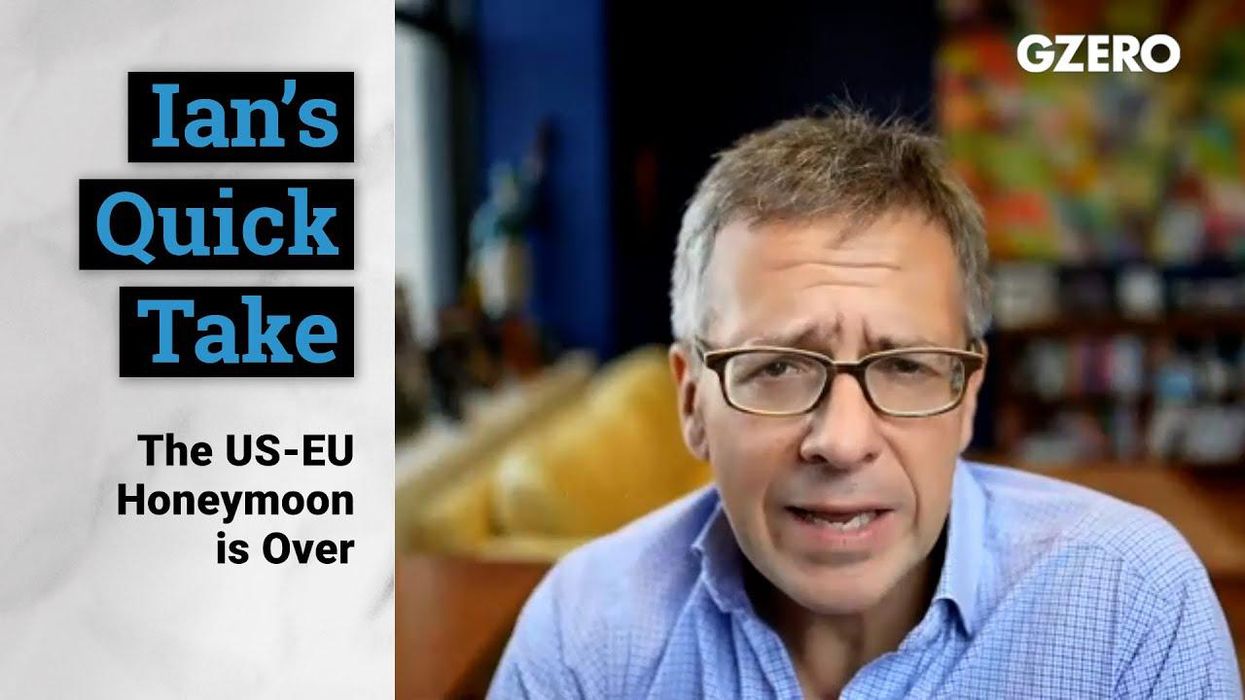
Ian Bremmer's Quick Take:
Hi everybody. Happy Monday. Ian Bremmer here with your Quick Take. Plenty going on between the United States and its allies. You have seen the fallout from the US announcement of this new defense pact with the Australians and the United Kingdom called AUKUS. That's great, always like USMCA, we take the acronyms, and we try to find a way to make it comprehensible. And of course, the Chinese are not enormously happy about this, because it is a military plan to put more American material in their backyard. And the day after the Chinese announced formerly that they wanted to apply to the CPTPP, which is the major trade deal that the Americans initially were the architect of and then under Obama said, "No, we can't get it done." And then Trump pulled out. That's unfortunate and long-standing and not surprising. And China won't be able to get in, in all likelihood, because it's a heavy lift, even though Vietnam did make it, but state capitalism and TPP doesn't really work very well together.
But the more interesting and salient point for the headlines is that the French government was absolutely incensed. So, what's going on here? Why are the allies having such difficulty?
One obvious point that I've heard directly from Paris is that the French government disliked and mistrusted Trump a lot more, but it's precisely because their expectations with Biden were higher, that they wanted to send a much more sharp and direct message. Under Trump, the ambassador never was recalled from the United States. I mean, certainly the relationship in many ways was dysfunctional. In part, the French were walking on eggshells when there was summitry because they just didn't know what Trump might actually do. And in part it was more strategic misalignment. So, you saw the French trying to lead an anti-Trump group in the EU on trade, which is certainly not where the French are today, vis-à-vis the United States.
But they were very surprised. They had had ongoing meetings with the United States specifically on defense coordination in the Pacific. Most of the EU has very little interest in the Pacific. The French are more interested on the national security side. Some of that's competitive. After the US and Russia, the French are the third-largest arms exporter in the world. So, it matters to their GDP, their bottom line, but also, they have territories in the Pacific. They're actually the closest neighbor to Australia in a couple of directions. The island of Réunion, for example, is part of France. So, unlike say Germany, the French really do see the Indo-Pacific as a place that is important to them. And the Americans had been asking/telling the French that they wanted more coordination and more support, particularly against China on the national security side, through NATO, through the EU, on trade, on export restrictions, on cyber, as well as on military support.
And indeed, the French had been doing joint patrols with the Americans and the Australians. So, they were particularly angry that they were cut out, both economically as well as an ally. And I would argue the latter is more important to them than the former. I mean, the deal itself was some 60 billion euros, which is major, but only about eight billion of those euros were going to be spent in France itself. Most of it was in Australia and elsewhere. And also, the French had been playing hardball on the negotiation of the contract. The contract was already agreed, but they wanted lots of European contractors, subcontractors to be involved in the deal, and that was unacceptable to the Australians as well as the Americans. So, there were difficulties in the contract, but the Americans and the Australians didn't just shift the contract. They also announced a new defense pact that was the US, Australia, and the United Kingdom. And France was no part of it.
France only learned of it afterwards. Indeed, France had a suspicion that things were going badly. They found out a week and a half ago that several Australian Cabinet ministers were in Washington negotiating with the Americans. The French didn't get a heads-up, which is unusual given the Defense Minister and given the fact that there was coordination on lots of other issues there. So, the French immediately get in touch with the Americans on the day and ask for phone calls, both with state and with defense. At the secretary level, they hear nothing back. In fact, they hear nothing back until Wednesday when the deal is announced in the Australian press. So, in other words, the French actually found out not only that they lost their submarine contract, but also that there was a new defense pact and France wasn't going to be a part of it.
That was really ... I mean, particularly Macron, who I mean his level of ego didn't seem perhaps to drive so many headlines when Trump was around for four years, but absent that, very clear that embarrassing Macron is something he takes very, very personally. So as a consequence, the ambassadors from the US and Australia were pulled. From the UK, not pulled, interestingly, and in part that's because they weren't as directly involved in the deal, and also because the relationship is itself so broken. A bit like Trump, but also what one French diplomat said is, "Look, if the dinner's horrible, you don't complain to the dishwasher. You complain to the chef." A particularly French way of describing their level of pique with just what is going on right now.
I do think it's very clear that the honeymoon between the United States and the Europeans is over. It's one thing for Trump's "America First", which most of the Europeans saw as an unusual and exception to the rule in the United States, but they didn't think it was a more structural shift. Now it's becoming more clear that a greater level of unilateralism, a greater focus on internal American affairs is baseline for what they should expect, irrespective of how experienced the diplomatic hands are, how oriented they may be, the domestic constraints are more significant and the relative level of indifference of how American allies respond if they're not seen as providing something transactionally important to the United States.
The US, of course, is much more powerful. So, to a greater degree, it can get away with that. And I've also heard from French leaders in the past couple of days that they certainly intend, they want to still work with the Americans on Indo-Pacific strategy. They want to still be seen as an ally. They don't want to throw NATO away, but this is going to make it harder to coordinate on a bunch of issues. And certainly, the G20 coming up in Rome is going to be much more publicly dysfunctional than the G7 was in Cornwall.
So that's a little bit for me. That's kind of a deep dive into the politics behind AUKUS. And I do expect that the French ambassador, at least to Washington, and probably to Canberra, will be quietly back in relatively short order, let's say weeks, not months, but the damage will last for longer. That's it for me. Talk to you all soon.
More from Quick Take
GZERO Series
GZERO World with Ian Bremmer
Puppet Regime

Quick Take
ask ian
Ian Explains
GZERO Reports
GZERO Europe

The Debrief

GZERO Daily: our free newsletter about global politics
Keep up with what’s going on around the world - and why it matters.