Skip to content
Search

Latest Stories

News

What We're Watching: American missile defense, Chilean impeachment scandal

What We're Watching: American missile defense, Chilean impeachment scandal

Israel's Iron Dome anti-missile system intercepts a rocket launched from the Gaza Strip towards Israel, as seen from Ashkelon.

REUTERS/Ammar Awad
Make us preferred on Google

The US ups its missile defense game. Israel has used for years a precise missile defense system — known as the Iron Dome — as a bulwark against short-range rocket attacks from terror groups. In recent weeks, the US has been using the same technology — jointly developed by Israeli and American defense contractors — in the US Pacific territory of Guam to test its own defense capabilities against Chinese weapons, according to the Wall Street Journal. This comes after Beijing, as part of a military drill, recently sent sophisticated hypersonic missiles into space that could reach Guam, about 1,800 miles from mainland China. The Pentagon is not messing around in anticipating potential threats from Beijing right now as bilateral tensions continue to rise. However, the DOD says this tech isn't a long-term fix because Iron Dome isn't meant to be used to thwart cruise missiles, which are capable of transporting a nuclear warhead long distances. Meanwhile, the US military has requested more than $200 million to develop a new missile defense system for Guam, but Congress has yet to deliver.


Chilean impeachment. Chile's outgoing President Sebastián Piñera was impeached on Tuesday by the lower house of parliament, with 78 out of 155 votes in favor, the minimum needed to approve the measure. The reason? He was one of 14 current world leaders named in the so-called Pandora Papers, which recently exposed global tax-dodging among the world's most powerful. According to the report, one of Piñera's sons used an offshore company to avoid paying taxes on the 2011 sale of a mining project co-owned by the family. What's more, the buyer demanded that the Chilean government — headed at the time by Piñera — not classify the area as a nature reserve in order to keep it open for mining. (The president, one of Chile's richest men, has denied any wrongdoing.) Piñera will likely survive impeachment because his allies have a majority in the Senate. Still, he'll leave office with a 79 percent disapproval rating, and the impeachment probe will probably hurt his center-right party ahead of presidential elections on November 21. Right now the frontrunner is far-right Pinochet enthusiast José Antonio Kast, widely expected to win the first round but then lose the runoff in December to far-left former student leader Gabriel Boric.


More For You

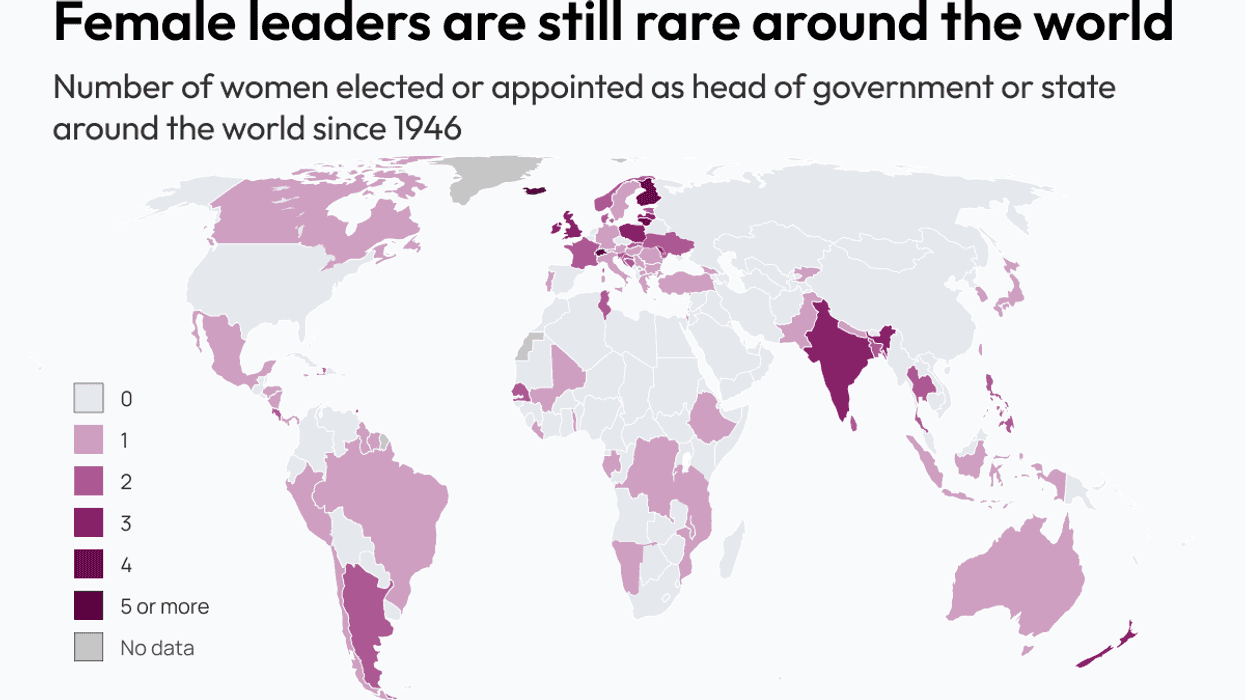
Female leaders are still rare around the world
Eileen Zhang
Several elections next year could bring historic firsts for women in politics. In France, Marine Le Pen leads the polls in the country’s presidential race, while Ilse Aigner is the leading contender to become Germany’s next president. Meanwhile, attention is already turning to the 2028 US presidential race, and former Vice President Kamala Harris [...]
Nvidia CEO Jensen Huang speaks on stage during the Invest in Germany Summit in Berlin, Germany, October 19, 2026.

Nvidia CEO Jensen Huang speaks on stage during the Invest in Germany Summit in Berlin, Germany, October 19, 2026.

REUTERS/Lisi Niesner
US national security and the Nvidia honeypot scandalOver the weekend, Jensen Huang, CEO of the $4 trillion US microchip manufacturer Nvidia, admitted to an affair with a woman thought to be a Chinese spy. Three immediate questions arise, each with huge implications for US national security, the shape of the “AI race,” and US-China relations. [...]
Chile’s new president sees approval sink
Will Fitzpatrick
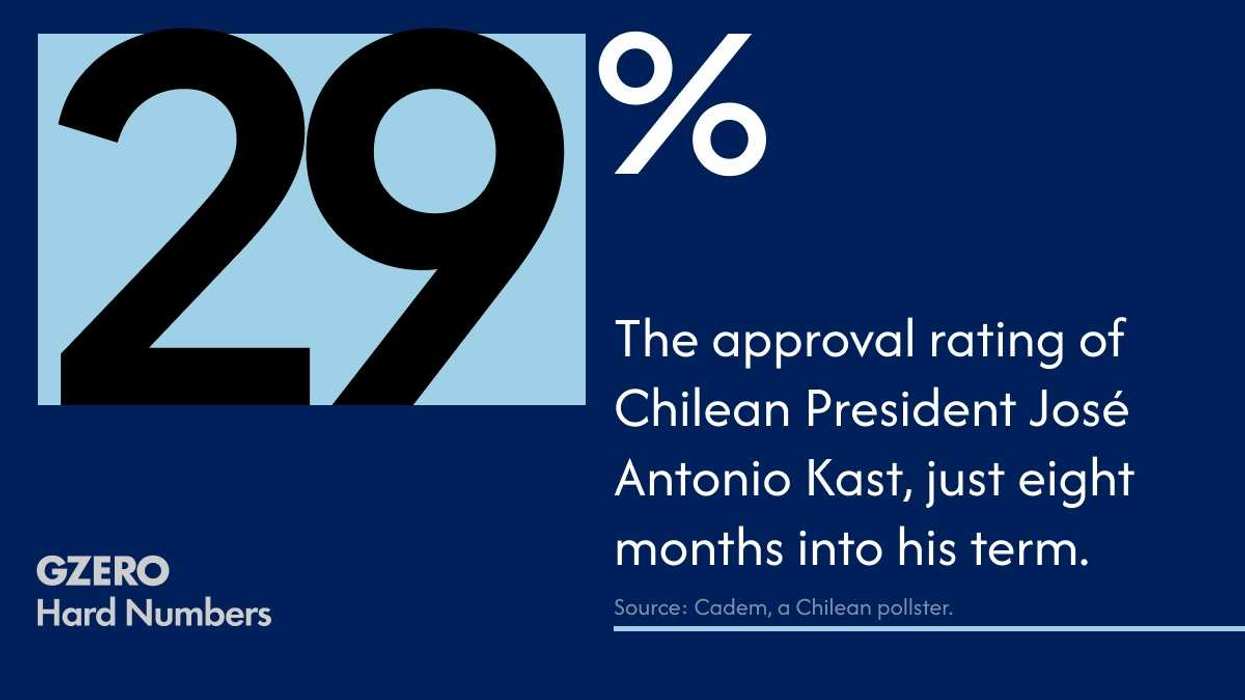
Kast, an ultra-conservative Catholic, won Chile’s presidential runoff in a landslide last December, taking nearly 60% of the vote with promises to be tough on crime and immigration. But almost immediately after he took office in March, his approval rating began to fall, and has now plummeted some 30 points overall. A leading reason is a recent [...]
Brazilian voters arrive at a polling station at Cidade Universitaria to cast their ballots in the second round of Brazil's presidential election in Lisbon, Portugal, on October 25, 2026.

Brazilian voters arrive at a polling station at Cidade Universitaria to cast their ballots in the second round of Brazil's presidential election in Lisbon, Portugal, on October 25, 2026.

Luis Boza via Reuters Connect
Elections have been taking place around the world in recent weeks – and if there’s one thing they have in common, it’s this: voters are fired up.In Serbia, turnout reached its highest level since the breakup of Yugoslavia in 1992. In Israel, it was the highest in more than two decades. Brazil saw an additional three million people who had [...]