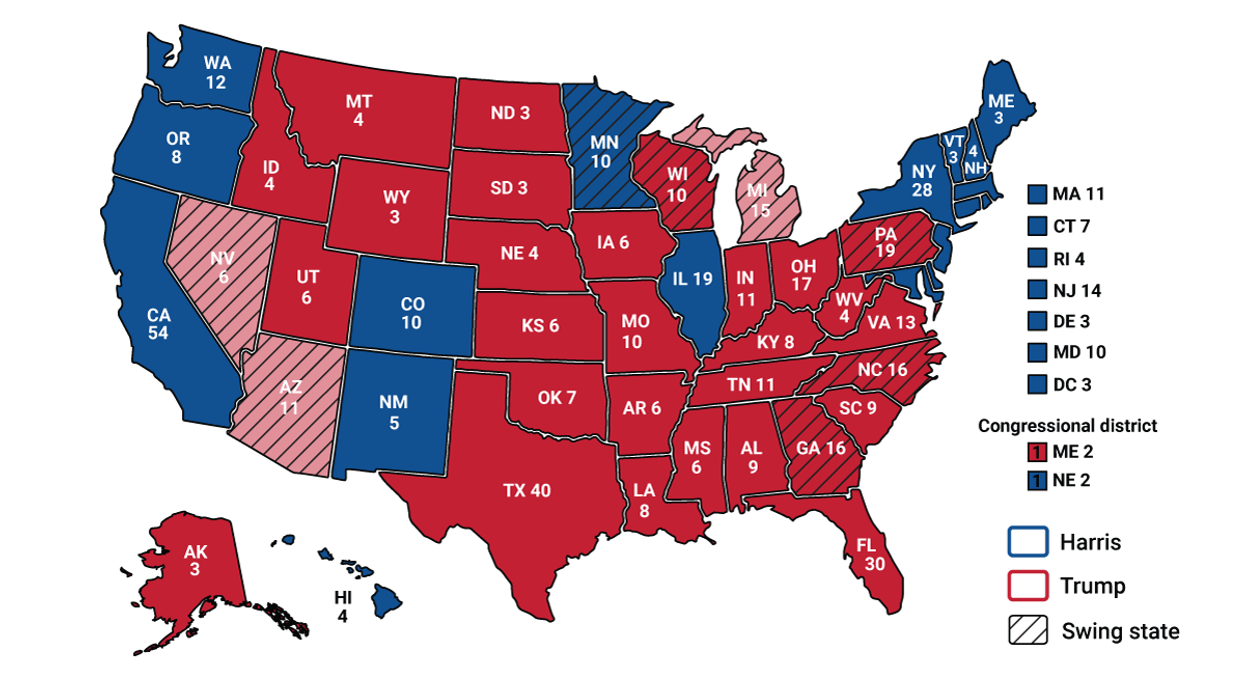
Well, this certainly isn't how lots of people thought the US election would go. Most of the polls — may they rest in peace — foresaw a decisive Biden win. After all, Trump lost the popular vote in 2016 and didn't seem to care much about expanding his base since. Even when the economy boomed before COVID-19, his approval rating never even neared 50 percent. Then, of course, came the pandemic, and with it the worst short-term economic downturn since the Great Depression.
So why was this thing even close at all? Here are some preliminary thoughts.
For one, Trumpism is a viable and resilient political force. For about half of American voters, close to 70 million people now, either the style of Trumpism (a gratifyingly vulgar challenge to high-handed liberal "elites") or its substance (conservative justices, tax cuts, deregulation, decimating immigration) has a real, visceral appeal. In a deeply polarized country, Trump is selling what millions of people struggling with economic inequality, cultural anxieties, or racial resentment want to buy.
For another, Trump's coalition actually did grow — it got more female and... browner? The president lost some ground among his base of white male voters, but he padded his numbers among white women and, crucially, among voters of color. Black voters broke for Biden by a 60-point margin, but that's 8 points smaller than what Hillary Clinton did in 2016.
One particular spotlight at the moment is Trump's improved showing among the (hardly monolithic) "Latino vote". Two thirds of Latinos supported Biden, but Trump's standing improved by 3 points nationally, and by 12 points in Florida (where many Cuban American and Venezuelan American voters are especially suspicious of leftwing politics). In one heavily Mexican American district of Texas, meanwhile, there was a 55-point swing to Trump.
There are many potential reasons for Trump's growing shine among Latinos, but among them are his appeal for religious conservatives (on policy if not personal conduct), his pro-business policies, and his hard line on immigration, which many recently naturalized citizens in fact support. Biden's weak outreach to Latino voters, outside of Nevada at least, certainly didn't help.
The pandemic didn't figure as heavily as you'd think. Going into the election, we noted that "the economy" — rather than the pandemic — was the top concern for voters. Amid the pandemic-related recession, that might have augured poorly for Trump. But for a lot of voters who have experienced layoffs or bankruptcies without being directly affected by a coronavirus death, Trump's "the cure is worse than the disease" refrain resonated more strongly than public health experts would like.
But, still, Trumpism is not actually the American public's preference. The American system of electoral college votes rather than a straight-up nationwide election can sometimes obscure the real level of popular support for a candidate, or worse: twice in the past 20 years, the winner of the presidency has actually lost the popular vote (Bush in 2000 and Trump in 2016).
At the moment, despite Trump's unexpectedly strong showing, Biden is set to receive some 70 million votes, the highest total for any presidential candidate in US history. Trump is about 3 million votes behind. In addition, Biden's electoral map showed that some of the most reliably red states in the country may turn blue in the future. Biden is only the second Democrat to win Arizona in the past 70 years. He even made GOP bastion Texas competitive for the first time in decades.
That tells you that, in fact, a majority of Americans did reject the last four years of Trumpism. But it was only a small majority. And even Biden does squeak out the win here, likely GOP control of the Senate will make it very hard for him to make good on his pledges to roll back Trump's impact on American politics and society. The power and appeal of Trumpism will outlast Trump's (possible) departure from the White House.