Hôtel de Ville, the city hall of Limoges in central France, was built by architect Charles-Alfred Leclerc in 1883. A historically protected building of Limousin granite and Poitou limestone, adorned by statues symbolizing the historical industries of Limoges atop its pediments, it has stood through three French Republics, two world wars, and a four-year-long occupation by Nazi Germany.
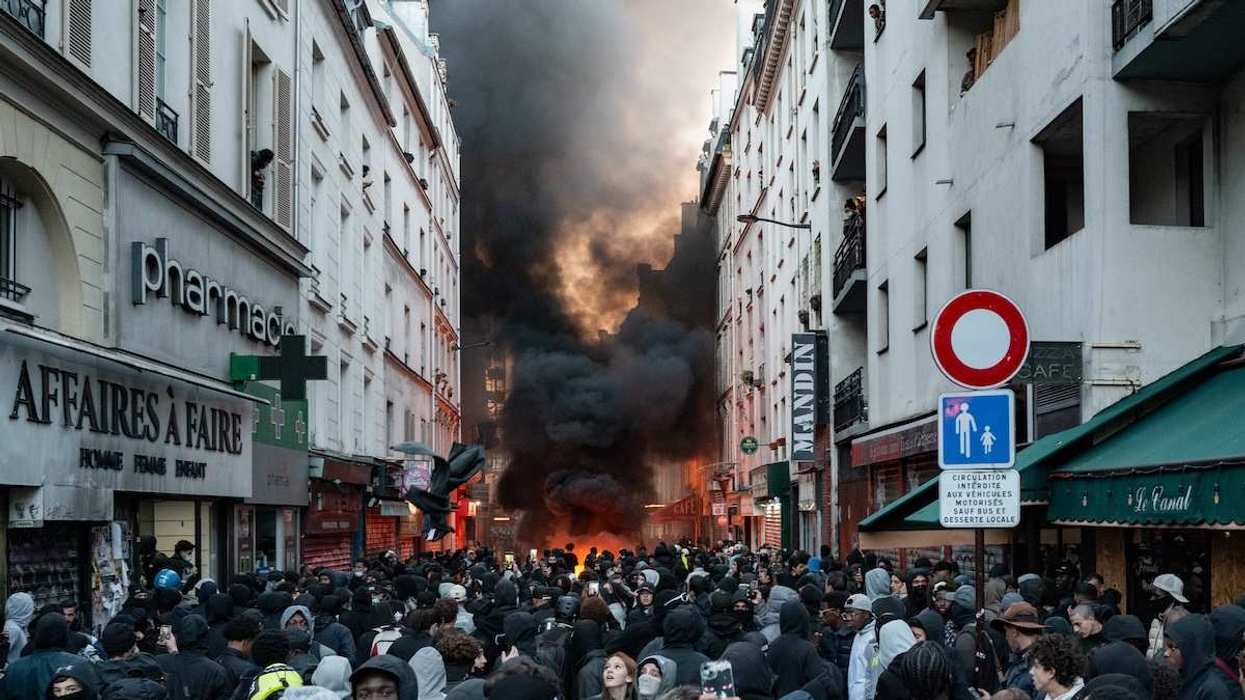
On Saturday night, Hôtel de Ville burned. By Sunday, only the husk of the building was left standing – arsonists set it ablaze amid riots that have rocked France for days. It encapsulates a France whose governing institutions are being pulled apart by its citizens – a story that carries far-reaching implications for the future of the country and the European Union, as far-right candidate Marine Le Pen leads presidential election polls, while bond markets lose confidence in France’s capacity to repay its debts.
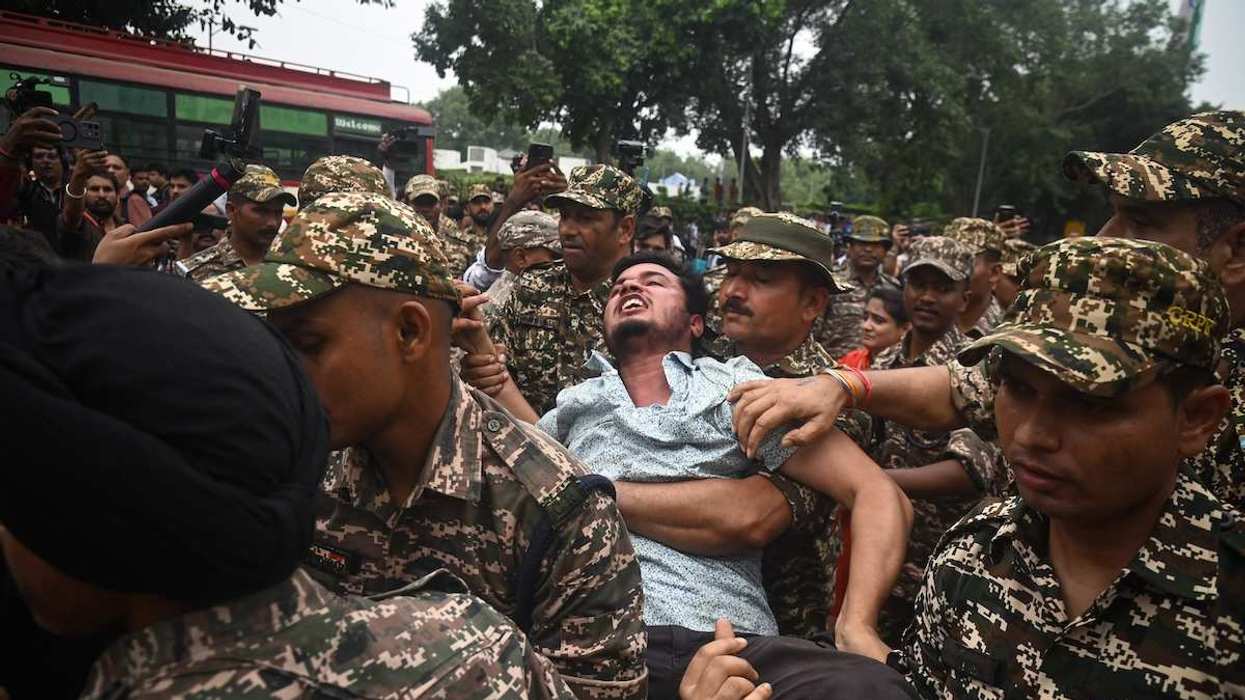
The unrest began several weeks ago with protests led by students demanding better conditions in French schools. Often joined by their teachers, the student protests led to school closures across France, the arrest of more than 6,000 people, and all sorts of violent incidents between the police and demonstrators. In one instance, reported by The New York Times, police shot a tear gas grenade into a fourteen-year-old boy’s face from two yards away, “breaking his jaw and destroying many of his teeth.”
The situation further escalated this past Saturday, when hundreds of thousands of protesters filled the streets for a march protesting both the state of the education system and the cost of living. They were accompanied by rioters who damaged or looted 1,500 businesses, burned the Hôtel de Ville, and caused likely over one billion euros of damage.
The aftermath has scrambled the already fractious presidential election. Before the riots, far-left candidate Jean-Luc Mélenchon had risen in the polls to second behind Le Pen, prompting fears that the second-round runoff could feature two extremist candidates. Centrist candidates Édouard Philippe and Gabriel Attal, both former Prime Ministers under President Emmanuel Macron’s increasingly unpopular government, have divided their vote share, leaving an opening for Mélenchon until one of them drops out of the race. Another candidate, Raphaël Glucksmann, has recently emerged as a center-left option hoping to take advantage of fears that Mélenchon will make the runoff.
Polling shows that Le Pen is favored to win the second round by a wide margin against either Philippe (who is more likely to make it than Attal) or Mélenchon, despite her criminal record of embezzlement, support for Russian President Vladimir Putin (even occasionally using the Kremlin’s own talking points), and longstanding antisemitism allegations against her National Rally party. A highly unlikely Mélenchon victory would send to office a man who has similarly argued that Russia’s invasion of Ukraine was the fault of Ukraine and the United States, and who would seek to cancel broad swaths of France’s national debt, while lowering France’s retirement age (already the lowest among Europe’s major economies and the source of fiscal pressure) to 60.
The riots are expected to help Le Pen, given her longstanding law-and-order rhetoric, and hurt Mélenchon, given his early support for the protests. Philippe and Attal are not well-positioned either, given their ties to Macron’s unpopular record – dissatisfaction that helped spur this unrest and earlier protests, such as the Yellow Vest Movement. Meanwhile, Glucksmann has struggled to walk a fine line between supporting the protesters and condemning the violence.
Le Pen is the one candidate poised to profit from the fact that France is beset by what my colleague Mujtaba Rahman recently termed “un engrenage” or “a vicious spiral.” With a debt over 4 trillion dollars, a public unwilling to tolerate significant cuts to France’s public spending, rising anger over the cost of living, and a divided political establishment, France faces interlocking crises that raise the appeal of a conservative populist.
The bond market sees these problems too. French borrowing costs have soared to highs unseen in decades, with the French-German bond spread reaching its peak since the Eurozone crisis. That has led to fears that France could face a debt crisis, which would prove catastrophic not only for the country’s finances but for those of the European Union – a scenario not far off from Greece in 2009 but with an economy 12 times larger and accordingly, much more difficult to bail out. A French economic calamity would quickly become a European one too.
Even if France gets its finances in order – which Le Pen has tried to reassure investors she will do if she wins – the European Union could still find its actions paralyzed by a deeply Euroskeptic leader at the helm of one of its most powerful nations. There were similar fears after the election of conservative Prime Minister Giorgia Meloni in Italy; however, her moderation in office allowed her to become a serious player in Brussels.
Will Le Pen likewise reverse course? It’s possible, but she lacks the same incentives. Italy is more reliant on the European Union, given the relatively smaller size of its economy and its own debt issues, so it was always in Meloni’s interest to change her tone towards Brussels once in office. France – if it avoids a disastrous debt scenario in which it needs help from the European Central Bank – is more powerful economically, militarily, and diplomatically. A Euroskeptic leader of France is more likely to win EU concessions than a Euroskeptic leader of Italy.
There is still a significant possibility that Le Pen is defeated by one of the centrist candidates, and a smaller chance that a new candidate such as Glucksmann breaks through. But the range of outcomes for the European Union looks bleak: France led by a far-right leader or a weakened centrist candidate with the same coalition infighting that Macron has suffered – on top of a worsening debt problem in the EU’s second biggest economy.
And the challenges aren’t isolated to France. Italy likewise experienced a weekend of riots linked to anger at the political establishment, as Meloni tries to fend off a challenger on her right. Spain has seen massive protests over housing costs after the recent eviction of 87-year-old María del Carmen Abascal. In Germany, a wave of state election breakthroughs for the far-right Alternative for Germany has weakened incumbent Chancellor Friedrich Merz’s government.
Across Europe, establishment parties are straining to maintain support, as voters lose patience with rising costs caused by sluggish economies and wars in Ukraine and Iran. Their frustration leads them to protests and more extreme parties who attribute their countries’ problems to immigration and European support for Ukraine. Today, France is the most extreme example. But it is far from the only one.
Yet most of Europe is not in a state of total decline. While Europe’s economy has struggled in recent years, the EU has made significant progress on implementing the reforms suggested by the Draghi Report to improve competitiveness. European countries are finally investing appropriate levels in their militaries, headlined by Germany’s historic rebuilding of the Bundeswehr. The EU might be far behind the US and China in developing AI, but they’re well ahead in governing it. And while the economic model of Europe needs reform to compete with the US, the reality is that the quality of life there is in many ways better than that of Americans due to a robust welfare state and a greater prioritization of work/life balance.
What’s not working in Europe right now is the politics. That is why these protests and riots matter: they demonstrate the groundswell of anti-establishment anger lurking in the European electorate. Hôtel de Ville was badly damaged by arsonists, but it will be rebuilt. The rest of Europe’s historic institutions – governments led by establishment parties, central banks, the European Union itself – are also the subject of an uncontrollable outburst of fury by the citizens they represent. Can Europe’s institutions, like Hôtel de Ville, be rebuilt to stand for future generations?