Over the weekend, MSNBC’s Joe Scarborough tweeted the following, urging the Biden administration to stand up for Ukraine more forcefully lest timidity against Russia embolden China to invade Taiwan:
This sentiment has been echoed by many in recent days. A muted response to another Russian invasion of Ukraine, the argument goes, will cause Beijing to second-guess America’s commitment to defend Taiwan.
The former supreme allied commander of NATO, retired Adm. James Stavridis, warns that US actions to defend Ukraine “will inform [China’s] calculus regarding Taiwan.” Famed political scientist Francis Fukuyama writes that “the Chinese are watching how the West responds in this crisis very closely, as they calculate their prospects for reincorporating Taiwan.” The top Republican on the House Foreign Affairs Committee, Rep. Mike McCaul (R-TX), says that “U.S. credibility from Kyiv to Taipei cannot withstand” the US making “concessions at the expense of our strategic partner Ukraine in response to the Putin regime’s provocative military buildup.” Even Democrats like Sen. Tim Kaine (D-VA) believe that a measured response to Russian aggression could lead China to conclude that it could get away with attacking Taiwan without facing strong resistance from the West.
I disagree.
Want to understand the world a little better? Subscribe to GZERO Daily by Ian Bremmer for free and get new posts delivered to your inbox every week.
The US not coming to Ukraine’s direct military aid will not embolden China to invade Taiwan. Here’s why.
Reasoning from a bad analogy
Ukraine and Taiwan are often put in the same boat, and sure enough they are similar in some respects.
There is, of course, a parallel between Putin claiming Ukrainians and Russians are “one people” and Beijing claiming sovereignty over Taiwan under the “One China” principle. Both Ukraine and Taiwan are first-order national security priorities for Russia and China, enshrined in national mythology and identity as indivisible parts of their respective territories. Russia sees the prospect of Ukraine joining NATO as an existential security threat, and China views Taiwanese independence and alignment with the West in a similar light. Both global powers would like to annex these “breakaway regions.”
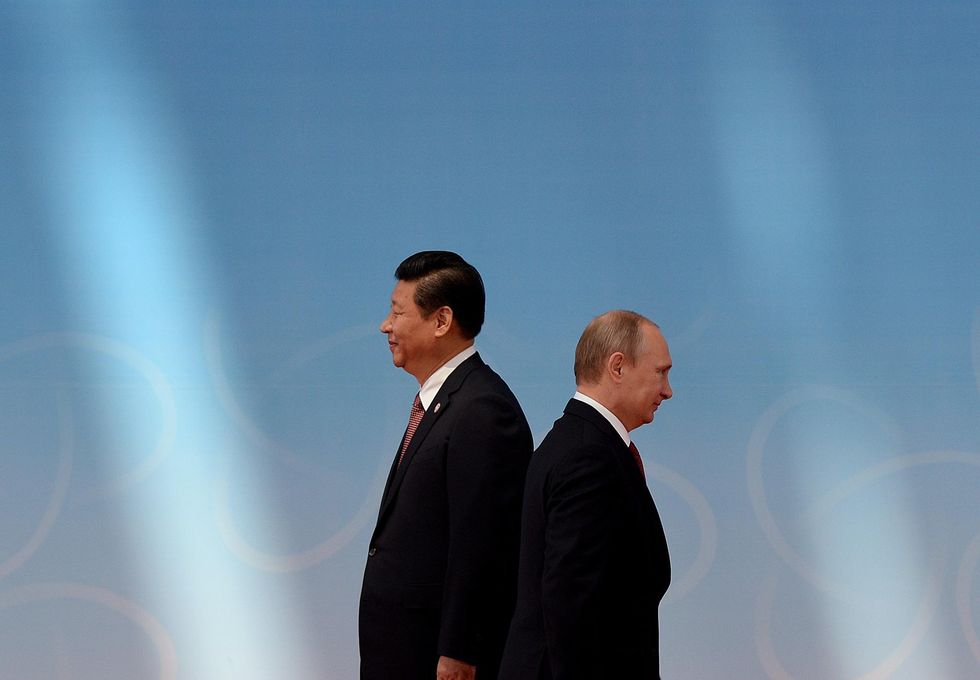 Xi Jinping and Vladimir Putin in 2014.(Mark Ralston/AFP via Getty Images)
But that’s where the comparison ends. The differences between the two contested hotspots far outweigh the similarities.
For starters, Taiwan (and the broader Indo-Pacific region) is a vital national interest for the US while Ukraine is at best a secondary one. Specifically, Taiwan is an advanced industrial nation with a strong democracy, close economic and diplomatic relations with the West, critical semiconductor production capabilities, and a key role in Washington’s Asian alliance system. As Assistant Defense Secretary Ely Ratner testified recently, Taiwan’s role in “anchoring a network of U.S. allies and partners […] that is critical to the region’s security and critical to the defense of vital U.S. interests in the Indo-Pacific.” Meanwhile, Ukraine has weak political institutions with deeply entrenched corruption and limited military and economic value to either the US or Europe—so much so that it wouldn’t be a desirable candidate for NATO (or EU) membership even if Russia was in favor.
These differences in strategic importance help explain why America maintains a deliberate policy of “strategic ambiguity” toward Taiwan but not toward Ukraine. While the US has not enshrined its assurance to defend Taiwan in a treaty, repeated statements from Washington make clear that Washington is committed to Taiwan in a way that it isn’t to other non-treaty allies. To wit, the White House has explicitly ruled out direct use of force to defend Ukraine from a Russian attack. This means military conflict over Kyiv doesn’t risk escalating into World War III, whereas Xi faces the prospect of war with the US if he decides to invade Taiwan.
A Russian re-invasion or annexation of Ukraine would impose limited costs on the US and would not lead to the demise of NATO (indeed, it would almost certainly strengthen the alliance). A failure of deterrence and defense of Taiwan, on the other hand, would significantly erode US military power in the western Pacific and kneecap America’s technological supremacy over China. The gap in geopolitical stakes makes it more credible that the US and its allies would go to war over Taiwan.
In turn, a Chinese invasion of Taiwan would be much less likely to succeed and much more costly than a Russian re-invasion of Ukraine. Beijing’s military capabilities are steadily increasing but they remain decades from ensuring a quick victory and an easy occupation in the face of US opposition. And unlike Russia, China’s economy is strongly dependent on America and its allies. Were China to attack Taiwan, it would risk a humiliating military defeat, devastating economic damage, and sweeping diplomatic isolation—all of which would threaten Xi’s and the Communist Party’s standing.
That’s not a risk Beijing needs to take. Unlike Putin, the leader of a declining power, Xi Jinping looks forward to leading his country into the 2030s, when the economic, military, and technological balance of power will favor China far more than it does today. It’s also likely that in that time the US will become increasingly consumed by domestic crises, or that a US president will be elected who is unwilling to defend Taiwan. Why act now at great peril rather than wait for the balance and circumstances to swing in his favor? As long as deterrence works to keep Washington and Taipei clear of China’s red lines—no declaration or recognition of Taiwan independence—Xi can afford to bide his time until he’s able to change the political map without firing a shot.
The riskier course of action would be to listen to the credibility advocates and entangle the US more assertively in yet another conflict of peripheral strategic value. Indeed, war with Russia would divert American resources and attention away from the Indo-Pacific, making the US deterrent in Taiwan less powerful and a Chinese attack more likely.
Beijing would love nothing more than an overextended US.
🔔 And if you haven't already, don't forget to subscribe to my free newsletter, GZERO Daily by Ian Bremmer, to get new posts delivered to your inbox.