Just three days after Russian rockets began raining down on his country, Ukrainian President Volodymyr Zelensky warned the world that Vladimir Putin’s invasion was the “beginning of a war … against democracy.”
The message quickly caught on.
French President Emmanuel Macron says the war has called democracy into question “before our very eyes.” US President Joe Biden has since called it a “new battle for freedom.” US House Speaker Nancy Pelosi has even said that Ukrainians are fighting not only for their own democracy but for America’s as well.
Well, are they right? Is Ukraine on the frontlines of a global battle to preserve self-rule, human rights, and respect for the rule of law both at home and abroad?
Here are two ways to look at the question. Let’s start with the “yes” side of it:
Ukraine is a democracy that is quite literally fighting for its life. Pre-war Ukraine was by no means a perfect democracy. But if the country is overrun by Russia, it will be stripped of its sovereignty entirely and turned into a puppet state of Putin’s dictatorship. Remember, this war came about in part because Ukraine wanted to join the EU and NATO, the world’s two most powerful groupings of democracies. Putin invaded to stop that.
Ukraine’s opponent is a global supporter (and exporter) of illiberalism. Over the past decade, Russia has gone to great lengths to amplify underlying problems in the world’s democracies — its 2016 US election meddling was merely one example — and has emerged as a beacon to illiberal forces around the globe. A good comeuppance in Ukraine, combined with strong sanctions on the Russian economy, might well temper the Kremlin’s ability to keep playing that game.
If Russia prevails, it would send a signal to other strongmen looking to crush troublesome democracies along their borders: give it a shot. If any country is worried about this, it’s US ally Taiwan. The self-governing island lives under the perpetual threat of forcible annexation by mainland China, which – as Putin did with Ukraine – denies its legitimacy as an independent country.
We can learn something from Ukrainian nationalism. The sight of millions of citizens of Ukraine – both ethnic Russians and ethnic Ukrainians – fighting shoulder to shoulder against an invading force is a stirring counterpoint to the increasingly tribal ethnic, racial, and political identities that are hobbling the world’s established democracies these days.
Lastly, authoritarian #1 has chosen its side of the conflict. Surely it’s no coincidence that the world’s most powerful authoritarian country, China, is firmly in Russia’s corner in this fight, is it?
Ok fair, enough. What about the opposing arguments?
The teams aren’t so neatly divided. Yes, the world’s most populous dictatorship, China, is in Russia’s corner, but the most populous democracy, India, has refused to criticize Putin as well. Other large democracies like Brazil and South Africa, as well as smaller ones like Hungary, an EU and NATO member itself, have hedged their bets here too. Outside of North America and Europe, dozens of developed democracies have in fact opted not to impose sanctions against Russia over its invasion.
Does consistency matter? If the world’s democracies are committed to protecting rule of law and human rights, it’s fair to ask whether Washington and Brussels can still do more to stop the much larger and more destructive war in Yemen, which was launched not by an adversary of the US, but by a strategic ally, Saudi Arabia. If not, how credible is their commitment to democracy – and the values that underpin it – as such?
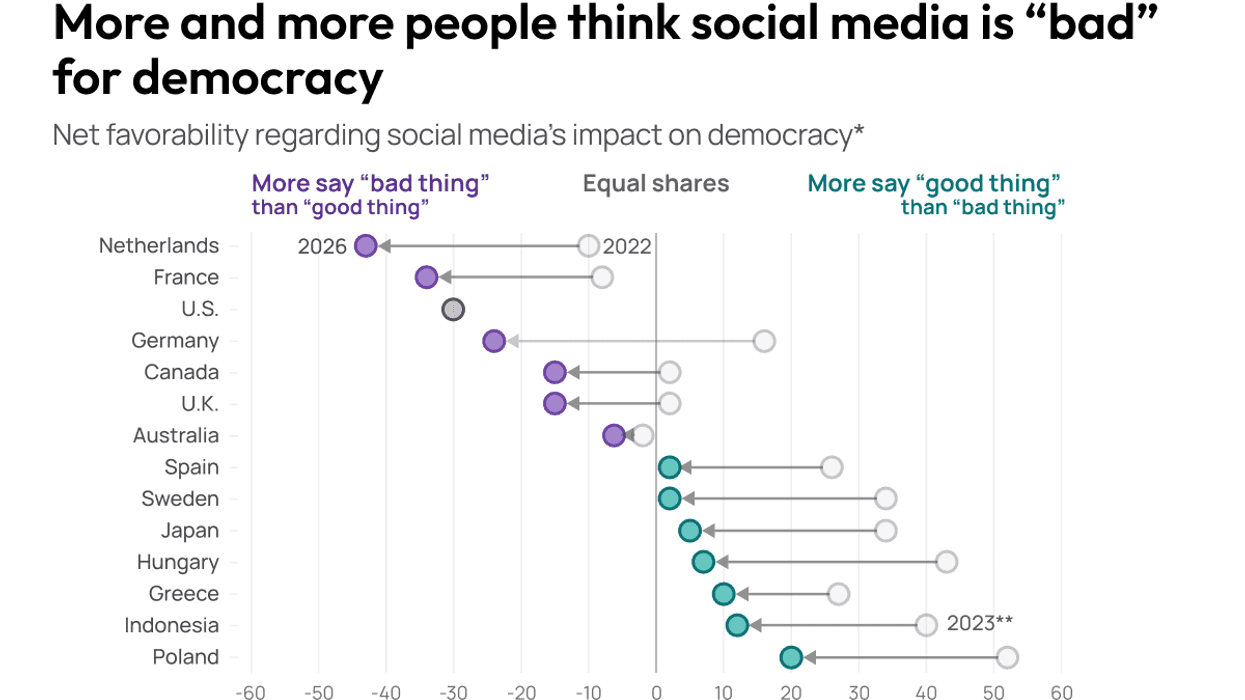
Ukraine’s struggle is a small part of a much larger story. For 16 consecutive years now, the world’s democracies have been deteriorating, according to Freedom House, a watchdog. Around the globe, popular dissatisfaction with poorly functioning democratic systems has opened the way for illiberal leaders to take power, eroding democracies from within. Well over half of those polled in the world’s leading democracies say they aren’t satisfied with their political system. And between 2019 and 2021, more than 2 billion people saw their societies become less free.
If Ukraine holds off Russia, that would certainly prevent an additional 40 million people from joining their ranks. But would it help reverse the broader erosion of democracy globally? That may be a problem that’s much closer to home.
What do you think of these arguments? Is Ukraine’s fate tied to the fate of democracy writ large? Let us know here, and we’ll happily publish a selection of the best thoughts we get.