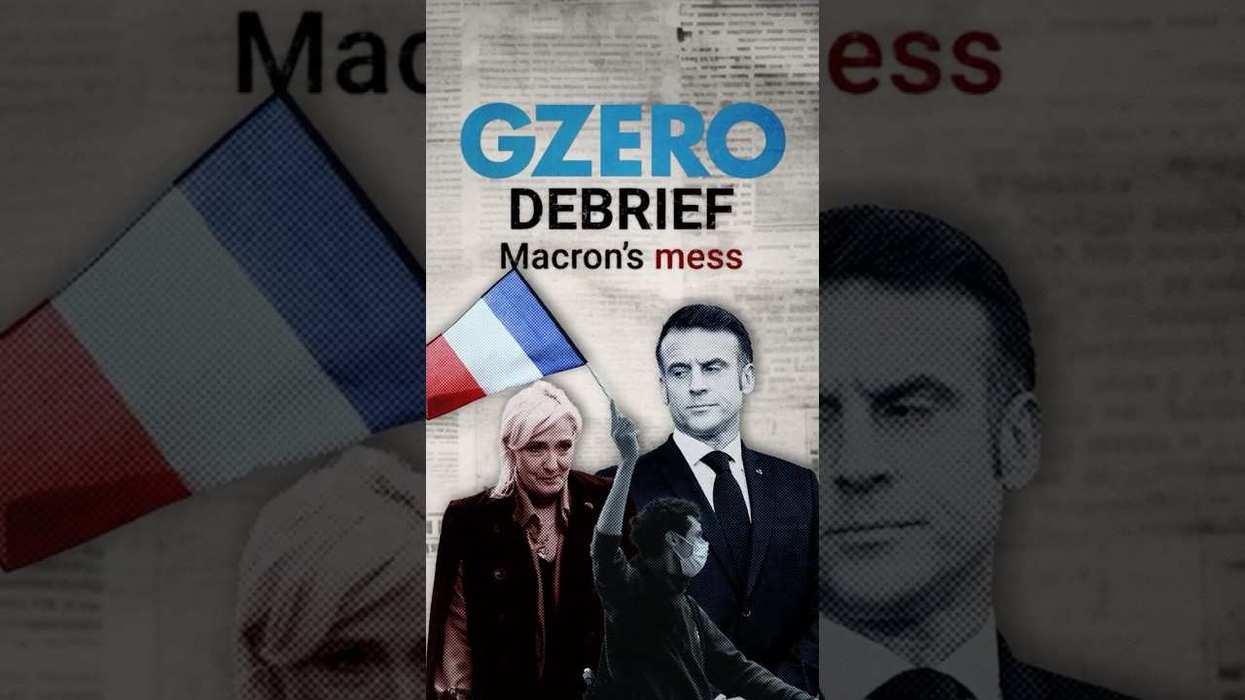
French President Emmanuel Macron thought he’d have his reelection in the bag by now.
But days out from the first round of voting, far-right firebrand Marine Le Pen is giving the incumbent a run for his money. Macron is still ahead – with a current poll putting him at 27%, just three and half points ahead of Le Pen. Still, the forecast is not what Macron – an ideological chameleon who has tried very hard to establish himself as Europe’s diplomat in chief – had been expecting.
Why is Marine Le Pen, who once tied her political fortunes to her father Jean-Marie – founder of the National Front Party who’s faced charges for antisemitic and racist rhetoric – doing so well?
Rebrand and refocus. For years, Le Pen has tried to distance herself from her toxic family brand. After riding his coattails into politics, she broke ranks with her dad, pushing him out of the leadership role in 2015. Then, in 2018, she changed the party’s name to the National Rally, a xenophobia-lite offshoot of her father’s brainchild. Like him, she’s long espoused anti-EU sentiment, rallied against immigration, and trafficked in anti-Muslim prejudice.
But seeking to balance her hardline credentials, Le Pen has also leaned into the view that all politics is personal, playing up her background as a single mother with increased frequency. For several years, she’s also sought to position herself as a warm and fuzzy cat enthusiast with breeding aspirations.
More recently, Le Pen has placed her hardline anti-immigrant message on the back burner, focusing instead on bread-and-butter issues like inflation and soaring food and fuel prices. This has proven a prudent strategy with French voters, who are now overwhelmingly concerned with reduced purchasing power.
Le Pen also recently did something unusual: she has supported welcoming Ukrainian refugees to France, eschewing the message that’s long been at the center of her political platform. Perhaps that’s because 85% of French voters say they support helping Ukrainians who’ve fled the conflict.
So has Le Pen really changed?
Not according to Mujtaba Rahman, head of Eurasia Group’s Europe desk, who says she’s simply a savvy politician: “Le Pen is no more moderate or reasonable today than she has been historically. She remains an extreme right force in French politics.”
Le Pen has also benefited, significantly, from the mishaps of her opponents.
Macron saw a war-related bump last month as he conducted shuttle diplomacy with Vladimir Putin. But the president has failed to capitalize on the boost, in large part because he hasn’t done much (or any) campaigning, relying instead on his image as a globe-trotting statesman to do the heavy lifting. This is an extremely risky move in France, where the electorate is notoriously averse to their leaders, and has not re-elected an incumbent in two decades.
While Macron was setting the internet on fire visiting the Kremlin, Le Pen was hitting the pavement, visiting small towns, taking selfies, and shaking hands with common folk.
What’s more, Le Pen has been able to distinguish herself as a palatable figure on the far right compared to her main rival, Éric Zemmour, an outspoken TV personality and provocateur. Le Pen, a longtime Putin backer, read the room: she saw there’s little love for Putin in France right now and has downplayed her previous support for him. (Still, she insists that France needs to maintain relations with Russia, even with Putin calling the shots.)
Le Pen’s pragmatism has allowed her to steal voters from Zemmour, who has rallied against sanctioning Russia and is avowedly anti-NATO. She “has benefited from the existence of even more extreme candidates on the campaign field,” Rahman says. “This has created the impression of moderation where none really exists.”
Consider this: when Russia invaded Ukraine on February 24, the far-right rivals were just three percentage points apart in the polls. Today, Le Pen is ahead by at least 12, and Zemmour is barely relevant.
Marine Le Pen has long been a formidable player in French politics. So what’s the difference now? Well, the idea of a President Le Pen is no longer so scary to French voters. It’s not likely, but she could still pull this off.