Skip to content
Search

Latest Stories

Analysis

Where does Trump’s immigration crackdown stand, nearly 100 days in?

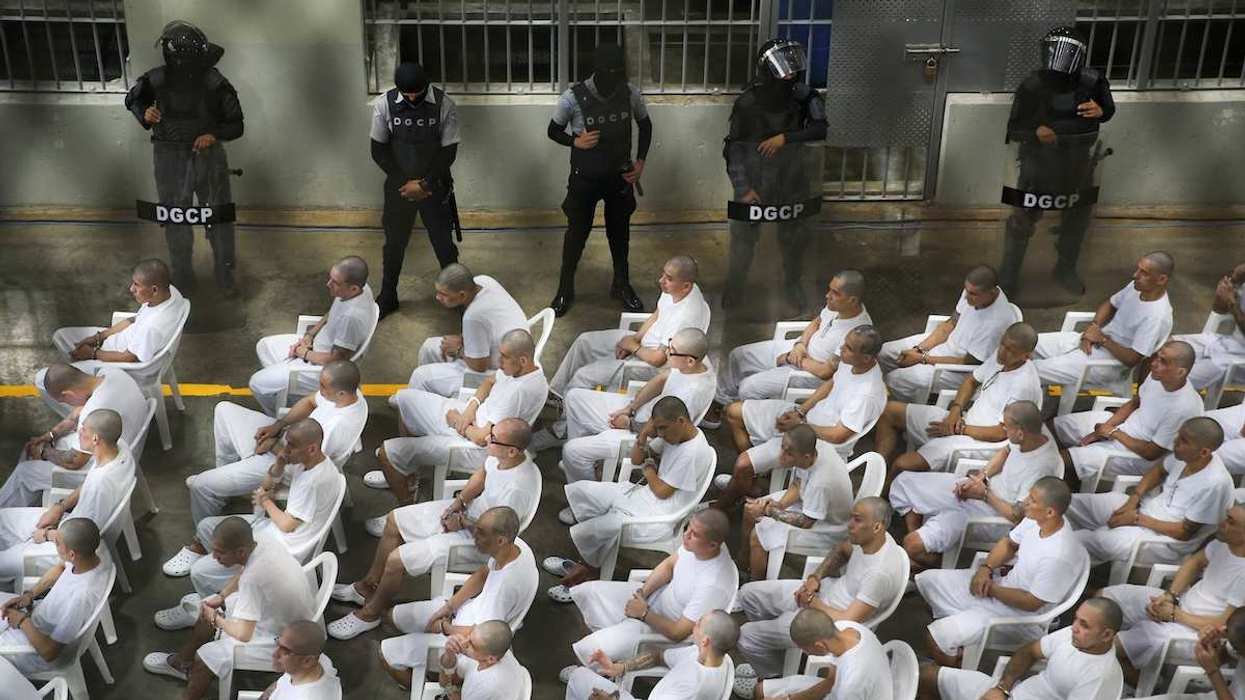
​Salvadoran police officers escort an alleged member of the Venezuelan gang Tren de Aragua recently deported by the U.S. government to be imprisoned in the Terrorism Confinement Center (CECOT) prison, as part of an agreement with the Salvadoran government, in Tecoluca, El Salvador, in this handout image obtained March 16, 2025.

Salvadoran police officers escort an alleged member of the Venezuelan gang Tren de Aragua recently deported by the U.S. government to be imprisoned in the Terrorism Confinement Center (CECOT) prison, as part of an agreement with the Salvadoran government, in Tecoluca, El Salvador, in this handout image obtained March 16, 2025.

Secretaria de Prensa de la Presidencia/Handout via REUTERS

President Donald Trump’s actions against migrants have generated among the most controversy of any of his policies during the first few months of his presidency. His administration’s deportation of alleged Venezuelan gang members to a Salvadoran maximum security facility has drawn comparisons to the worst abuses of totalitarian regimes, and Trump’s approval rating on immigration issues has slipped a bit in several polls.


Here’s a brief rundown of three of the most salient actions Trump has taken on migration.

1. Mass deportations of alleged criminal migrants

In March, the Trump administration defied court orders to remove over 200 Venezuelan migrants whom it alleged – without providing proof or due process – were criminals without legal status in the United States. The White House claimed it had the authority to do so thanks to the 1789 Alien Enemies Act, which it invoked to target the Tren de Aragua, a gang it alleges to be conducting “irregular warfare and undertaking hostile actions against the United States.”

The Supreme Court ruled on April 8 that while the administration could use this act to deport alleged gang members, it must provide them the opportunity to challenge their removals in court first. Eleven days later, it ruled that the administration must halt deportations under the Alien Enemies Act pending a further ruling from the court. The White House derided challenges as “meritless litigation” – even though it admitted in one case, that of Kilmar Abrego Garcia, it mistakenly deported him to a potential life sentence in El Salvador. Despite another Supreme Court ruling that the administration must facilitate his return to the United States, the administration says it cannot retrieve him from El Salvador.

2. Executive Order “Protecting the American People Against Invasion”

Trump issued this broad executive order, aka PAPAI, within hours of his inauguration. It revokes several Biden-era executive orders related to immigration and attempts to further the crackdown Trump promised on the campaign trail.

For example, it removed restrictions on immigration authorities attempting to make arrests at sensitive locations like churches, schools, or certain workplaces. It urges state and local law enforcement to aid in immigration arrests, which are usually outside their jurisdictions, and threatens so-called sanctuary cities with the loss of federal funds if they do not assist. The order also mandates the creation of “Homeland Security Task Forces” in each state, reporting to the Departments of Justice and Homeland Security. These task forces are meant to marshall more manpower and resources to make arrests, but the White House has expressed frustration with the pace of detentions.

3. Militarized border protection

In another executive order signed on his first day in office, Trump declared a national emergency on the southern border, enabling military forces to take a greater role in securing the region. He also assigned the Roosevelt Reservation, a 60-foot wide strip of land running along much of the border from New Mexico to California, to the Defense Department. DoD has announced it will administer part of the reservation as a section of Fort Huachuca, a military base in Arizona. Doing so will allow military personnel to put up barriers and make arrests as part of their security duties, but those actions are likely to be challenged in court.

Despite – or perhaps because of – the crackdown along the border, apprehensions are way down compared to the Biden administration. Authorities detained just 11,017 attempted migrants along the southern border in March 2025 compared to 189,359 in March 2024.


More For You

Police officers pass a burnt police armoured personnel carrier after gunmen kidnapped several people from an orphanage in a mountainous community that has been under deadly attacks by armed gangs since the start of this year, on the outskirts of Port-au-Prince, in Kenscoff, Haiti August 4, 2025.

Police officers pass a burnt police armoured personnel carrier after gunmen kidnapped several people from an orphanage in a mountainous community that has been under deadly attacks by armed gangs since the start of this year, on the outskirts of Port-au-Prince, in Kenscoff, Haiti August 4, 2025.

REUTERS/Fildor Pq Egeder
Last fall, Haiti created a transitional presidential council tasked with regaining control over the gang-ravaged Caribbean country and ushering in elections by February 2026. On Tuesday, the transitional government passed a law calling for elections in August, missing the original deadline but calming fears that leaders intended to indefinitely [...]
​Ukrainian President Volodymyr Zelensky inspects a guard of honor by the Irish Army in Dublin, Ireland, on December 2, 2025.

Ukrainian President Volodymyr Zelensky inspects a guard of honor by the Irish Army at Government Buildings during an Irish State visit, in Dublin, Ireland, on December 2, 2025.

REUTERS/Clodagh Kilcoyne
It hasn’t been an easy year for Ukrainian President Volodymyr Zelensky – and not just because Russia is still invading his country.US President Donald Trump’s return to office heralded a sharp slowdown in new White House spending on Ukraine – it has dropped to virtually zero this year. Europe has made up for some of the shortfall, but is now [...]
​The Gen Z group led by Miraj Dhungana escalates their ongoing demonstrations in Kathmandu, Nepal, on Nov. 26, 2025.

The Gen Z group led by Miraj Dhungana escalates their ongoing demonstrations, confronting police outside the prime minister's official residence in Kathmandu, Nepal, on Nov. 26, 2025.

Sanjit Pariyar/NurPhoto
Youth unemployment is making headlines from China to Canada, with many countries’ rates at historic highs. While the global youth unemployment rate for 2025 is projected to be slightly lower than that of 2020, at 12.8%, regional disparities abound. In developed countries, four in five workers aged 24-29 have a regular paid job, but in developing [...]
US ​President Donald Trump pardons a turkey in Washington, D.C., USA, on Nov. 25, 2025.

US President Donald Trump pardons a turkey at the annual White House Thanksgiving Turkey Pardon in the Rose Garden in Washington, D.C., USA, on Nov. 25, 2025.

Andrew Leyden/NurPhoto
Well, it’s about to be Thanksgiving in the United States. Although not all of our global readers celebrate that particular holiday, it’s still good to remind ourselves that while the world offers plenty of fodder for doomscrolling and despair, there are still lots of things to be grateful for too. Here’s a selection of five good news stories from [...]