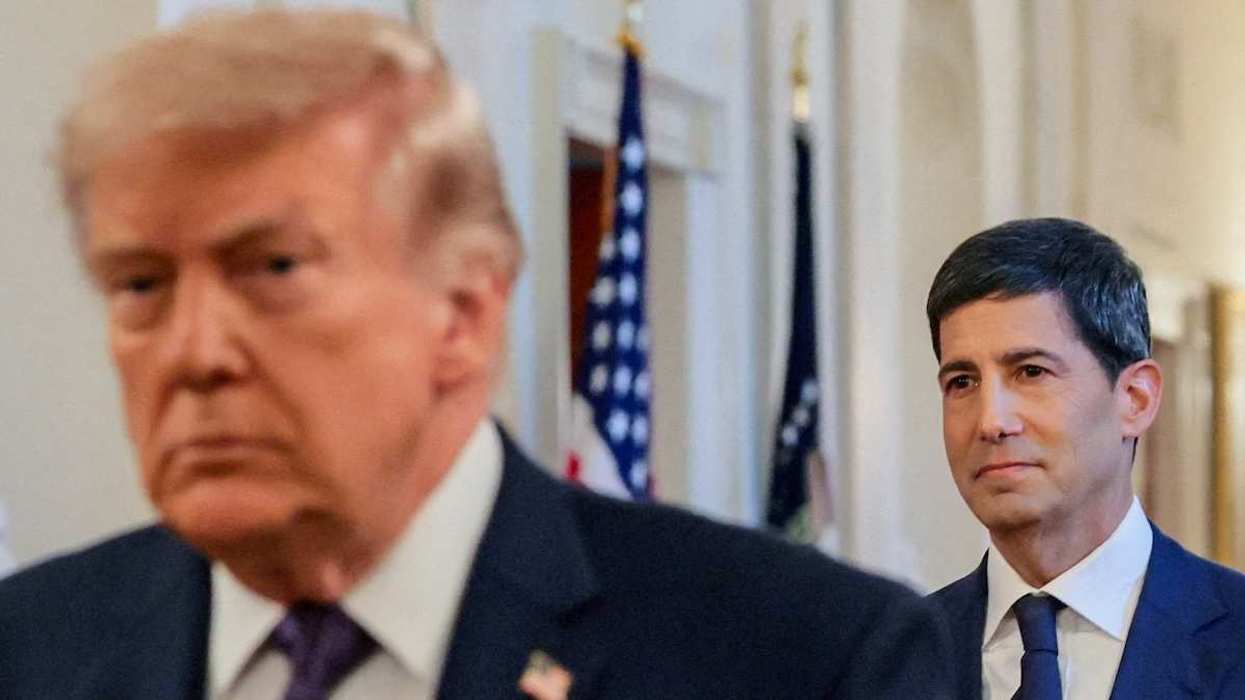
Tonight at 6 p.m. EST, US President Donald Trump will be featured in “America Reads The Bible,” reciting a verse from the holy book in the Oval Office. The week-long event will see five hundred people, including Trump, Secretary of State Marco Rubio, Defense Secretary Pete Hegseth, and White House Chief of Staff Susie Wiles, read the Bible in its entirety in a series of live and prerecorded segments. All the participants are Republican; organizers say they invited Democratic members of Congress, but that none responded.
The event has been a year in the making, but the timing is ironic. It comes as Trump’s relationship with Christians is suddenly in unusual flux. Last Tuesday, he clashed with Pope Leo XIV, the first American pontiff, calling him “WEAK on Crime, and terrible for Foreign Policy” after the Catholic leader criticized Trump’s threat to wipe out Iran’s “whole civilization.”
Trump then stoked controversy by posting an AI-generated depiction of himself as a Christ-like figure, healing a sick man. Many Christians said it was blasphemous; the US leader later removed it, but claimed it merely depicted him as a doctor, not Jesus. Undaunted, a day later he posted another AI meme showing himself embracing Jesus before an American flag. “The Radical Left Lunatics might not like this,” he wrote, “but I think it is quite nice!!!”
“An imperfect vessel.” On the one hand, Trump has cultivated a strong relationship with faith leaders and Christian voters, who played a key role in both his 2016 and 2024 election victories. Devout Christians have largely supported Trump despite his famously un-Christian personal conduct, with evangelical leaders sometimes describing him as an “imperfect vessel” for God’s work, and some likening him to King Cyrus who freed the Jews from Babylonian captivity despite not believing in their God.
On the other hand, some of Trump’s policies, such as his immigration crackdown, have lost support among all faith groups – and his dustup with the popular Pope may not help his cause with the one in five voters who belong to the Catholic Church.
How religious is America today? Over the past century, religiosity has declined in the US. In 1937, 74% of Americans belonged to a house of worship; by 2023, only 45% did. In 1965, 70% of Americans said religion was very important to them; by 2023, only 45% felt the same way. Still, in the last five years, the number of self-identified Christians has held steady at 62%, and the number of Americans reporting no religious affiliation has plateaued, at 36%.
Republicans are significantly more religious today than Democrats. According to a study by political scientist Ryan Burge, “the GOP vote is 80% Christian and 17% non-religious, whereas the Democratic vote is 48% Christian and 45% non-religious.” Furthermore, 56% of Republicans identify as Protestants, compared with just 38% of Democrats. Catholics, in contrast, are more evenly distributed between the two major parties: Trump won 55% of their vote in 2024.
How did the GOP get G-O-D? While 75 years ago neither Democrats nor Republicans had a monopoly on churchgoers, the decades since have seen a sharp split, with the GOP becoming the home of conservative Christians – especially Evangelicals – while the Democratic Party's members have, with some exceptions among minority voters, moved in a more secular direction.
In the 1980s, President Ronald Reagan capitalized on opposition to abortion rights and “godless communism”, while in the 2000s President George W. Bush championed “compassionate conservatism” that saw Christian organizations partner with the government to deliver social services.
Trump has cultivated a mixture of Christian conservatism and robust nationalism that is often described as “Christian Nationalism.” This includes a hardline immigration agenda, the rolling back of abortion rights, and a scorching backlash against laws that permit people to legally change their gender.
In fact, this set of views is partly what has put him in conflict with Pope Leo, whose vision of Christianity is diametrically opposed to Trump’s, emphasizing a moral obligation to support migrants, global solidarity, and a strong critique of nationalism.
Ballot box backlash? As the midterms approach, will Trump’s clash with the pope or his blasphemy-adjacent memeing cost him among the faithful? Not all churchgoing voters may react the same way.
Evangelicals, who form a core part of the Republican coalition, can be expected to remain strongly aligned with Trump, driven by priorities such as opposition to abortion, defence of religious freedom, and staunch support for Israel - a position that is sometimes rooted in theological beliefs about the end times.
Catholics, by contrast, are far less monolithic, making them less likely to embrace Trump’s vision. Four out of ten are immigrants or the children of immigrants; 36% are Hispanic. And while the Catholic Church opposes abortion, 59% of American Catholics think the procedure should be legal. In the 2024 election, Trump won more Catholics than ever before, but that number may not hold if he continues clashing with the Pope.
As it happens the verse that Trump will read tonight is a famous Old Testament passage in which God himself warns the ancient Israelites of the consequences of forsaking him. While it is sometimes read by modern American Christians as a call to nurture and protect Christian values in the country, it may carry a distinctly – and more directly – political message from Trump himself.