President Joe Biden woke up on Oct. 7 to find himself thrust into the middle of the second major foreign-policy crisis of his term. His response since has been guided by two conflicting imperatives: support Israel and prevent the crisis from escalating into a broader regional war.
Biden’s strong embrace of Israel is principled and non-negotiable. It reflects the longstanding bipartisan consensus in Washington as well as current public opinion across America. Polls show that most Americans side with Israel in the conflict and approve of both Israel’s retaliation against Hamas and US support for it. While Republicans tend to be more supportive of Israel than Democrats, who have become more sympathetic toward Palestinians over the past several years, majorities of both parties are broadly supportive of Israel.
But Biden’s unconditional support for Israel increases the risk of regional escalation. Despite Washington’s (largely private) efforts to convince the Israeli government to limit the scope and scale of its military response to Hamas’s attack and consider a “humanitarian pause,” Israel launched its long-anticipated ground invasion on Oct. 27. This offensive will inevitably inflict large-scale Palestinian casualties (especially since Hamas will continue to put civilians in harm’s way), stoke violence between Palestinians and Israelis in the West Bank, fan the flames of radicalism among Palestinian refugees in Jordan, Lebanon, and Syria, and lead to a marked escalation in attacks on Israel and US interests across the Middle East that will destabilize the wider region. Through it all, the US will continue to stand with Israel.
As a result, unlike the war in Ukraine, where the US and its NATO allies have worked hard to ensure their support of Kyiv doesn’t risk direct military confrontation between them and Russia, the US will become directly involved in this war. And for better or worse, Biden will own it. As the war expands and the US becomes further involved, the president’s handling of the crisis will grow more politically fraught.
Biden is vulnerable from left and right
While most voters are aligned with Biden’s stance on the war, and foreign policy is rarely a defining issue in US elections, this crisis still poses two political challenges to Biden’s 2024 prospects.
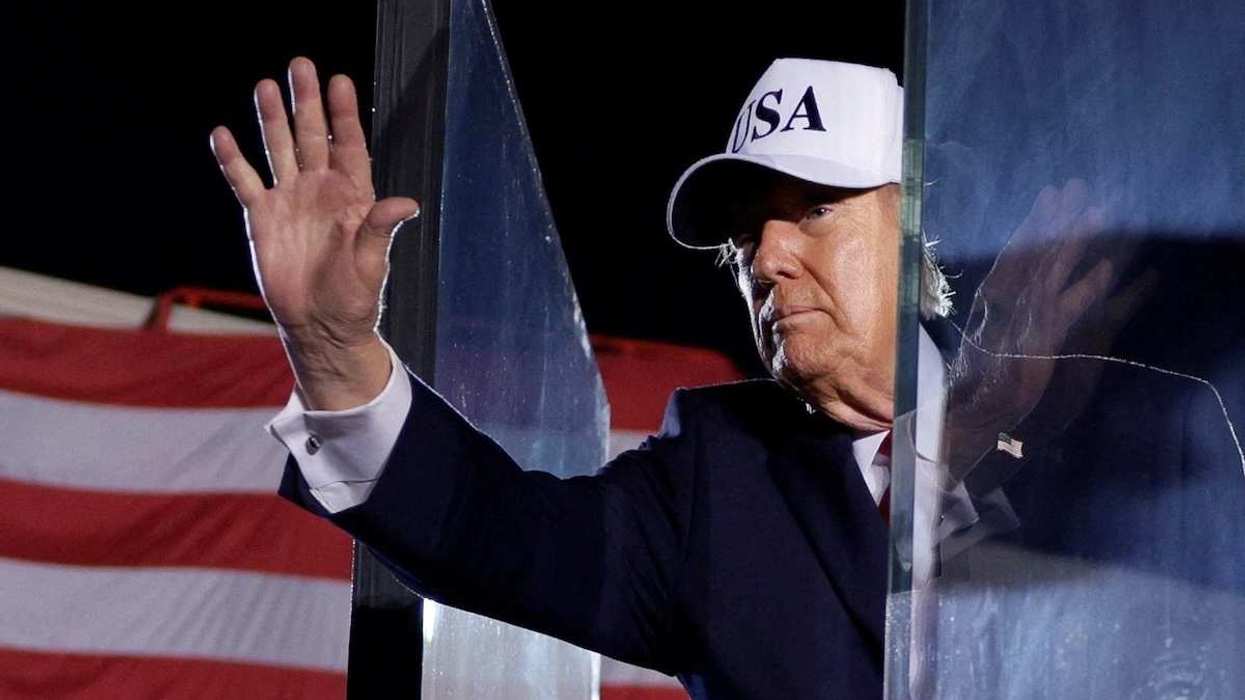
From the right, Biden will be accused of projecting weakness on the global stage. His all-but-certain 2024 rival, former President Donald Trump, is already making the case that the two major wars of Biden’s term happened only because Biden’s weakness emboldened US adversaries. Trump and his supporters argue that the relative global calm during the Trump administration was due to his strategy of “peace through strength,” particularly on Russia and Iran, and claim that neither would have dared test the US had Trump been in office.
This could be compelling for many of the Republican-leaning swing voters who might decide the 2024 presidential election. Never mind that Trump’s own Abraham Accords – which normalized diplomatic relations between Israel and the United Arab Emirates, Bahrain, Morocco, and Sudan – ignored the Palestinians and helped sow the seeds for the Oct. 7 attack. Or that Trump’s constant threats against NATO would have been a gift to Putin. Or that Trump’s response to the Middle East war would probably be quite similar to Biden’s. Regardless of what happens next, Biden will always be the president on whose watch these two wars – which the US is funding and partially fighting – started.
From the left, Biden will be accused of enabling Israel’s killing of innocent Palestinians. Even before Oct. 7, young voters in the Democratic Party were far more progressive, pro-Palestinian, and skeptical of Biden than the average Democrat, let alone the average voter. A CNN poll from earlier this month shows that just 27% of 18-to-34-year-olds view Israel’s military response to the Hamas attacks as “fully justified,” compared to 81% of those 65 or older. Then there’s Muslim and Arab-American voters, around two-thirds of whom backed Biden in 2020. Recent polls show that very few of them will vote for him again in 2024.
Faced with the choice of Biden vs. Trump, these voters – an important part of the Democratic coalition in 2020 and 2022 – would have no choice but to stick with Biden as the lesser evil (or stay home and benefit Trump). But the third-party candidacy of progressive Professor Cornel West, who has been strongly critical of Israel throughout his entire career, gives them an alternative that could still hurt Biden. A USA Today poll shows West already picking up between 4-7% of the vote nationally, primarily from Biden. It would only take 2-3 percentage points for West to be a spoiler in a swing state like Wisconsin, potentially tipping the balance to Trump in a close election.
The war is all downside, no upside for Biden
Despite these risks, Biden is not going to back away from Israel. Doing so would run counter to his personal convictions, buck the strong pro-Israel bipartisan consensus in Washington, and alienate centrist voters who are otherwise likely to vote for him. Indeed, Biden’s handling of this crisis has thus far been one of the president’s few polling bright spots: His average net approval rating on Israel is significantly higher than his poor overall approval rating. There’s no reason for him to jeopardize that by pivoting away from supporting Israel.
At the same time, a Middle East crisis that Biden can’t fix will eventually weigh on the president, particularly if the war escalates, US involvement deepens, and the US economy starts to pay the toll through higher oil prices. A Morning Consult poll showed Biden far behind Trump in seven key swing states on his handling of the economy, which is likely to be the top issue in the 2024 campaign. Biden will also bear the burden of any terrorist and antisemitic attacks against Americans that emerge because of heightened tensions surrounding the war and growing US involvement in it, which could further sour voters’ mood on the president.
For now, 2024 is still a very close race. Biden remains the narrow favorite to win reelection, largely because of Trump’s extraordinary and unique weaknesses. But a Middle East crisis that is still dominating headlines in November 2024 will only compound the structural factors and weak economic outlook that have already created a bad environment for an incumbent president seeking re-election.
Unless he emerges as a peace broker (unlikely), an escalating and politically divisive war in the Middle East can only hurt Biden.