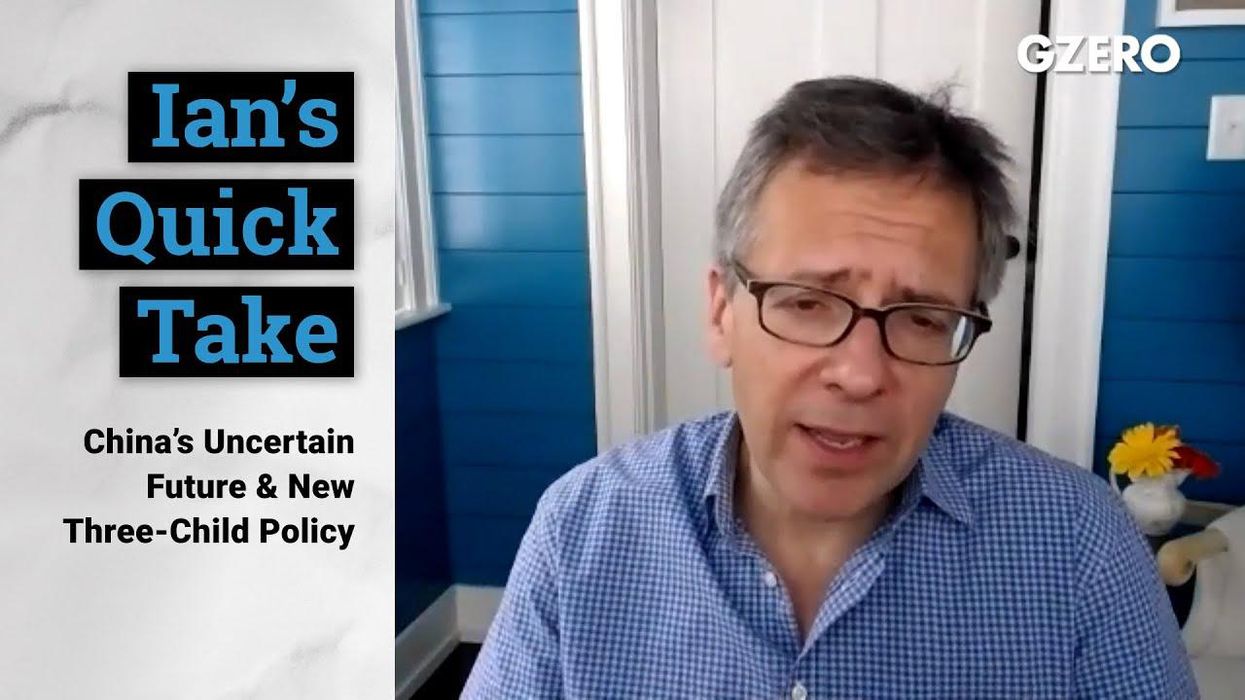
China's uncertain future & its new three-child policy
June 01, 2021
Global Stage LIVE from United Nations WATCH REPLAY
Ian Bremmer, political scientist and president of Eurasia Group and GZERO Media, shares insights on global political events.
Presented by

Ian Bremmer's Quick Take:
Hi everybody. Happy post long weekend. I want to do a quick take today on China, because you will have seen that the two-child policy has now gone the way of the one child policy. It is now a three-child policy. The one child policy, when they got rid of it, didn't really move people towards faster childbearing, as education rates improve, as well improves ... demographic explosion is reduced. And it's very hard to turn that around with a pro natality policy. Very few countries around the world have been able to accomplish that. And China is clearly not one of them.
But what is interesting, first of all, the fact that Xi Jinping recognizes that his policy isn't working. And so, he's moving forward with something new. I mean, frequently in authoritarian regimes, leaders don't get good information from the people around them. And so, they don't tend to admit mistakes or pivot to policies. And then when they have problems and we have seen that in the case of China, there is a lot of overreach. We've seen that. For example, with the shutdown recently, the trade war with Australia, it didn't work really well. And very quietly, the Chinese started buying a lot of essential Australian inputs. Again, we're seeing that now on the three-child policy, but there is I think in the west, this increasing presumption. Well, we know that China is on path to being the world's largest economy, that projection is by 2028 now.
It's probably going to be kicked out 2030 because the US economy is going to grow a lot faster this year than people had previously expected. The rebound is pretty sharp on the back of last year being, of course, a major contraction while China was growing. One of the only countries, the only G20 country that was growing in 2020. Vietnam was the next largest economy. I think they're number 35 or something like that. So can show just how extraordinary China efforts to lock down the coronavirus once they admitted to it actually were. But I feel a little cautious around projections of what China is going to be doing in the next 10 years. And I'd be cautious, not because I'm much more pessimistic than everyone else is, rather I think I'm much more uncertain than the economists are. I mean, on the downside, as you see demographics in China are getting problematic quickly, they are getting much older as a middle-income country.
That means you're not going to have as much consumption. It means you're not going to have as much labor and it makes it harder to stimulate growth. And ultimately, that means the size of the economy is going to be more constrained by these demographic facts. Also, the fact that China has to invest and stimulate to a greater and greater degree for lower and lower returns. And the reason for that is massive debt, particularly massive corporate debt, that they're unwilling to address. Addressing it immediately could create a financial crisis, addressing it over a longer period of time is going to limit your levels of growth. And so as a consequence, I mean every other middle income economy out there has had to deal with the so-called middle income trap. China's is of a much greater scale. And unless the rules don't apply to them, then at some point in the next 10 years, they are likely to underperform significantly.
And that should give us some different views of what their trajectory in power is going to look like compared to that of the United States. Okay. So that's on the negative side, but on the positive side, 10 years ago, there was no one out there that thought that China could be at parity in technology with the United States in 2020, 2021. And yet in many key areas of cutting-edge technology, that is exactly where they are today. In digital currency, they're ahead. In 5G technology, they're ahead. In voice recognition, in facial recognition, they're ahead. And in some other areas, they're behind. Semiconductors, they're probably behind by about five years right now. General research in artificial intelligence and towards neuro-mapping, they're behind. Biotech, it's close. Depends on what you're looking at.
But the point is that literally in 10 years, not just because of ripping off intellectual property though that's certainly happened, not just because of leveraging access to the Chinese market to get technology transfers, though they've done that too, but also because they have, by far, the world's largest set of data that they use in a consolidated way to engage in deep learning that helps to power new artificial intelligence breakthroughs and that plus an enormous amount of money being spent on research and scientists has given the Chinese an extraordinary acceleration in their technological capabilities to the extent that within 10 years, China has gone from being no better. In fact, worse than a lot of second tier technology countries in the world, say Japan or South Korea or Germany or Canada, to suddenly being competitive with the United States, the world's technology superpower. And if we got that wrong over the last 10 years, might we be getting it wrong in the next 10 years?
In other words, are the Chinese going to suddenly stop? Are they going to reach parity and that's it, or are they going to be able to actually continue to accelerate? And in 10 years' time, might the Chinese be the dominant technology power compared to the United States on cyber, on AI, in digital currency, in key apps and in key areas where companies really matter in exploiting not only how we consume, but also our national security, the ability to defend a countries wellbeing, it's economic wellbeing, its health, it's critical infrastructure. Right now, the US and China both have massive offensive capabilities that can do massive damage to each other, have very limited defensive capabilities. There's a level of mutually assured destruction between the US and China and the US and Russia on cyber. In 10 years' time, I feel quite comfortable saying the Americans are going to continue to be able to get beyond the Russians on this issue, but the Chinese, I'm not clear on that.
What about the future of 5G? Where will they be? Even on semiconductors? Can they catch up if they invest massive amounts of money for X? What they were spending in 2019 and spent in 2020, they're intending to do a similar kind of increase in 2021. Where does that get them? Even if we shut them down from Taiwanese semiconductors, even if we shut them down, if we say, no, not just Huawei, but other key technology champions of China, aren't going to be able to get them to put export controls on. That's an enormous question. We don't know. So the takeaway here is that there is much more uncertainty around China's trajectory than people generally presume.
I would like to see that kind of discussion more infused in the foreign policy establishment in the United States and American critical allies. It is not right now, perhaps it will be over time. Maybe this quick take makes a small bit of difference. Anyway, I hope everyone is well. Avoid fewer people. We're having a good time here and it is almost summer. Be good. Talk to you soon. Wear white pants if you feel like it. We're past Memorial Day.






Keep up with what’s going on around the world - and why it matters.