Site Navigation
Latest Stories
Sign up for GZERO Daily.
Quick Take
Ian Bremmer, political scientist and president of Eurasia Group and GZERO Media, shares insights on global political events.
Presented by

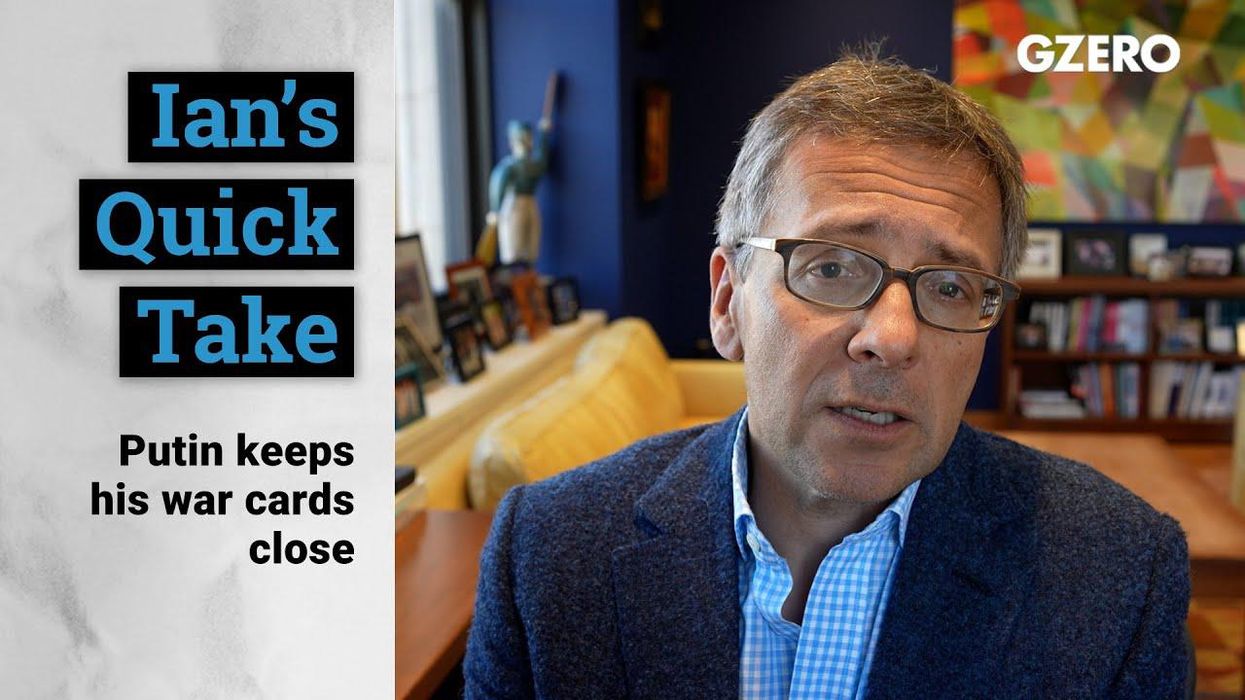
Ian Bremmer's Quick Take: Hey, everybody, Ian Bremmer here, and a Quick Take to start off your week. It is, of course, May 9th, and that means Victory Day. It's when the Soviets were celebrating their defeat of the Nazis in World War II. The Russians of course, continued that after 1991, when the Soviet Union collapsed.
And today even more important in the context of Russia's invasion into Ukraine, not in any way victorious and Putin, wasn't trying to claim it was, rather, it was all about justifying what he referred to as a preemptive rebuff to NATO aggression. He talked about the Ukrainians as a Nazi regime, that they were trying to get nuclear weapons, that NATO and Ukraine were going to take Crimea back from Russia. All of which was made up from a whole cloth, but nonetheless was the basis of Putin's speech.
Some things he didn't say. First on the negative side, he didn't say that Russia has won, that they've emerged victorious, that the second military operation has been as successful as the first phase of the military operation. And that Ukraine has now been denazified, and the Russians in Donbas who had acts of genocide committed against them have been protected. Again, all would've been fake news, but Putin has control of all state media in the country. And there isn't any other kind at this point. That could have been the basis for a frozen conflict, even negotiations on a ceasefire. That's not where we are at all. That's the negative side.
The positive side, the UK and their general intelligence had come out a week ago and said that there was a plan for an announcement of a general mobilization of Russian troops. Putin did not do that, nor did he announce an escalation of broad war footing against NATO. The propaganda value against NATO continues to be high. The sense that this is a fight that is absolutely necessary for the Russians and that they have to emerge victorious, that is the case. But it's still the actual war goals for the Russians continue to be vague, giving Putin significant flexibility in how he reacts to what happens on the ground, both in Ukraine and more broadly over the course of the coming weeks and months.
So what would I say? I think that it makes me not more positive in any way about the Russia-Ukraine fight, but rather it does give us at least for the next few weeks, a little more clarity on what the parameters of the conflict are likely to be. Right now, Russia's taking about one to two kilometers of land on the ground in Luhansk and Donetsk, around the Donbas. Every day they're losing some territory around Kharkiv, which is just outside, to the northwest of the Donbas.
To the Ukrainians the fact that there is no general mobilization means that Ukraine with better arms and much higher morale, should be able to start counter attacking in the Donbas probably at some point in June. So maybe the Russians can take all of it, but then the Ukrainians are going to bring the fight to them, as they already have surrounding Kyiv and in Kharkiv.
What that means to me, at a minimum, we're talking about fighting primarily in the Donbas over the course of the coming weeks and months with not a lot of understanding of what's going to happen between Russia and NATO as Finland and Sweden join, and as we continue to see escalation in sanctions against the Russians from the G7, from the Europeans, from the United States, and as we see escalation in the military support that's being provided from NATO and aligned countries into Ukraine.
I think one important point that was raised was that Putin described in the Donbas, the Russians as fighting for their own territory. And that makes clear from Putin something that I've certainly been presuming over the course of the past two, three months, which is that the intention is to either fully recognize the expanded Donbas as independent, or to formally annex. All of which baseline are unacceptable for the Ukrainians. So making very clear that a very significant piece of Ukrainian territory is going to be permanently occupied from the perspective of the Russians. That is what Putin's goal continues to be, irrespective of how badly his troops are fighting on the ground.
Then over the course of the last few days, the fact that you've had intensified bombings and artillery and missiles against Odesa, as well as other cities across Ukraine, that is punishment of the Ukrainians for having the temerity to continue to fight against Russia, and potentially it shows that there are broader territorial goals that the Russians will have in the medium to long term. Odesa someplace I'm particularly focused on. Transnistria, which is this Moldovan breakaway province, mostly populated by ethnic Russians, which itself has declared independence from Moldova. If they were to formally break away with Russian troops and support, you would then have an encirclement of Odesa, which is Ukraine's largest port. And I absolutely think that is a significant strategic aim for Putin at this phase in the conflict, as he's thinking longer term. But again, what's so interesting about this speech is he continues to not show any cards that he doesn't feel are necessary. He wants to give himself maximum flexibility to act in an environment where things have not gone the way he has planned so far.
Beyond that, I would say that another very important point is that we continue to see all sorts of civilians getting killed. Over this weekend, a school in the Donbas that was bombed and with a lot of civilians that were using it as a place of refuge, looks like some 60 civilians have been killed as a consequence of that bombing. Obviously, not a target of any strategic value, military value to the Russians. And again, all of that is going to lead to more calls of war crimes, and a hardening of positions on the part of not just the Ukrainians, but NATO allies. The more information that comes across like this with extraordinary saturation coverage from the West, the more you're going to continue to see these countries leaning into their fight against Russia.
Final thing I would mention is that Russia is of course, fighting Ukraine and NATO here, but it's not that they're fighting NATO in a coordinated fashion. Increasingly, you have a whole bunch of NATO countries that have different goals in terms of what they're trying to accomplish in the war. All the NATO countries agree that what Russia has done in Ukraine is beyond the pale, and they should be punished, and that Ukraine should be supported. Those are table stakes. But beyond that, are you trying to destroy Russian military capability? Do you want to remove Russian troops from all of Ukraine? Does that include Crimea? Do you want undermine Putin personally? Do you want to take out Russia's generals? It really depends on who you listen to. And frankly, there are a number of governments that are coming across in some ways as more intransigent and hardliner, even what you're now hearing from the Ukrainian government itself. And that is precisely because the domestic politics in many of these countries is moving towards piling on against Russia.
When that happens, you have a lot of individual political leaders that are acting in a political entrepreneurial way, and they're paying attention to their domestic politics. They aren't necessarily coordinated in every policy. That's a problem. It makes accidents easier, and it also makes it harder to have an effective strategic policy as one NATO. I don't think it makes it easier for Russia to divide and conquer because there is so much anger and animosity from NATO, and because the Russians have already been cut off so much diplomatically, culturally, economically, and that's not going to change from NATO. But I do think that it means that the conflict is harder to resolve, and it means the potential for escalation, unintended escalation continues to grow.
So a meaningful speech by Putin. It doesn't radically change the way we think about the conflict, but does certainly create a little more specificity in latest understanding of where Putin is and unfortunately, latest understanding of where this war is going.
That's it for me. Hope everyone's doing well and I'll talk to you all real soon.
For more of Ian Bremmer's weekly analyses, subscribe to his GZERO World newsletter at ianbremmer.bulletin.comMore from Quick Take
GZERO Series
GZERO World with Ian Bremmer
Puppet Regime
Quick Take
ask ian
Ian Explains
GZERO Reports
GZERO Europe
The Debrief

GZERO Daily: our free newsletter about global politics
Keep up with what’s going on around the world - and why it matters.