Site Navigation
Latest Stories
Sign up for GZERO Daily.
Global Stage LIVE from United Nations WATCH REPLAY
Quick Take
Ian Bremmer, political scientist and president of Eurasia Group and GZERO Media, shares insights on global political events.
Presented by

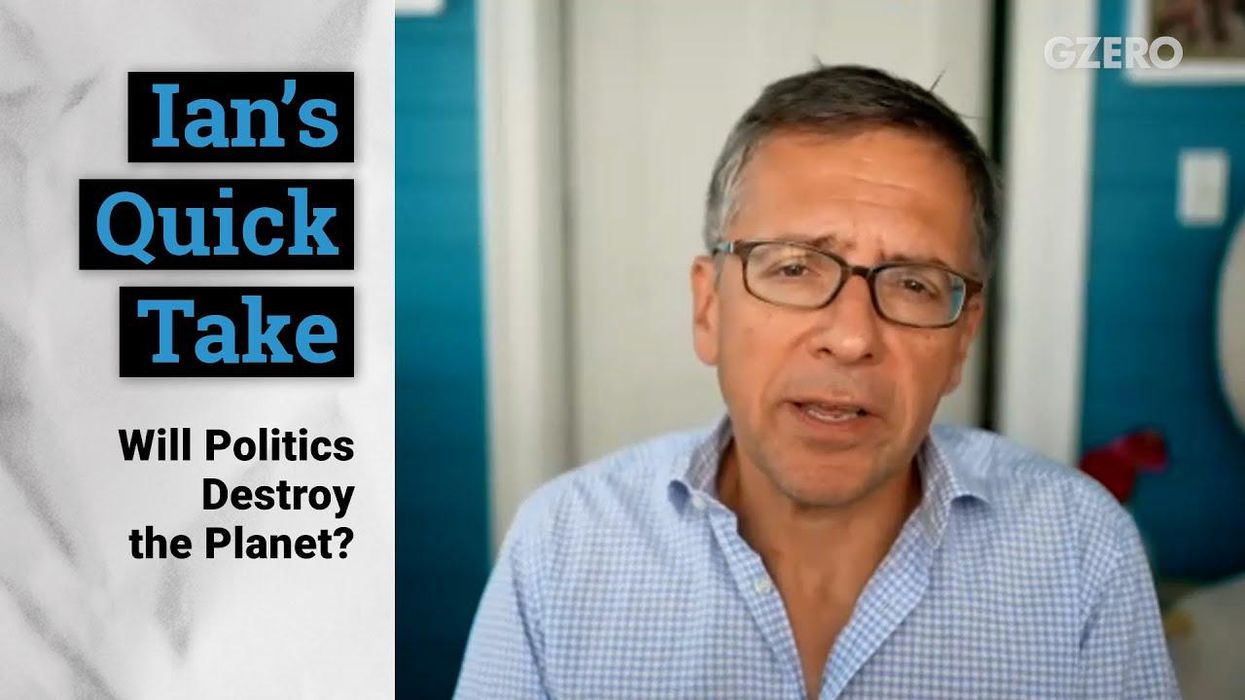
Ian Bremmer's Quick Take:
Hi everybody. Ian Bremmer here and a happy week to you all. I want to talk about the latest report, a very significant one from the Intergovernmental Panel on Climate Change, the IPCC. They release them every few years as sort of the state of the world on climate, on global warming, on sea level rise, on changes, and extreme storms, and droughts, and precipitation levels. And no one should be surprised that this is not a particularly happy piece of news. I mean, of course, so many headlines around major wildfires in California, and Oregon, and Turkey, and Greece, and others around the world and major flooding challenges.
I mean, it's not been a happy situation. But this report, one thing I can say, to start off it, is that it should give us cause for optimism. Is that with over 200 countries participating, you get an overwhelming consensus around where the state of climate change actually is. There's still a lot of uncertainty as to what the longer-term implications will be, particularly variability around things like how much sea level rise will go, to what extent you will end up with complete melting of the Arctic polar cap up, for example.
But over 200 countries, including most of the significant carbon emitters, the fossil fuel producers, and exporters, all participated. They all basically said, "Yeah, this is real." I mean, climate denialism, which you saw in significant pieces of politics, certainly in my own United States and in the Gulf states, in the Middle East, you're not seeing that anymore. There is an understanding and a general consensus that it's real and the level of the impact is no longer something that even the companies that are involved, whose business models are fundamentally dependent on things like oil and gas and coal, they may be making very different arguments on what one needs to prioritize and how one engages in transition. But no one out there is really, they don't believe this is happening. That itself compared to where we were five, 10 years ago is a positive thing.
Another thing I would say is we are now seeing, I mean, in terms of where there is consensus. There's consensus that humans are responsible for a rise in temperature on the planet. On average, over one centigrade degree already, about 1.1, the headline number. Interestingly, this report claims that there is still an opportunity for the world to move to 1.5 degrees centigrade. The 1.5 is already baked in. You can't possibly do less than that. But if you're able to significantly reduce carbon emissions by 2040, functionally net zero, you can keep it at 1.5.
I want to be clear, from our climate practice at Eurasia Group, none of us believe that is going to happen. We think that the most positive realistic scenario is more like 2.5 degrees centigrade of warming. We think we are presently on a trajectory of 3.5 degrees of warming and the calamitous implications of that for the global economy, for human development are very, very real. Actually, this report with the 1.5 degree, it was more optimistic than I expected. I suspect a big part of that is because it is politically very contentious to throw away the 1.5-degree goal that so many countries have been publicly setting and hanging their recommendations on. They want to show politically that we can still get there. Again, I don't think the politics exists for that.
What that means though, even at that level, is that a lot of climate change by 2050, which for most of us is, kind of the foreseeable lifespan outlook that we're thinking about is already locked in, baked in, if you will, in terms of the global average. It means that you will have a foot of sea level rise, irrespective of what is done globally. It means that you will have extraordinary heat waves and climate extremes that will affect every area of the world at the 1.1 degree increase in temperature. That shows that it's not just Sub-Saharan Africa, it's everything. It's Europe, it's Eurasia, it's Asia, it's the North, it's the Southern Hemisphere. Not nearly as much data or certainty in terms of precipitation levels. Not nearly as much certainty about where sea level is going, but a significant amount of certainty as to what this means for temperatures.
I also would mention that one big thing that isn't mentioned at all in this report are the implications of all the die offs from flora and fauna, from animals, the extinctions that we are increasingly seeing at. I mean, truly levels that are unprecedented in millennia. And that is, we don't know. Science is really uncertain about what it means when you take big pieces of the ecosystem out of the equation. What kind of genetic engineering are we going to try to engage in to address those problems? And can we avoid the worst-case scenarios of what could be a breakdown in food chain, for example? A breakdown in sustainability that comes from the life that exists on the planet, as you are engaging in such a short-term dramatic change in the climate environment that they live in.
Another thing I would just mention is one of the reasons why I think that the 2.0, 2.5 degrees are so unlikely and we're more likely to hit 3.5, is because I'm a political scientist, and I'm looking at the differentiated responses of different countries around the world. The United States from a per capita carbon consumption perspective has been decreasing for decades now. And per capita carbon consumption in the United States today is far lower than it was 10, 20 years ago.
But in China, which is industrializing, which has a lot more people than the United States, 1.4 billion, they now have well over 2X the total carbon emissions that the United States does. They'll be 3X in relatively short order, in a couple of years. Part of the reason for that is because they need so much more energy to produce for their population. Per capita, much less carbon usage than in the United States, radically less.
But today, almost 60% of energy consumption inside China comes from coal. And a lot of their export too, to even poor countries around the world is coming from fossil fuels. India, less wealthy than China. Same population. Going to outstrip their population in very short order. They want to industrialize too. And the ability of the wealthy countries to convince India, China, to actually start hitting net zero targets is going to require a conversation of equity about the fact that we have done, in the wealthy countries, most of the historical carbon emissions while the Chinese and the Indians are trying to catch up to our living standards today.
Per capita, ours are far higher than those of the Indians, the Chinese and other countries around the world. Don't they matter as people? What kind of an equity conversation are we going to have with them? Given the lack of trust and given the unwillingness of most people to think about, to value the long-term future on the planet for their kids, for their grandkids, the discount variable we all have, the uncertainty around what new technologies might be able to unlock. We know we have a bird in the hand today. That makes these conversations much more challenging.
Even before you get to the G-Zero and the lack of global coordination and the lack of leadership, even in my own country, the partisanship and the inability of a Biden administration that cares a lot more about climate than previous administrations, but still very constrained in what they can actually do. So, for all of these reasons, our orientation is more still towards 3.5, with an upset scenario for the planet at maybe 2.5 degrees centigrade. And this 1.5, is, in my perspective, an overly optimistic take.
We'll be talking a lot more about that in the future. Hope this is worthwhile for everyone and talk to y'all real soon.
More from Quick Take
GZERO Series
GZERO World with Ian Bremmer

Puppet Regime
Quick Take
ask ian
Ian Explains
GZERO Reports
GZERO Europe

The Debrief

GZERO Daily: our free newsletter about global politics
Keep up with what’s going on around the world - and why it matters.