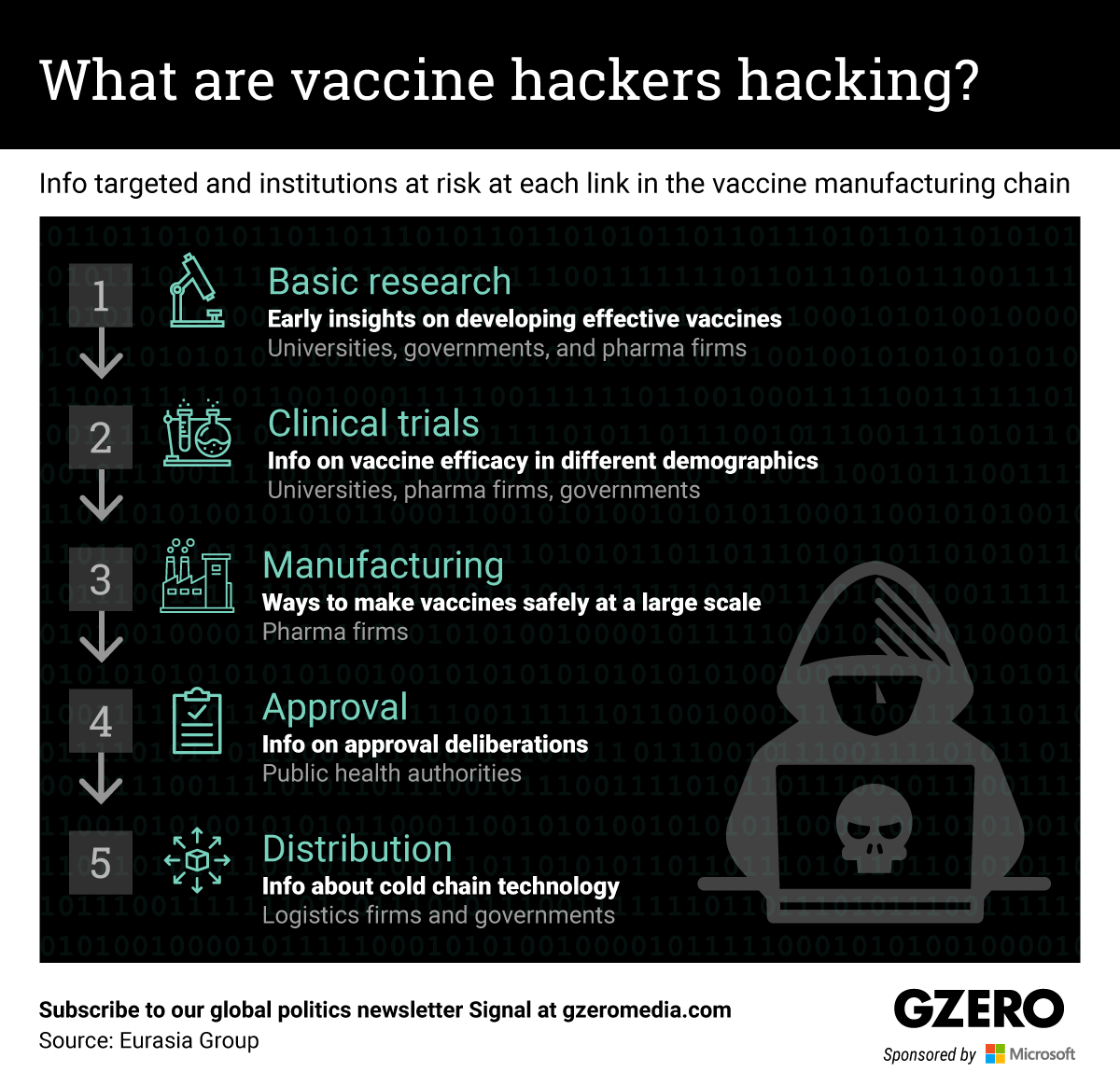
While governments around the world race to develop a coronavirus vaccine, intelligence services and criminal organizations see an opportunity: to steal vaccine research, keep tabs on the competition, or hold critical information for ransom. The vaccine manufacturing process involves a wide group of public and private organizations that have access to sensitive vaccine and manufacturing details as well as the personal information of trial participants. In addition to the risks of stolen intellectual property or personal information, hacks could also delay or derail elements of the quest for a viable vaccine. Here's a look at what hackers are after at each stage of the vaccine development process.
Graphic Truth
The Graphic Truth: What are vaccine hackers hacking?
By Alex Kliment,
Alex Kliment
Alex wears a few different caps and tips them all regularly. He writes for the GZERO Daily, works as a field correspondent for GZERO's nationally syndicated TV show GZERO WORLD WITH IAN BREMMER, and writes/directs/voices GZERO's award-winning puppet satire show PUPPET REGIME. Prior to joining GZERO, Alex worked as an analyst covering Russia and broader Emerging Markets for Eurasia Group. He has also written for the Financial Times from Washington, DC, and Sao Paulo Brazil. In his spare time, he makes short films and composes scores for long ones. He studied history and Slavic literature at Columbia and has a Master's from Johns Hopkins SAIS. He's a native New Yorker, a long-suffering Mets fan, and owns too many bicycles.
Gabriella Turrisi
Gabriella Turrisi was formerly a senior graphic designer for GZERO Media and Eurasia Group. See more of her work at https://www.gabriellaturrisi.com/.