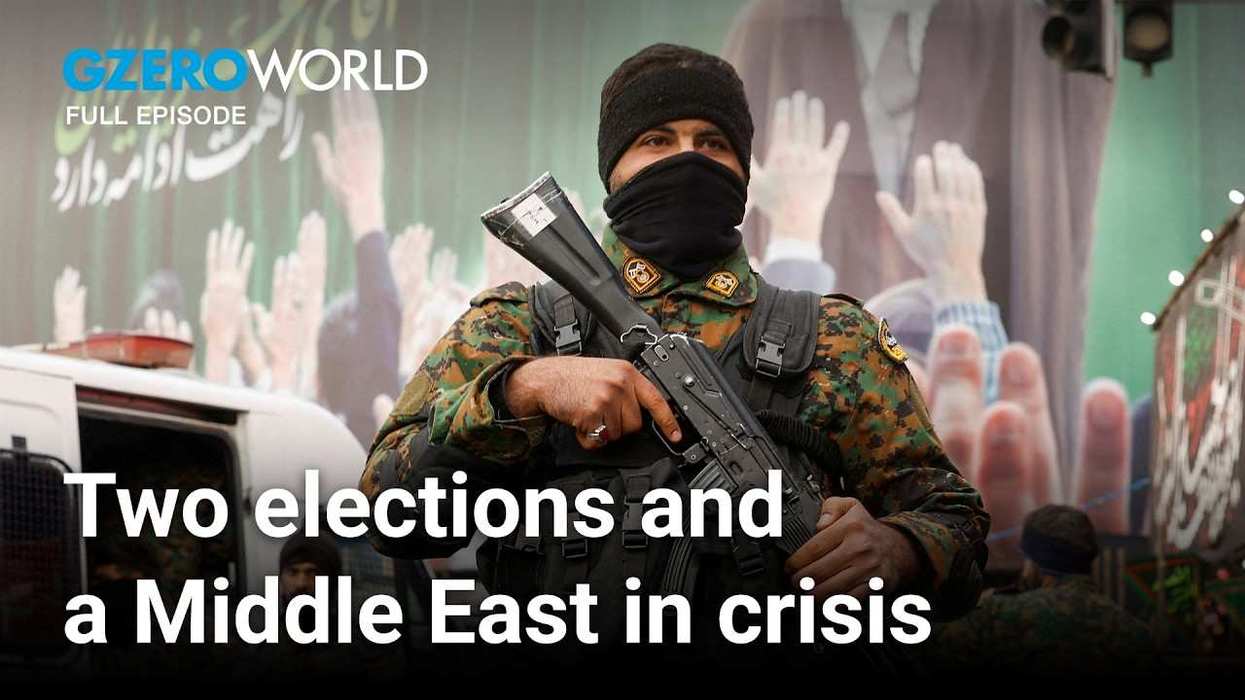
Hamas’ unprecedented terrorist attack on Israeli soil on Oct. 7 left many with two burning questions: Was Tehran behind it? And if so, would the war between Israel and Hamas expand to include Iran?
Iran had a lot to gain but even more to lose
So far, the answer to the first question appears to be no.
The day after the Hamas attack, citing Hamas and Hezbollah sources, the Wall Street Journal reported that Iran not only gave Hamas the green light but in fact helped the terrorist group plan the operation. However, a few days later the New York Times reported that Tehran was actually surprised by the attack, citing US intelligence. Washington and Jerusalem, meanwhile, have denied having hard evidence of direct Iranian involvement in the Oct. 7 operation.
The strongest argument in favor of Iranian complicity is that Iran has backed Hamas for decades, supplying it with an estimated $70 million a year in funding along with weapons, training, and logistical aid. There’s no doubt that Hamas wouldn’t have been able to carry out an operation of this magnitude without Iranian military and financial support. It’s also likely that members of the Islamic Revolutionary Guard Corps had a hand in training the terrorists who carried out the attacks. So it’s not like Iran had nothing to do with it.
However, as of now, there is no evidence tying Iran directly to this specific Hamas operation. Yes, Iranian Supreme Leader Ali Khamenei celebrated Hamas’ success, but that was to be expected irrespective of direct Iranian involvement, and he unambiguously denied Iran’s participation. The Wall Street Journal report has been broadly disputed, with certain details — such as the alleged involvement of Iran’s foreign minister, who normally has no role in coordinating military operations with regional proxies and who is under close American and Israeli surveillance — casting doubt on its accuracy. By contrast, US intelligence showing that Iranian leaders were themselves caught off guard by the attack is credible.
While it’s true that Hamas’ capabilities rely on Iranian support, the group operates with a broad degree of autonomy and has its own agenda independent of (albeit usually aligned with) Tehran’s. In fact, plausible deniability is a design feature of the proxy relationship between Hamas and Iran, allowing the latter to pressure Israel without becoming involved.
To be sure, Tehran stands to benefit from the ensuing chaos in three ways. First, the attack will keep Israel distracted and focused on domestic security concerns, temporarily limiting its ability to project power regionally. Second, the attack has for now scuttled negotiations for a Saudi-Israeli normalization deal that would have included an implicit commitment to containing Iran. And third, the attack undermines Israel’s image as a military power, while the humanitarian toll of Israel’s devastating response in Gaza will turn global public opinion against the Jewish state.
But Tehran benefitting from the attacks is a far cry from Tehran orchestrating the attacks and risking a war with Israel — and, potentially, the US — at a time when the strategic environment was getting somewhat more constructive for them. Israel had been deterred by the US from attacking Iran, and Netanyahu was distracted by domestic politics. Commercial and diplomatic ties with Beijing and Moscow were booming. Oil exports were flowing again. They had just signed a China-brokered breakthrough agreement to restore full diplomatic relations with their longtime foe Saudi Arabia. They were even days away from receiving $6 billion in frozen funds as part of a prisoner exchange with the US amid a broader de-escalation effort over the past six months. None of these actions and developments implied a desire on the part of Iran to destabilize the region.
No one is interested in a bigger fight … for now
At this point, the likelihood that Iran gets directly involved in the war seems very, very low to me — at least in the near term.
Iran has much to gain from allowing events to play out while keeping its own involvement relatively limited given the risks of disrupting its broader foreign policy strategy, which includes normalization with the Gulf states and a de-escalatory understanding with the US. Case in point: Iranian President Ebrahim Raisi had his first direct call with Saudi Crown Prince Mohammed bin Salman on the back of the attack, where they both called for short-term containment and de-escalation.
Iranian officials did warn that a full ground offensive by Israel into Gaza could elicit a response from proxies like Hezbollah, the Houthis in Yemen, and other groups in Syria and Iraq, with Quds Force commander Esmail Qaani visiting Syria, Lebanon, and Iraq to coordinate among allies. But there are no major drills or troop movements going on among its own forces, so it does not seem like Iran is gearing up for a big fight beyond training or supplying its proxies.
Absent Iranian escalation or conclusive evidence of direct Iranian involvement in the Oct. 7 operation, neither Israel nor the US will take action to expand the crisis with an attack on Iran. Israel will be focused on containing the immediate security threat from Hamas and managing the offensive in Gaza, while the US will support Israel but push back in private against any move to broaden the conflict. (The Biden administration did announce on Oct. 12 that it had “re-frozen” the $6 billion in Iranian funds previously released following significant bipartisan political pressure to get tougher on Iran, but this move was intended for a domestic audience and does not signal more escalation to come.)
Both Israel and the US will remain reluctant to broaden the conflict while the crisis in Gaza is ongoing. If Israel does retaliate against Iran, it will likely do so through covert operations (e.g., sabotage, cyberwarfare, assassinations) at a time and place of its choosing. For its part, the US has limited options to escalate beyond slapping additional (largely symbolic) sanctions on Iranian officials short of clamping down on Iran’s oil exports, which would cause a spike in the price of oil (in turn raising US inflation) and provoke a strong response from Tehran and potentially Beijing (because China refines the bulk of Iranian crude). The risk of the conflict turning into a general war between Iran and Israel and/or the US is therefore low.
In the short term, the biggest risk of the conflict escalating comes not from Iran but from Hezbollah, the crown jewel of Iran’s proxy network. For now, the Lebanon-based group — already in a vulnerable domestic position as Lebanon’s economy remains weak and its public support has suffered — seems uninterested in opening a second front in the war beyond some symbolic strikes and skirmishes along the Israel-Lebanon border. But that could change if Hezbollah and Iran become concerned that Hamas will be completely wiped out.
And if Iran feared both its major proxies in the Levant were about to be destroyed … well, there’s no telling what they might do to avert that.
___________________
🔔 Be sure to subscribe to GZERO Daily to get the world's best global politics newsletter every day on top of my weekly email. Did I mention it's free?