The war is not going well for Russian President Vladimir Putin.
And that’s an understatement.
Since launching an unprovoked invasion of Ukraine on February 24, his military has performed abysmally, failing to capture Kyiv, overthrow Ukrainian President Volodymyr Zelensky, hold onto Kharkiv, and control the entire Donetsk. His economy has been forcefully and permanently cut off from a united West, turned into a glorified gas station for China and the developing world. His country has become isolated on the global stage, shunned not just by the United States and Europe but increasingly even by friendly countries like India, China, and Kazakhstan, which resent the war’s impact on global food and energy prices and would like to see stability restored.
Last week, after Ukraine’s armed forces managed to successfully evict the Russian invaders from the northeastern region of Kharkiv in a stunning counteroffensive, I wrote that Putin was running out of good options to turn the tide of the war in his favor. This increased the odds of a Ukrainian victory but it also made the war more dangerous, because a cornered Putin would be more likely to escalate.
Want to understand the world a little better? Subscribe to GZERO Daily for free and get your daily fix of global politics on top of my weekly email.
It didn’t take Putin long to prove me right.
In a blustering speech on September 21, the Russian president ordered a partial mobilization of up to 300,000 troops, endorsed annexation referenda in four Ukrainian regions, and threatened the West with nuclear retaliation over threats to Russia’s “territorial integrity.” These are steps that Putin had purposefully avoided taking for months, and for good reason.
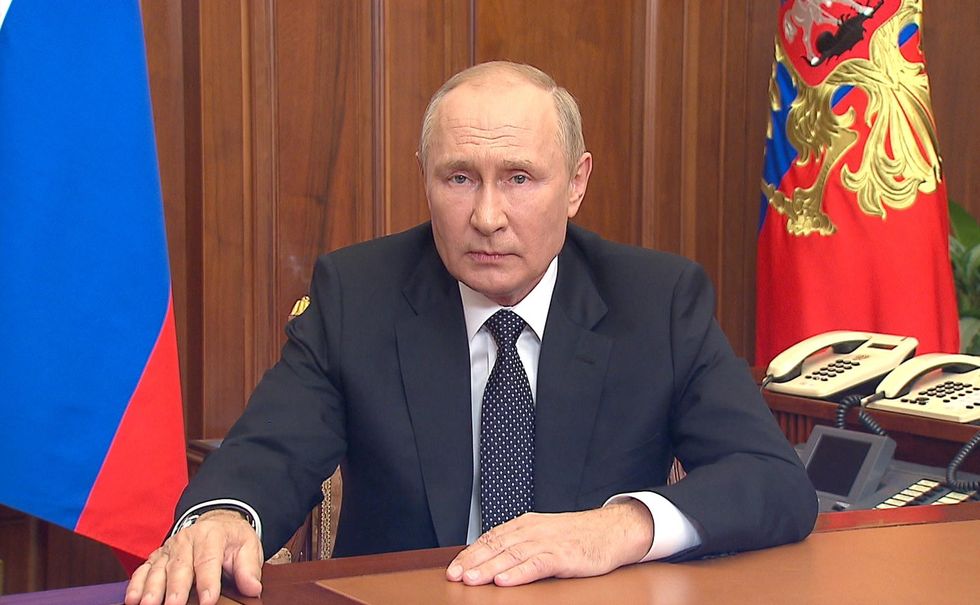 Putin addresses the nation from Moscow on September 22.Credit: Russian Presidential Press Service
For starters, according to the Russian government, this is a “special military operation”—not a war. In fact, the very act of calling it a war is still punishable by up to 15 years in prison in Russia. Moreover, all along the Russian people had been led to believe that victory was at hand, their forces overwhelmingly superior to those of the enemy.
Mobilization, whether partial or general, constitutes an undeniable admission not only that the country is indeed at war, but also that the war is going badly for mighty Russia. It makes the war “real” for the 25 million Russians and their families who have suddenly become eligible to die abroad—the vast majority of whom cared little for the conflict as long as it didn’t directly affect their personal lives. It gives every Russian a stake in the war, and a right to have an opinion about it. For these reasons, mobilization was rightly deemed by Putin as too politically costly—until the Ukrainian counteroffensive in Kharkiv.
For the first time since the war started, Russian state media is now being somewhat transparent about the situation on the ground. The military setbacks suffered by Russian forces have become too big for even Kremlin propagandists to ignore, and nationalist voices to Putin’s right are chiding the president publicly for not being aggressive enough, calling for him to do something. Accordingly, Putin has decided to bite the bullet and pay the political price of mobilization, believing it to be less onerous than the humiliation—and career risk—of defeat or capitulation.
Mobilization, however, is no silver bullet for Russia’s military woes. Yes, 300,000 is a lot more than the 190,000 troops Russia initially deployed to prosecute the invasion—and certainly more than the roughly 100,000-120,000 troops that remain on the ground after accounting for likely casualties. A build-up of this magnitude will reinforce Russia’s ability to hold its defensive lines and pose challenges to future Ukrainian counterattacks.
But it will take at least 3-4 months to draft, train, arm, and deploy these new recruits. And there’s no guarantee they will perform any better than their predecessors. In fact, given the coercive nature of mobilization and the fact that Russia’s highest-quality troops have already been exhausted, they are likely to be an even less effective, cohesive, and motivated fighting force. Russia’s newly announced stop-loss policies, which indefinitely extend the service contracts of the more experienced soldiers that are already deployed and ban them from refusing deployment, may be more effective. But these measures are sure to anger the servicemen in question, increase exhaustion, and aggravate Russia’s morale problem. On balance, mobilization is unlikely to turn Moscow’s fortunes around.
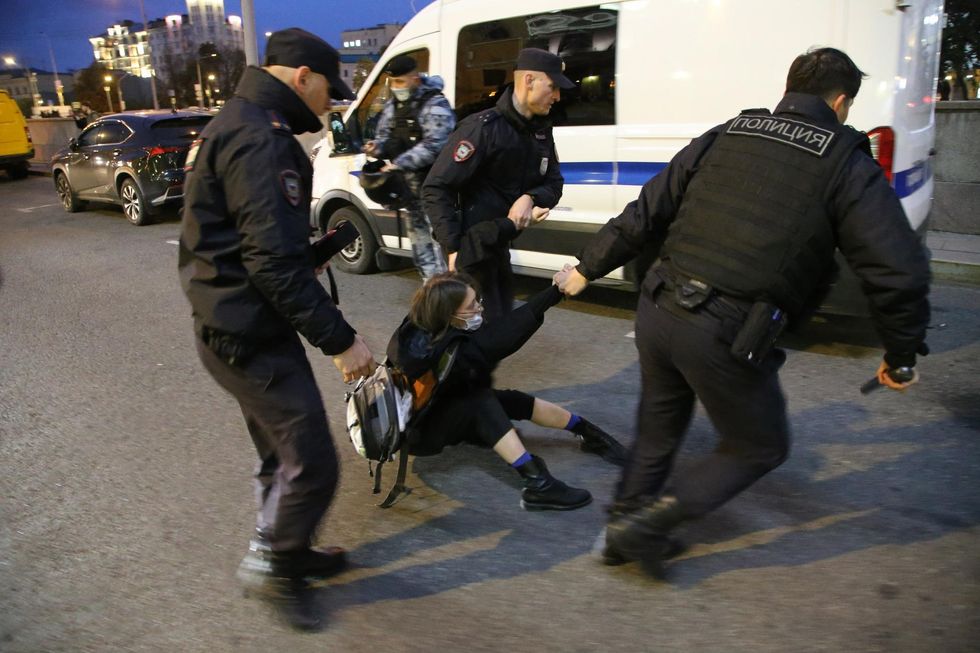 Russian police detain an anti-war protester in Moscow on September 21.Credit: Getty Images
What about the referenda announcement?
It’s a fig leaf for Russia to formally annex even more Ukrainian territory than it has illegally occupied since 2014. Making these lands officially Russian, the thinking goes, can deter Western support for continued Ukrainian fighting in “Russian territory”—which Putin has vowed, in no uncertain terms, would be met with nuclear retaliation.
The problem for Putin is that no one is buying it. The U.S. has already rejected the referenda as illegitimate, as has the European Union. Instead of halting their support for Ukraine they are increasing it, and sanctions against Russia are being stepped up. Russia’s economy will shrink by about 6% this year, and next year’s contraction will be much worse.
Putin claims he’s not bluffing, of course. But he had also promised military consequences if Finland and Sweden joined NATO, and that’s turned out to be a bluff. The Ukrainians have hit Crimea already—they have even hit Belgorod, which is in Russia proper—yet the Russians haven’t escalated with weapons of mass destruction.
Paradoxically, all of this makes this war more dangerous, not less. An increasingly isolated, impoverished, and cornered Russia is a Russia with increasingly little to lose. That’s a scary prospect for the world.
🔔 Don't forget to subscribe to GZERO Daily and get the world's best global politics newsletter every day PLUS a weekly special edition from yours truly. Did I mention it's free?