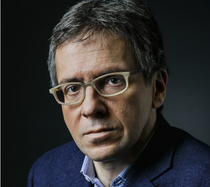
Economic Forum (WEF). This is the first time the annual gathering of world leaders, CEOs, and public figures takes place in the spring (no snow boots!), courtesy of Omicron. It’s also the first in-person forum since the pandemic hit in January 2020, and it couldn’t be happening at a more critical moment for the world.
Indeed, the theme of this year’s meeting is “History at a Turning Point,” and what a turning point it is. From Covid-19, climate change, digitalization, and deglobalization to the war in Ukraine, slowing global growth, surging energy prices, and a looming food crisis, this is the most crisis-rich backdrop to a World Economic Forum I’ve ever seen.
Want to understand the world a little better? Subscribe to GZERO Daily by Ian Bremmer for free and get new posts delivered to your inbox every week.
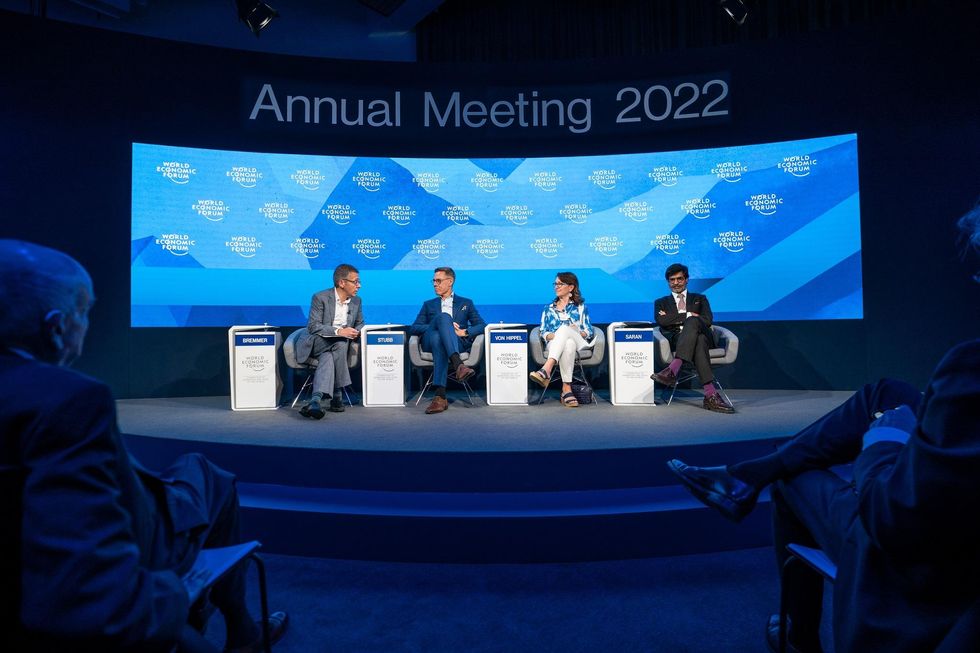 Me moderating a panel titled "Russia: What's Next?"Source: World Economic Forum/Sikarin Fon Thanachaiary.
Why are we seeing so many converging crises at the same time?
Largely, I think it’s because we are in a geopolitical recession—a moment in history when nobody (not the U.S., not the G7, not the G20) is driving the bus—where many of the reigning global institutions are increasingly not aligned with the geopolitical balance of power. The United Nations Security Council, NATO, the World Trade Organization, the World Bank, the International Monetary Fund—all of these institutions were the product of a bipolar world forged atop the ashes of World War II.
The balance of power has shifted since—from the collapse of the Soviet Union and the rise of China to the end of the U.S.-led order—but institutions haven’t adapted. That’s why Germany and Japan, two wealthy, dynamic, free-market democracies with governments strongly committed to multilateralism and the rule of law, don’t have seats at the UN Security Council...while Russia does.
As a result of this vacuum of leadership and growing misalignment, the global architecture is no longer fit for purpose, and instead of global cooperation, we get every nation for itself. That makes crises more likely to emerge and the world less capable of responding to them.
Of all the Davos gatherings I’ve attended—and I’ve been coming since 2008—this is by far the one that is most being driven by geopolitics. Helle Thorning-Schmidt, former Prime Minister of Denmark, echoed this feeling during a Global Stage livestream conversation hosted on Monday by GZERO Media and Microsoft. Business leaders are starting to realize that they have no choice but “to engage in geopolitics,” she rightly noted.
Back in 2009, the first or second time I came to Davos, there was a massive sense of crisis, too. But everyone attending at least felt like they understood the playbook, the tools we had to respond to it. This time is different. People know there are massive crises brewing, but they don’t really know what the second- and third-order consequences will be, and they sure don’t know how to deal with them.
At the top of the agenda this year is the war in Ukraine and its many cascading effects. Everyone at Davos is worried about it, and for once, most everyone at Davos (though certainly not globally) is on the same side of the conflict. There’s a lot of consensus around Putin needing to be stopped and Ukrainians deserving all the help we can give them. But that’s where the unity ends. How does the conflict end? Can the Ukrainians actually win? Does that require humiliating the Russians? Or does Putin need to be offered an off-ramp? On those questions, there’s no agreement whatsoever.
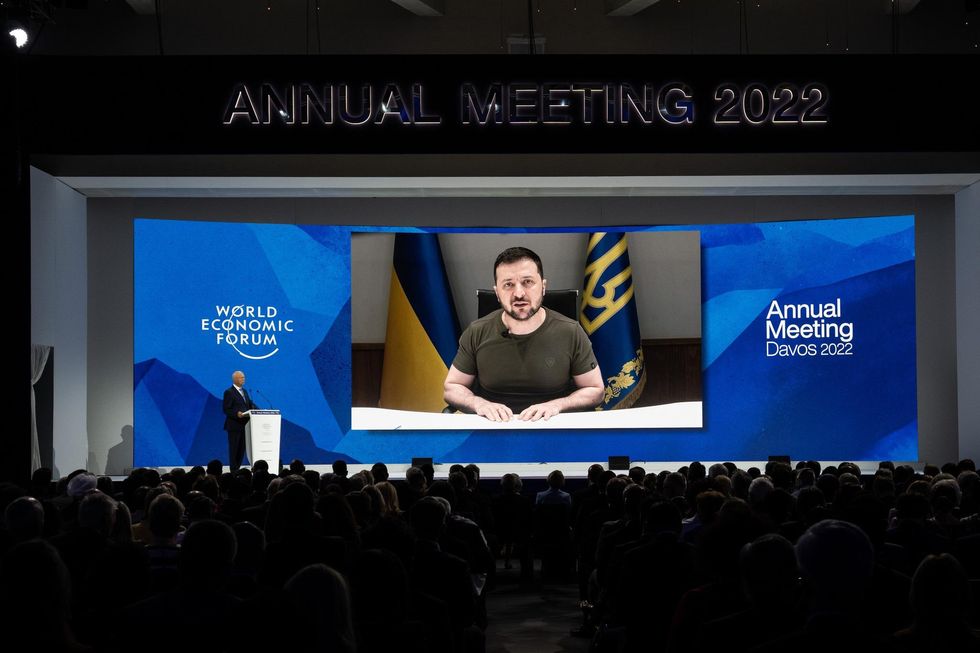 Ukrainian President Volodymyr Zelensky addresses Davos via video.Source: World Economic Forum/Sikarin Fon Thanachaiary.
As for the outlook for the conflict, the pessimists (like me, on this one) think the fighting will continue, albeit at lower levels of intensity than we’re seeing now. The optimists think the fighting can stop, albeit not definitively. Either way, everyone agrees on at least three things: (1) a negotiated settlement is a remote possibility, (2) there’s no stable equilibrium in sight, and (3) the United States and its advanced industrial allies are in a cold war with Russia (veering on hot, if you count cyber, disinformation, and espionage).
This decoupled environment is far from the globalist ideal the World Economic Forum has been committed to for 50 years. A case in point is the fact that there are no Russians in attendance at Davos: no business leaders, no delegates, no government officials. The “Russia House,” a building in this mountain town that used to serve as an outpost for Russian oligarchs and officials, has been turned into the “Russian War Crimes House,” an exhibit of images depicting the atrocities committed by Russian forces against Ukrainian civilians.
🔔 And if you haven't already, don't forget to subscribe to my free newsletter, GZERO Daily by Ian Bremmer, to get new posts delivered to your inbox.