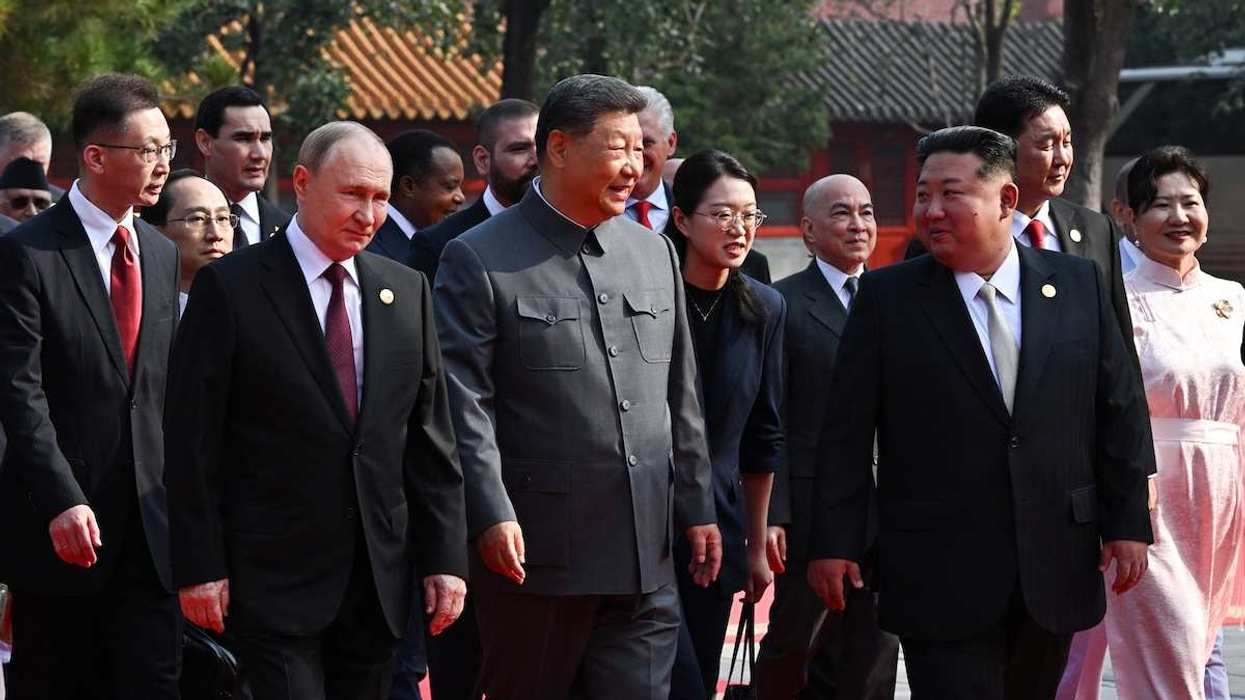
This past week has seen the most dramatic escalation of the war in Ukraine since Russia’s initial invasion on February 24. It comes directly on the back of Russian President Vladimir Putin meeting with his last remaining important friends on the global stage—the leaders of China, India, Kazakhstan, Turkey—all of whom directly pressured him in private and in public to end the war.
What did Putin do in response? He escalated.
Want to understand the world a little better? Subscribe to GZERO Daily for free and get your daily fix of global politics on top of my weekly email.
Putin called up a minimum 300,000 additional conscripts in a mobilization that he’d been avoiding for months because he knew how unpopular it would be at home.
He announced the formal annexation of four Ukrainian regions—Donetsk, Luhansk, Zaporizhzhia, and Kherson—containing some 7 million people and comprising about 15% of Ukraine’s territory, and took their future status off the negotiating table.
He warned that any military incursions or strikes into these illegally annexed regions would be considered attacks on the Russian homeland and hinted that they would be met with potentially nuclear retaliation, even though Russia didn’t completely control these regions at the time of annexation and there are still active hostilities going on there.
It’s likely he ordered the sabotage of the Nord Stream 1 and Nord Stream 2 gas pipelines to Europe last week—something the Kremlin denies responsibility for but NATO members are convinced (albeit with only circumstantial evidence to date) the Russians were behind.
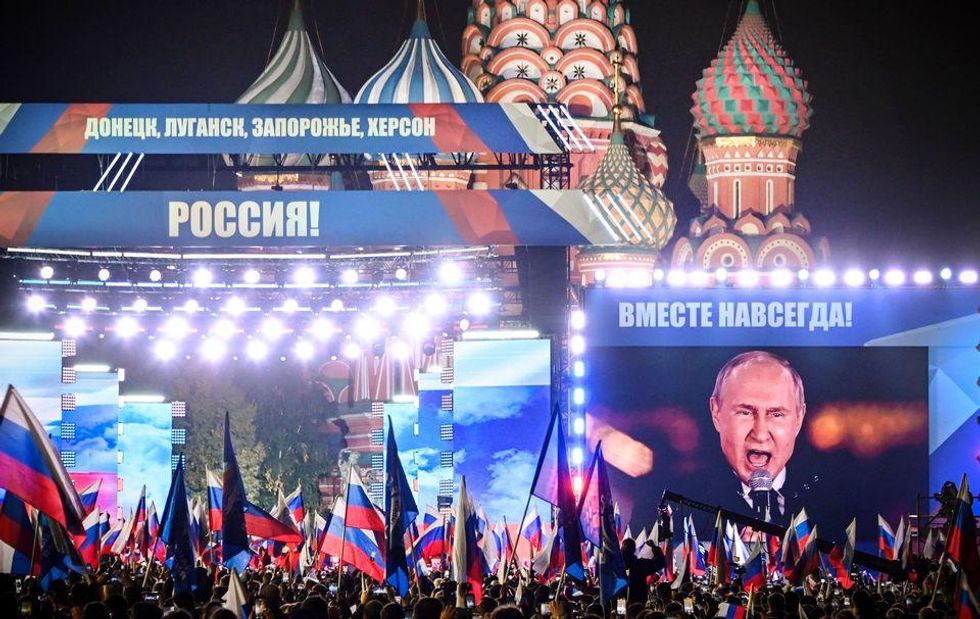 Putin addresses a rally at Red Square marking the annexation of Ukrainian territory on September 30.Alexander Nemenov/AFP via Getty Images
Yet these escalatory actions have neither meaningfully improved Russia’s chances on the battlefield, made a dent in Ukraine’s resolve to win the war, nor weakened the West’s support for Kyiv.
In fact, over the last week Ukrainian forces have made significant advances in both eastern and southern Ukraine, pushing Russian troops out of strategic cities in Luhansk, Donetsk, and Kherson regions—three of the four illegally annexed Ukrainian territories. These losses add to the more than 2,000 square miles that Ukraine had recaptured in the Kharkiv region in mid-September, even forcing the Kremlin to admit that the self-declared borders of the Kherson and Zaporizhzhia regions—and, therefore, the claimed borders of Russia itself—have yet to be determined.
Russia’s humiliating battlefield setbacks have prompted rare public criticism from even Putin’s closest cronies and confidants. The shambolic mobilization effort, meanwhile, has been met with nationwide protests and stinging rebukes by even Russian state media. Between 200,000 and 700,000 Russians have fled the country to dodge the draft.
For his part, Ukrainian President Volodymyr Zelensky responded to Putin’s escalation by abandoning his past offer of neutrality, signing a request to NATO for fast-track admission to the alliance (which he won’t get but is nonetheless symbolic), and declaring negotiations with Putin an “impossibility.”
The United States and the United Kingdom have already issued new sanctions, and European Union leaders will unanimously agree on an eighth round of sanctions as soon as this Friday, likely including a price cap on imports of Russian oil. The U.S. has also announced a new $625 million arms package including the provision of 4 more HIMARS rocket launchers, on top of the $1.1 billion in security aid and 18 HIMARS announced last week.
In the coming weeks, Ukraine is poised to make additional battlefield gains, especially in the strategic Kherson region. How will Putin respond to further losses of “Russian” territory now that he has publicly committed to defending it by any means necessary?
His troops are incapable of turning the military tide, no matter how much cannon fodder he continues to throw into the meat grinder. He has made negotiations with the Ukrainians a non-starter. And he doesn’t seem prepared to simply take the loss and move on.
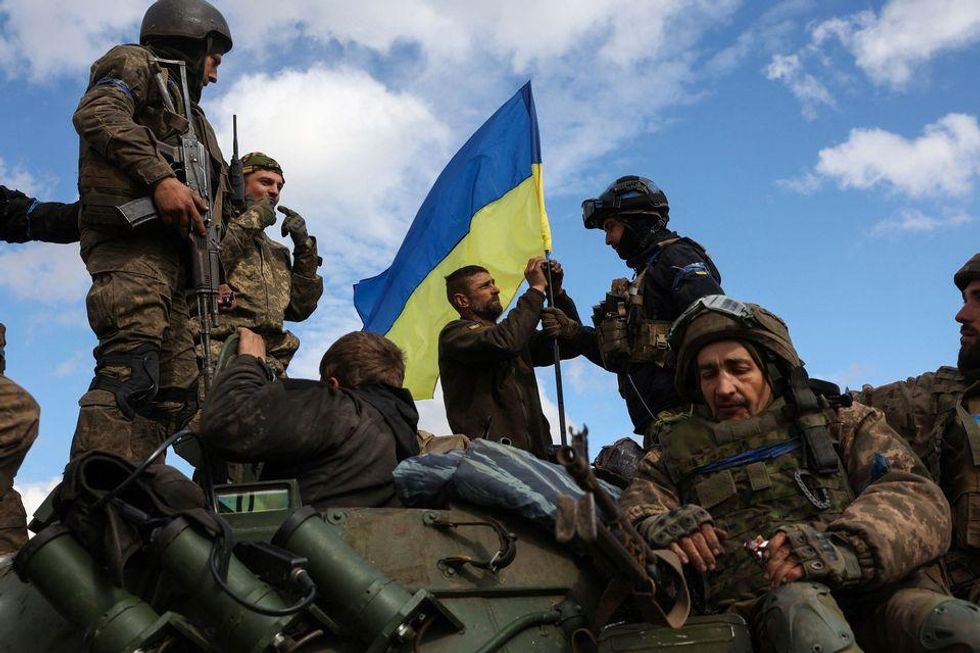 Ukrainian soldiers raise the national flag near Lyman, Donetsk region on October 4.(Anatolii Stepanov/AFP via Getty Images)
But what other options does he have?
He can and almost surely will cut off all the remaining gas to Europe, in the hopes that the economic and political pain of a tough winter will create divisions and undermine support for Ukraine. But that’s not going to work: the Europeans (and, indeed, all of the allies) have held together incredibly tightly in response to previous Russian escalations, and they are now fairly well-prepared to survive this winter without Russian gas while avoiding severe rationing.
Similarly, he could lash out against Ukraine’s Western supporters by launching asymmetric attacks on NATO members (e.g., cyberattacks, drone or missile strikes on military depots or supply lines). Indeed, Putin’s September 30 speech and Russian state media have been laying the ground for this type of escalation, framing the conflict not as Russia vs. Ukraine but as Russia vs. the collective West. But Putin knows that an attack on NATO would automatically expand the war and trigger direct U.S. military intervention, no doubt precipitating Russia’s total defeat.
That’s why we have to take the nuclear threat seriously: Putin is increasingly boxed in, with no good military, diplomatic, or economic options to turn the tables. He’s losing badly on every front, and in seven short months Russia has gone from China’s most important partner on the global stage to a bigger Iran—a global pariah. Is it possible Putin views nukes, the ultimate game-changer, as the only move he has left?
The White House certainly believes this is a real possibility, and they have explicitly warned Putin that the U.S. would respond to nuclear use by directly attacking Russian troops and military assets on the ground in Ukraine. That would of course turn the current cold/proxy war between Russia and NATO into a full-fledged hot war between nuclear-armed powers.
Everything possible has to be done to avoid that. Unfortunately, while the United States and its allies have proven to be very effective at punishing the Russians and supporting the Ukrainians, they have been incapable of deterring Putin’s behavior. Despite all the actions taken by the West in the last 7 months, he has continued to escalate. It is now clear that at the end of the day, the decision to deploy nukes is up to Putin, and there’s little anyone can do to change that.
I still think it’s very unlikely that the Russians would actually use nuclear weapons on the battlefield. But it’s much more likely now than it was a couple of months ago, and the more desperate Putin gets, the more plausible this scenario becomes. The war is becoming more dangerous.
🔔 Don't forget to subscribe to GZERO Daily and get the world's best global politics newsletter every day PLUS a weekly special edition from yours truly. Did I mention it's free?