Search
AI-powered search, human-powered content.
scroll to top arrow or icon

Jacinda Ardern on the Christchurch Call: How New Zealand led a movement

During a Global Stage livestream conversation hosted by GZERO in partnership with Microsoft on the sidelines of the UN General Assembly, the former New Zealand Prime Minister Jacinda Ardern revealed that when she reached for her phone to share the heartbreaking news of the Christchurch massacre, she found a horrifying surprise: A livestream of the massacre served to her on a social media platform.


For a period of 24 hours, copies of the footage were uploaded to YouTube as often as once per second, spreading the 17-minute massacre faster than tech companies could shut it down.

The experience drives her work at the Christchurch Call, combating online extremism and working with government and civil society to build guardrails against the exploitation of technology by extremists, , she explained during a Global Stage livestream conversation hosted by GZERO in partnership with Microsoft on the sidelines of the UN General Assembly.

Watch the full Global Stage Livestream conversation here: Hearing the Christchurch Call
More from Global Stage

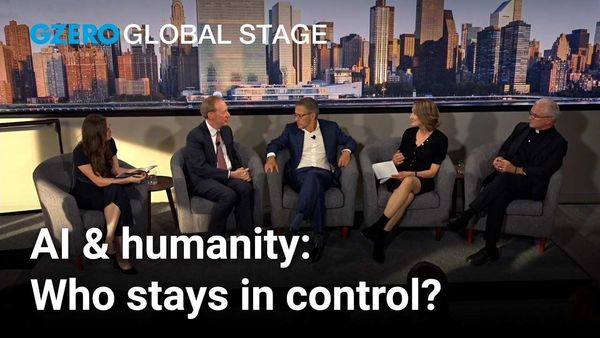
Can we use AI to secure the world's digital future?

How do we ensure AI is safe, available to everyone, and enhancing productivity? It’s a big topic at this year’s UN General Assembly. That’s why GZERO’s Global Stage livestream brought together leading experts at the heart of the action for “Live from the United Nations: Securing our Digital Future,” an event produced in partnership between the Complex Risk Analytics Fund, or CRAF’d, and GZERO Media’s Global Stage series, sponsored by Microsoft.

Is the Europe-US rift leaving us all vulnerable?

As the tense and politically charged 2025 Munich Security Conference draws to a close, GZERO’s Global Stage series presents a conversation about strained relationships between the US and Europe, Ukraine's path ahead, and rising threats in cyberspace.

Can we rebuild the Internet for democracy?

At the 2026 Munich Security Conference, entrepreneur and Project Liberty founder Frank McCourt makes the case that the internet, and the AI systems rapidly reshaping it, must be redesigned to serve people, not platforms.

Ian Bremmer: The US–China AI space has “Zero Trust”

China was largely absent from the core conversations at the 2026 Munich Security Conference. That, says Ian Bremmer, is telling.

Why countries are picking their own alliances

At the 62nd Munich Security Conference, Parag Khanna, founder and CEO of AlphaGeo, says globalization isn't dead, it's evolving. Speaking with GZERO’s Tony Maciulis, he explains that countries are forming flexible alliances that expand and shrink based on their interests. “You’d rather be in the tent...if it suits your interest than not in it,” Khanna notes, highlighting how the US, Europe, and Asia are adapting to shifting global priorities.

What does “sovereign cloud” really mean?

Sovereignty has become one of the most powerful, and least defined, words in tech policy. At the 2026 Munich Security Conference, SAP global head of government affairs, Wolfgang Dierker, explains why governments and enterprise customers are demanding more control over their data, cloud infrastructure, and AI systems amid rising geopolitical uncertainty.