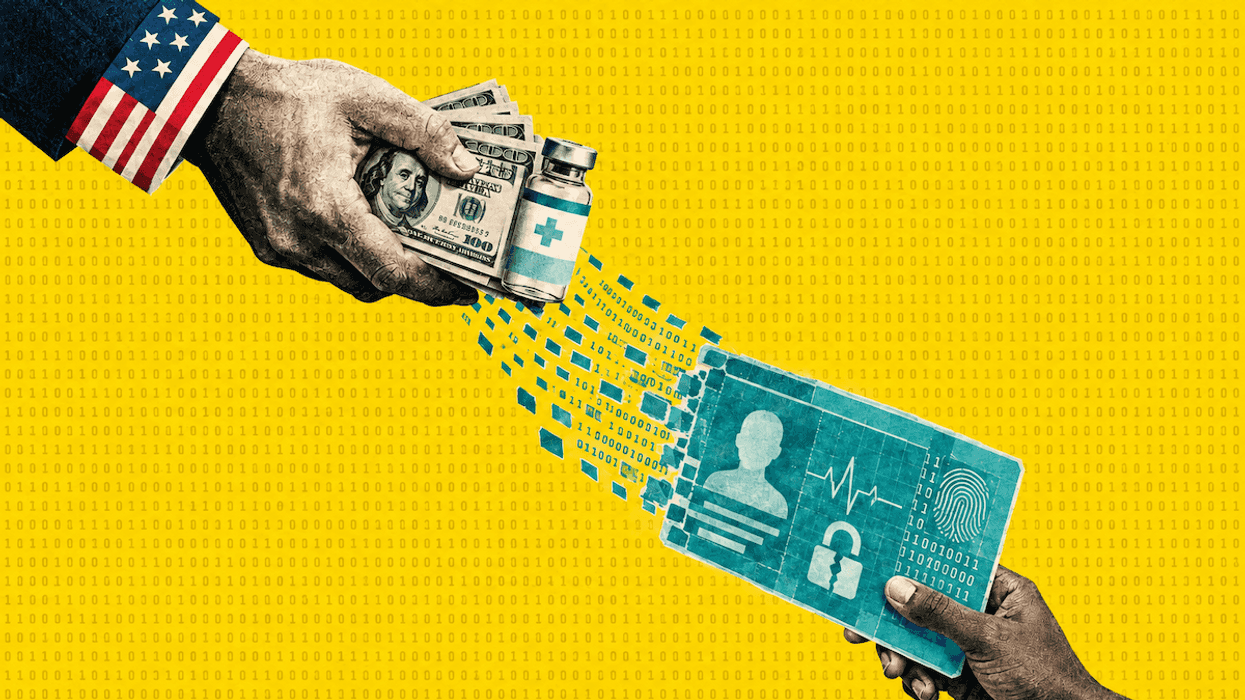
Unregulated chemicals are entering the United States from China and being injected into Americans’ bloodstreams. No, not fentanyl. We’re talking about peptides, which are short chains of amino acids that regulate hormones and spur changes in the body. Their rise, often dubbed the “biohacking” boom, has been spurred by the success of the weight loss drug Ozempic and influencers peddling their experimental peptide stashes online. But at its core, it's a story about China’s advantage in pharmaceutical manufacturing, declining trust in American institutions, and a political culture that treats self-experimentation as freedom.
US customs records show that American imports of hormone and peptide compounds from China nearly doubled in 2025, climbing to $328 million in the first nine months of the year, compared to $164 million the year prior. They are normally injected using a needle and a syringe into the abdomen, thigh, or upper arm. They can also be bought everywhere from the online Chinese retailer Temu, telehealth clinics like Hims and Hers, directly from Chinese factories, to “peptide raves” in Silicon Valley. Their market spans ideologies, from affluent tech bros in San Francisco, to looksmaxxing influencers on social media, to supporters of the Make America Healthy (MAHA) movement.
While many peptides are naturally occurring in the body, they can also be altered to induce more radical changes. Some of the most popular peptide products are Ozempic and Wegovy, which have revolutionized the weight-loss market by replicating a naturally occurring hormone that signals the body to eat less. But the popularity of these products, known as GLP-1s, has led people to experiment with other peptides like BPC-157 and TB-500, which are believed to be able to speed up injury recovery by encouraging the formation of new blood vessels, improve sleep, and even darken the skin without stepping into the sun.
With the exception of GLP-1s, many peptides are unregulated, untested by the US Food and Drug Administration, and sourced from upstart telehealth “wellness clinics” – many of which do not require a meeting with a real doctor. You can take a quick survey on a telehealth platform to get prescribed, or even turn to Reddit or Discord for ways to source peptides directly from factories in China – the so-called “gray market” where the products are sold for cheap directly from the original source.
How did China become a peptide powerhouse? In the same way it became the world’s second largest producer of pharmaceuticals. Despite leading the pack, the US is still “highly dependent” on China for production, according to Eurasia Group geostrategy and healthcare expert Jasmine Choi. This is because Beijing is the world’s largest producer of “key starting materials,” or KSMs – the chemical building blocks that later become active pharmaceutical ingredients in all kinds of different drugs, including peptides.
Today, 13% of all US drugs are manufactured in China, but that number jumps to 47% if you include that the biggest supplier of drugs to the US, India, is also heavily reliant on China for its KSMs, with some estimates reaching as high as 80% reliance. “I would ballpark somewhere between 40 to 80% in terms of US reliance on Chinese medicines as a result of their KSM dependence,” approximates Choi.
The story of how China came to dominate the pharmaceutical industry is similar to how it became the dominant manufacturer in a multitude of industries. In 1978, under China’s former leader Deng Xiaoping, the government provided subsidies for local provinces investing in industrialization, encouraging them to build supply chains from the ground up. For pharmaceuticals, this progression meant beginning with the simple compounds that go into drugs, or KSMs, and they have been climbing up the supply chain ever since. So China has a lot of the simple stuff, like peptides, to go around. As a result, some consumers are finding that it's much cheaper to cut out the middleman of American drug companies and source their peptides directly from Chinese manufacturers.
The trend comes as disenchantment with institutions is soaring domestically. Confidence in the agencies like the CDC and FDA has fallen to record lows since the COVID-19 pandemic, with many citing long drug approval times and the influence of money in the pharmaceutical industry as the cause. Peptides appeal in part because they promise control – over weight, sleep, skin, focus, and even signs of aging, without waiting for a seal of government approval from the FDA. But the approval process is slow for a reason: drugs are tested over time, across populations, and for side effects that may not show up immediately. “Many people taking unregulated peptides won’t see any potential side effects for years,” says Choi.
That skepticism toward regulation has reached the highest levels of government. Health Secretary Robert F. Kennedy Jr., a skeptic of vaccines and public health mandates, has embraced peptides. On Joe Rogan’s podcast in February, he said that he has used the peptides to heal injuries “with really good effect” and was pushing for the FDA to approve more of them in the future. His brand of medical libertarianism – the belief that health decisions belong to the individual, not the state – helps explain why he and some Americans cast doubt on tested vaccines and embrace experimental peptides with far less evidence. As one health law professor, Lewis Grossman, put it in the health and medicine publication STAT, it reflects a broader conviction: “I should be allowed to take anything I want.” In that worldview, self-experimentation isn’t recklessness, it’s medical freedom.
Where will the peptide industry go from here? For now, upward. The peptide market currently stands at an estimated $141 billion, but is expected to grow to over $300 billion by 2033, driven by massive pushes from pharmaceutical companies like Novo Nordisk and Eli Lilly. GLP-1s have normalized the idea that injectable treatments can be lifestyle products, and online communities have made it easier than ever for consumers to swap tips about suppliers and dosing regimens outside the formal healthcare system. As long as peptides remain cheaper through gray-market channels, and trust in regulators remains weak, demand is likely to grow.
The US is hardly the first country with a fixation on physical self improvement, but it may be the first to chase it through chemical self-engineering. The bigger question is whether peptides remain a niche biohacker obsession or become a broader political issue, either towards easier access or stricter regulation.
Right now, the political momentum is towards speeding up the FDA’s approval of more peptides, as those experimenting on themselves tout the positive benefits they are experiencing. If that continues, Americans may have to reckon with how their newfound medical miracle is made in China.