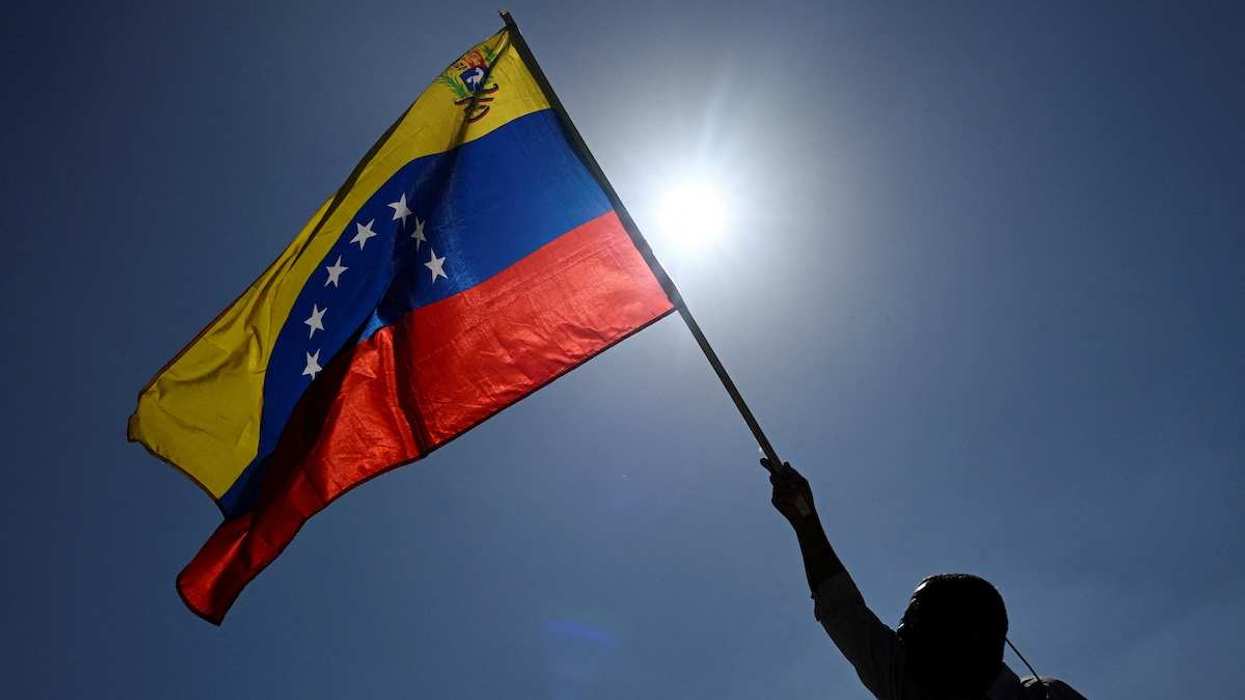
Since last weekend, Washington’s tutelage over Venezuela’s regime after the capture of autocrat Nicolás Maduro in January produced its clearest step yet toward an actual democratic transition: a US-brokered negotiation between the government and a slice of the opposition, opening what could be the first credible path to competitive elections in years.
The talks are less a summit than a scaffolding – a bid to rebuild the country’s institutions, settle who can legally speak for Venezuela abroad, and fix an electoral calendar. And it advances without the opposition’s widely popular leader and 2025 Nobel Peace Prize laureate, María Corina Machado, at the table.
That negotiation officially kicked off on August 1 without the formal table many expected: it began with a phone call between the heads of Venezuela's two rival National Assemblies. On the government side sits chief negotiator Jorge Rodríguez, interim president Delcy Rodriguez’s brother and head of the Chavista-controlled legislature – part of the political movement founded by Hugo Chavez and now led by Delcy, elected last year under widely disputed conditions following a massive electoral fraud in 2024. On the opposition side, congresswoman Dinorah Figuera chairs the delegated commission of the opposition’s National Assembly elected in 2015 – the last parliament widely recognized as competitive, which has kept operating from exile despite the official end of its term, as an institutional counterweight ever since. The two agreed on an agenda with “clear and verifiable goals” and had their first face-to-face this Thursday in Caracas.
Figuera's return to Caracas doesn't look like an isolated move but part of something more structured. As she landed, she said she came “at the invitation of the United States,” a phrase that captures the breadth of American tutelage since January over both Chavismo and the opposition. Everything suggests Washington is laying the groundwork for phase three – transition – of its Venezuela roadmap: a stage focused on negotiating the restoration of political institutions.
Each side is fielding five main negotiators and support teams. Jorge Rodríguez leads a government team of ministers and Chavista figures close to Delcy Rodríguez. Figuera heads an opposition delegation drawn from little-known lawmakers from two opposition parties that are part of the Democratic Unitary Platform (PUD), the main opposition coalition which is aligned with Machado and favors a clean institutional break with the Chavista system.
But Machado, whose relationship with the Trump administration has soured as the US cozied up with the Rodriguez regime, was not summoned to the main table – nor was Edmundo González, Machado’s ally who is widely considered as the actual winner of the 2024 presidential elections – though she said she “will not be an obstacle” to the talks.
In some ways, this Washington-backed initiative torpedoes the proposal set out in Machado’s Panama Manifesto, where the opposition coalition formally positioned Machado as the political head of any eventual transition negotiation – something Figuera has tried to balance by insisting her process is an institutional negotiation distinct from the political one. Nevertheless, the negotiations probably end up benefiting Machado, even though she did not design it and her team is not coordinating it.
The agenda covers relief for victims of the recent double earthquake, “strengthening democracy,” and “political rights and guarantees.” A negotiation between the two assemblies could therefore yield agreements on a new National Electoral Council (CNE), the steward of elections in the country, and even open the door to bargaining over other key bodies, like the country’s highest court – whose independence is widely questioned. It could also lead to the legalization of opposition parties and reverse the ban on opposition candidates from running, including Machado, as well as guarantees for Venezuela’s highly-censored press. The process is expected to yield results before year’s end.
The underlying logic points to a new electoral cycle in 2027, though Chavismo seeks to push presidential elections toward 2028 – a calendar friendlier to its room to maneuver and less exposed to the coercive weight of the Trump administration. Secretary of State Marco Rubio, for his part, said Venezuela must eventually hold legitimate elections at every level of government, while insisting the economy has to be stabilized and rebuilt first while defining Washington's role as that of a “facilitator.”
But skepticism remains high in Venezuela, where at least a dozen previous rounds of negotiations have failed to ensure a democratic transition in little over a decade. The process risks “repeating the most common mistake of the past few years of negotiations,” says journalist and electoral expert Eugenio Martinez, “Focusing the talks exclusively on the electoral question could prove a strategic error. A transition also requires discussing how power is redistributed – and how agreements are actually enforced.”
There’s also a less visible but equally important issue: money and assets. A central aim of the process would be to resolve the legitimacy problem of the Caracas-based Assembly, a recurring worry among foreign investors. Machado herself has stressed the point in talks with investors circling the country. Without a clear, recognized institutional counterpart, economic reconstruction gets far harder – and any business deal could be flatly void.
That is especially relevant for the legal representation of Venezuelan assets abroad, including litigation tied to state-owned oil firm PDVSA’s debt and, above all, CITGO: a PDVSA subsidiary in the US currently facing a legal dispute with debtors. Facing new licenses and potential restructurings, markets need to know who holds legitimate authority to represent the Venezuelan state. Distrust in the Chavista-controlled institutions has stalled the massive investments on Venezuela’s oil sector promised by Trump earlier this year.
Adding urgency to a transition are the twin earthquakes that hit Venezuela on June 24, killing thousands and destroying the coastal city of La Guaira. A survey by local pollster More Consulting taken after the quakes registered Delcy Rodríguez’s accelerating erosion: her approval as head of state has dropped 30 points since January, sitting at 16.2%. Machado, by contrast, hasn't slipped since February – holding above 45% positive and even ticking up a couple of points last month. More Consulting also describes a national mood swing from hopeful after Maduro’s capture to frustrated and worried, with many now casting themselves as “expectant critics.”
But the impact is not only affecting Rodríguez’s grip on power. Another local pollster, Poder & Estrategia, recently found that a plurality of Venezuelans no longer reads Washington’s role as “tutelage” but as “submission” – with the US shifting “from hero to increasingly questioned,” according to the firm's founder Ricardo Ríos.
Washington, for now, is content to keep steering. In an August 3 statement, spokesperson Tommy Pigott welcomed the August 1 declarations from both the Assembly led by Figuera and the interim government, backing “Venezuelan-led efforts” on earthquake relief, democratic institutions, and political freedoms. He framed them as feeding its three-phase plan toward “a transition to democratic elections.”
What may be taking shape, then, isn't just another round of political dialogue. It is a hybrid mechanism to solve three problems at once: the deficit of institutional representation, the tangle of the country’s external assets, and the runway to a future electoral transition to reestablish Venezuela’s democracy. Whether it delivers on any of them is the question the negotiators in Caracas – and their tutors in Washington – will now begin to answer.