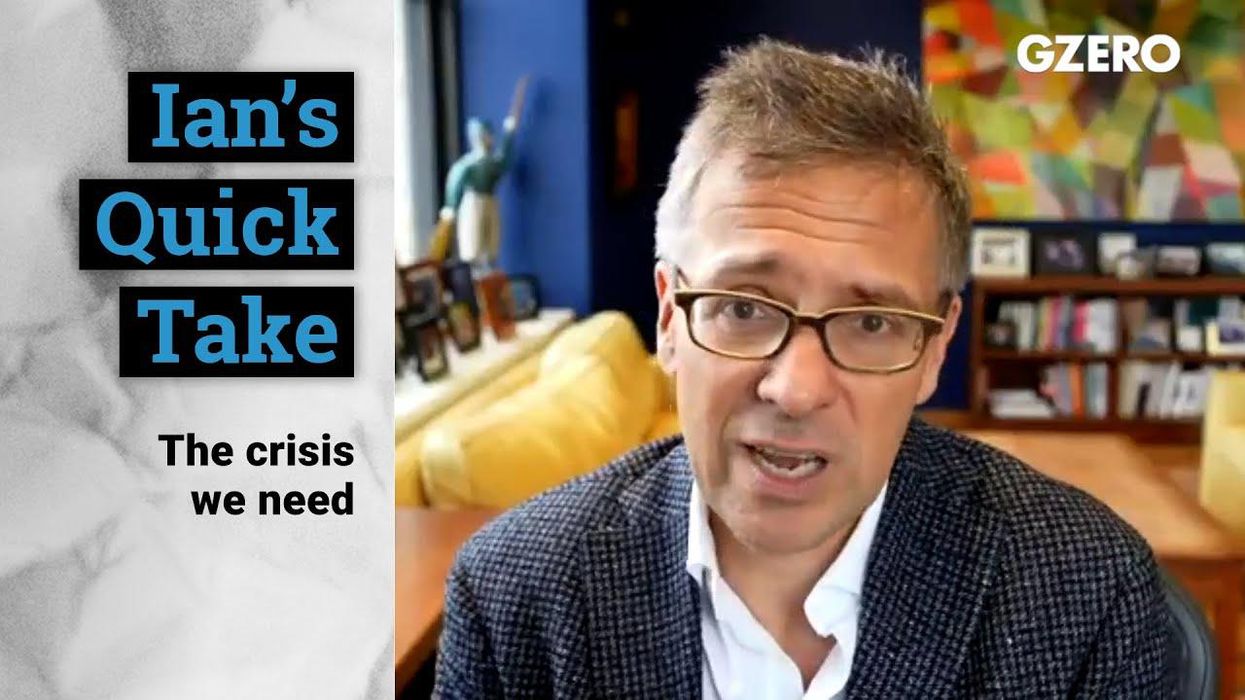
Ian Bremmer: power of the "Goldilocks crisis"
May 16, 2022
Global Stage LIVE from United Nations WATCH REPLAY
Ian Bremmer, political scientist and president of Eurasia Group and GZERO Media, shares insights on global political events.
Presented by

Ian Bremmer's Quick Take: Hi everybody, Ian Bremmer here. I have a Quick Take to kick off your week. And this week, you know what's coming. It's my new book. It's called The Power of Crisis. It is right here and it's coming out tomorrow. I certainly hope you'll get a copy.
But I thought I'd tease you with some of the big arguments that I'm trying to make in this book, because it's no surprise, this is a target rich environment for global crises. We've gotten through this two plus year pandemic. Now, it's still a huge problem in China and North Korea. We've got a new Cold War with the Russians, the invasion of Ukraine and confrontation with NATO. We've got climate change and over a billion Indians suffering massive heat stress, and that's only going to get worse going forward.
We also have disruptive technologies, which are increasingly hard to contain and in the hands of rogue states and even non-state actors, and what are we going to do about that? This is a book that is not saying the wheels are coming off. It's not saying the sky is falling, but rather it's saying, how do we take advantage of these crises to deal with a world that has become more anxiety inducing? And indeed made a lot of people feel like we're stuck, and the outcomes are inevitable and governments are never going to work.
I think that there's a much more hopeful way of looking at the world today. It is that these crises are creating not only the opportunities, but in many cases already the reality, that we're seeing much more collaboration, much more action, to not only respond to the crises themselves, but also to rebuild and revitalize our political institutions, our architecture, the way the world works. And that absent these crises, we were going to continue to just see incremental erosion. So indeed, as painful as the crises are, there ends up being a very significant silver lining to them.
That's what the book is about. And the book ends with what I'm going to start with, which is Russia. Because I had to put this book to press on February 28th, which was four days after Russia invaded Ukraine. I could only write quickly about that, but it's so obvious that we are taking advantage of the Russia decision to invade Ukraine.
And there are a couple of reasons for that. One is that pretty much everyone in the West, in the advanced industrial democracies, including the divided United States, agrees that this is a very serious crisis and we need to respond to it. And agrees on what kind of a crisis it is, that Putin is at fault, that he invaded an innocent Ukrainian country. He tried to take out that government and forcibly change their borders, and none of us are up for that.
So, there aren't two sides of this argument in NATO, for example. And furthermore, the farther the crisis goes, the longer it proceeds, the more we are nudged into recognizing that that was the right decision. And we need to do more, that our priors are being confirmed on the Russia-Ukraine crisis.
And what do I mean by that? Well, first of all, that the scale of the crisis increasingly isn't just about Ukraine, but it's Russia versus NATO. And the necessity of the Europeans spending more in defense, the necessity of NATO and other allies being more coordinated in their responses are very great. The fact that it is obvious that this isn't just about avoiding "genocide for the Russians in Southeast Ukraine", but the war crimes that are happening, the torture, the rape surrounding Kyiv, proving that this is a threat that needs an urgent response.
And the fact there is such a massive displacement, in terms of energy and food and fertilizer, means that the scale of the Russian crisis in Ukraine is actually much greater than crises in places like Sudan and Somalia and Yemen and Syria. And no, it's not because the Ukrainians are white and European. It's because there's economic interdependence and this is a massive global displacement and so more needs to be done.
For those reasons, the Russian invasion of Ukraine increasingly looks to me, what I call a "Goldilocks crisis". It's not so great that we want to curl into a ball and just wait for the end to come, but it's not so small that we aren't shaken out of our complacency. I think both of those things actually means that going forward on the back of the Russia crisis, our institutions and our leadership are going to be stronger and more robust than they were before the crisis came. That's Russia.
What about the pandemic? And it turns out that the lessons from the pandemic are actually much more challenging. Because at the beginning, and to be fair, in the United States, the first few weeks, once it became serious, there was a very strong consensus that everything needs to be done that can be done. Fauci was lionized and the CDC was paid attention to every day and Cuomo was on CNN. Everyone was talking to him, all this stuff.
But the reality is, it did not last long. And it didn't last long because in relatively short order, the Americans were the best in the world and led by the Trump administration, in terms of Operation Warp Speed, to develop and have access to vaccines at scale. And they were expensive and the US paid whatever was required, but they had them.
And in relatively short order, suddenly the Americans started feeling like, "Well, maybe this is mostly about older people and people with preexisting conditions and we have vaccines and we have therapeutics." And so the seriousness with which the Americans took the crisis over time, actually both reduced and became more divided.
The United States versus China, same thing. The Chinese response to the crisis initially was to lie about it and cover it up. They then completely shut down, locked down and were very effective as a consequence, tracking and tracing the virus. They were able to restart in 2020, when other countries that didn't follow the Chinese lead were having bigger problems and more waves. The Chinese then got complacent, said, "We've won. We don't have to worry about this." They didn't feel like they needed Western vaccines. They didn't even vaccinate their older populations well at all.
And so now two years on, the West has emerged with everybody, basically herd immunity, as well as lots of vaccines and therapeutics. While in China, nobody's gotten the disease and they also have refused to allow in Western vaccines. So the US-China relationship is more divided on the back of the pandemic. The United States, Democrats versus Republicans, more divided.
The Europeans are closer together. They used this crisis as an opportunity to do massive redistribution of wealth between the wealthy European countries and the poor countries. They also used it to bring together the EU and create new authority for everyone to get vaccines. To acquire those vaccines together, it took them longer than the Americans. Once they had it, everyone got them.
So there were some good stories and there was good stories and how the world, all the wealthy countries came together through the IMF to help ensure that the poorest countries in the world didn't have a financial crisis, but overall, this wasn't a "Goldilocks crisis". It was frankly too divided and too small to force global cooperation, that would have led to a better structural response.
That leads me to climate change. And if you look at climate change between Russia and the pandemic, it actually looks a lot more like the Russia crisis, which is first of all, that everyone in the world in this case actually agrees on what the crisis is. They didn't 20 years ago, 30 years ago, but now they do. Everyone agrees, it's anthropogenic. It comes from humanity, not cyclical, nature, changes in the climate.
And furthermore, that it's getting considerably worse over time. We know it's 1.2 degrees Centigrade of warming right now. We know the impact that has on countries around the world. We know that we have to get away from fossil fuels as fast as possible, if we want to address it.
So the fact that the world agrees, despite the fact that the United States and China aren't collaborating, despite the fact that the Democrats and Republicans hate each other inside the United States, is an extraordinary thing. And we're seeing that a combination of the Europeans and mayors and governors in the United States, and the private sector and banks and young people around the world, and particularly young people in the wealthy economies care immensely about this issue and are all rowing in the same direction.
And what that means is vastly more money into renewables. It means that things like solar and wind and nuclear, third generation nuclear plants, as well as electric vehicles and electric batteries and the infrastructure and supply chain to support that, are all getting vastly cheaper at scale. And within a generation, a majority of the world's power, not going to come from fossil fuels anymore.
Does that mean that this is all a win, that we don't have to talk about it? Of course not, because there's still enormous amount to play for between 1.5 and 2.5 degrees of warming. We're talking about trillions of dollars and hundreds of millions of lives in the balance. But nonetheless, it is the scale of this crisis that is leading to an extraordinary global reaction, that will create more global cooperation and new institutions that are desperately needed. That's a really positive thing.
Final point is disruptive technologies. And now we're talking about these new technologies that are not containable in the way that nuclear weapons were, because they're complicated, they're really expensive and they're dangerous and easy to track. But rather things like cyber weapons and disinformation weapons and artificial intelligence algorithms, lethal autonomous drones, even quantum computing, and all of these are increasingly going to be in the hands not just of the US and Russia and China, but also rogue actors and non-state actors.
And if we're unable to effectively contain them, then you're not going to have mutually assured destruction as you did with the nuclear balance. You're actually going to have democracies falling apart, massive dangers to the individual economies, the global economy, and potentially existential threats to humanity itself.
Ultimately, solutions are interesting in this space, because governments are not as powerful as actors. So the fact that the US and China don't work as well together and the US itself is so dysfunctional, may matter less than the question of what these technology companies themselves are going to do, and who's going to influence them, how they're going to be regulated globally by all sorts of different actors. And also who has power and what kind of models they follow.
It is the crisis that the governments are at least focused on. It's the global crisis that they're at least capable of responding to. It's the one that's least directly in front of us, but also the one that is most macro and most dangerous over the course of the next 10 years.
I don't know, I'm not confident to say it's a "Goldilocks crisis". But I will tell you that if it's not, we're not going to be here for that long. So we better act as if it isn't do our damnedest. Anyway, a little dark towards the end, but that's a little bit of what the book's about. There's a lot more under the hood. I hope you find it interesting. The Power of Crisis is in bookstores. You can grab it as of tomorrow, and appreciate you watching and a lot more from me coming up soon. Bye.
For more of Ian Bremmer's weekly analyses, subscribe to his GZERO World newsletter at ianbremmer.bulletin.com

Keep up with what’s going on around the world - and why it matters.