Israel vs. Hezbollah
September 24, 2024
Global Stage LIVE from United Nations WATCH REPLAY
Ian Bremmer, political scientist and president of Eurasia Group and GZERO Media, shares insights on global political events.
Presented by

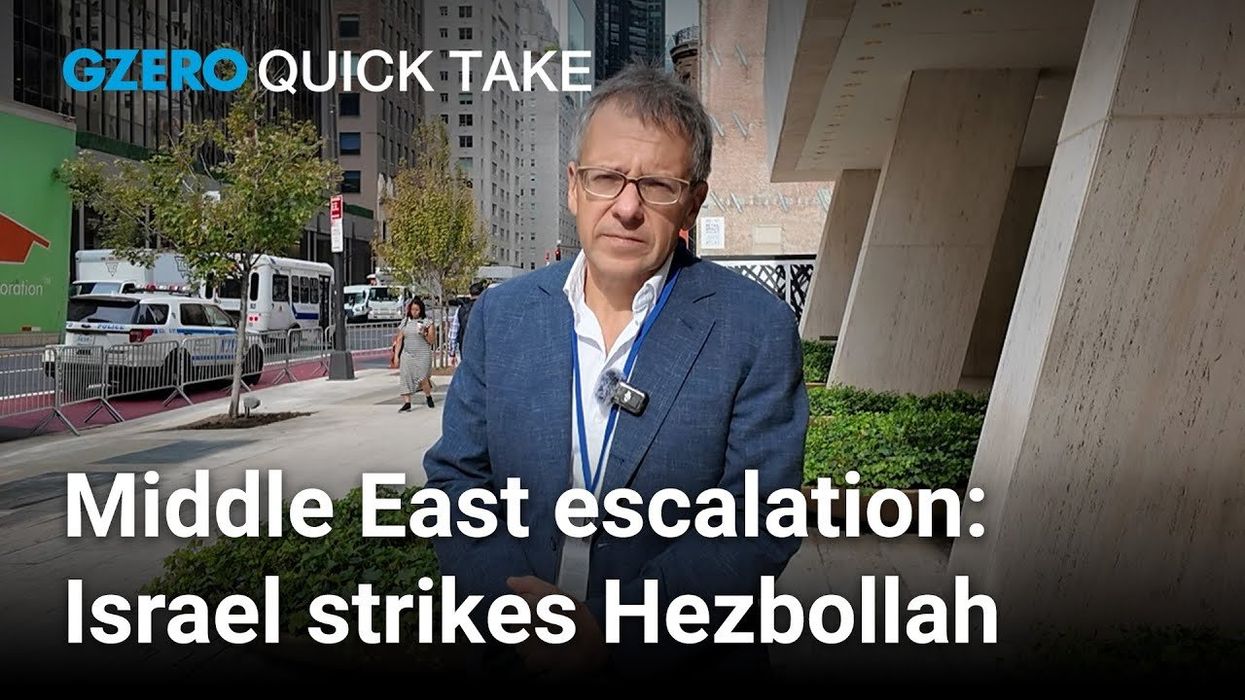
Ian Bremmer's Quick Take: A Quick Take from New York City. The United Nations General Assembly, High-Level Week. You've got heads of state from all over the world converging on New York, which means you're walking everywhere or taking the subway. You certainly don't want to be stuck in traffic.
What I wanted to talk about today though is not that, it is the war going on in the Middle East, continuing to expand. It's now the Northern front. It's Israel versus Hezbollah. In Lebanon, you have tens of thousands of Lebanese over the last 24 hours that have been fleeing for parts north so that they don't get caught up in the bombing. Hundreds of Lebanese have been killed, thousands injured, and that's just in the last 24 hours of Israeli strikes.
This has been percolating for a long time, the likelihood of escalation beyond just Gaza. The reason, if you're Israel, is because there are some 60,000 Israelis that live in the North of Israel, or should I say lived because they've been evacuated for almost a year. That's a pretty significant piece of the Israeli population. It's the equivalent of like if Connecticut or Louisiana was evacuated for a year after 9/11. So, it's created a lot of pressure on Israel to do something about it. But they've been slow-walking this. And the reason they've slow-walked it is because there's been a war going on in Gaza.
Having said that, the war in Gaza is now almost wrapped up. Not because the ceasefire is likely, but because the tunnels that they've found, they've destroyed, they've sealed. The military leaders, they've killed a lot of them. The military fighters, they've killed a lot of them. So the Israelis have now moved most of the Israeli defense forces out of Gaza, and they're available to defend borders across the country, available for operations if they need them in the North.
I wouldn't be surprised if the Israelis announce an end to major military operations in Gaza over the coming weeks because there's honestly not all that much more for them to hit. But that doesn't mean they're done. And again, the focus here is on what happens in Lebanon. This certainly is not all-out war. It's not striking across the entire country. The strikes have been at the south of Lebanon to try to make sure that they ensure, establish a buffer zone that will let the Israelis move back.
The big question is what kind of a response does that elicit from Hezbollah or even from their supporter, Iran? And so far, there's been not all that much. Is that restraint because Hezbollah is scared of an all-out war that ends up destroying their fighters the way you've seen Hamas and Gaza? Or is it because they're concerned of being seen as a paper tiger where their military capabilities aren't enough to actually provide significant offensive capacity vis-a-vis a heavily defended and extremely technologically superior Israel?
When Iran launched some 300 missiles and drones against Israel back, I guess in April, it was targeted. But there was an intention to be able to go in and do some damage against military targets. Caused almost no damage because the Israelis, with the Americans helping them, were able to identify and knock them down. So perhaps possible the Israelis are getting away with this because of their massive military advantages, their superiority, that no one is really a threat to them as long as they have their eye on the ball. But the danger is that this war continues to escalate.
The danger is that even if Hezbollah can't do that much, proxies in the region are going to continue to fight, are going to continue to strike. And of course, the long-term danger is that the ability of Palestinians to live effectively has deteriorated wildly, both in Gaza where a million and a half no longer have the ability to live normal lives, and as well as in the West Bank where larger numbers of amounts of territory has been taken. If that extends to Lebanon, which is an economy that's doing relatively badly at the best of times, then long-term, more radicalization, more instability. Very far from a two-state solution, very far from peace. All the Middle East leaders that I've seen in New York over the last 24 hours have said that this is the worst that they've seen since 1967.






Keep up with what’s going on around the world - and why it matters.