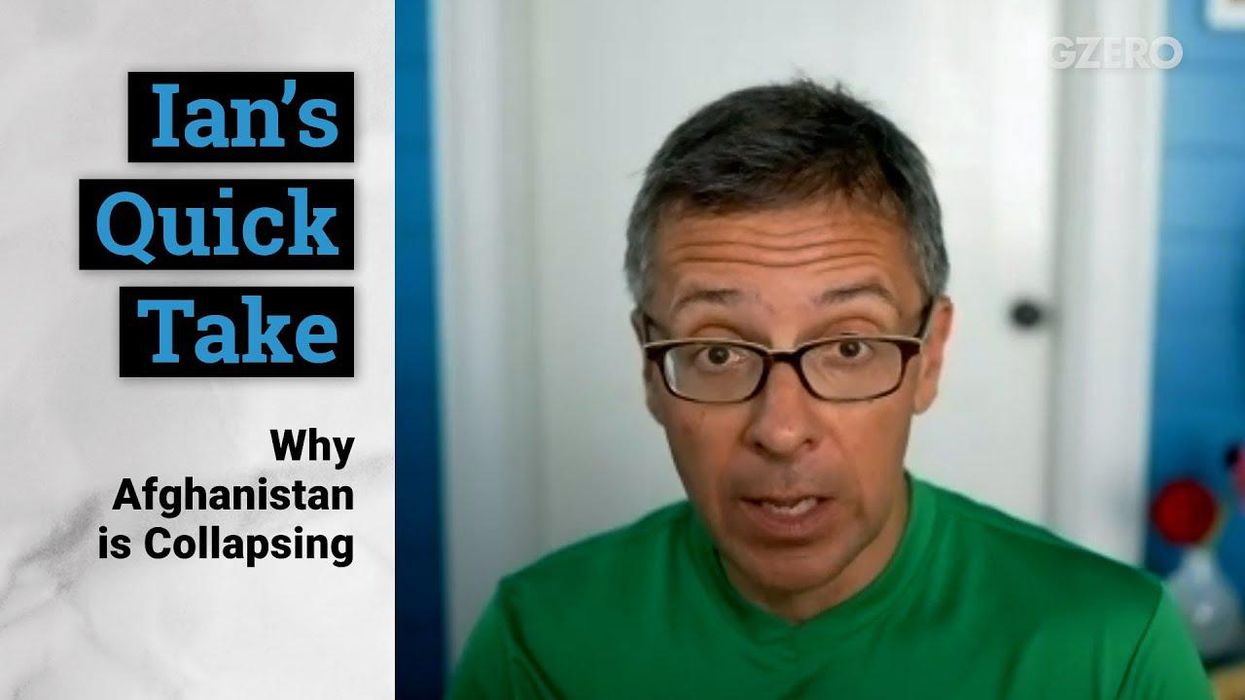
Why Afghanistan is collapsing
August 13, 2021
Global Stage LIVE from United Nations WATCH REPLAY
Ian Bremmer, political scientist and president of Eurasia Group and GZERO Media, shares insights on global political events.
Presented by

Ian Bremmer's Quick Take:
Hi everybody, Ian Bremmer here. Before we head off to the weekend I thought, given all of the news happening very quickly around Afghanistan and the imminent Taliban takeover of the country, the collapse of the existing government and the impact that's going to have on the United States Biden administration, certainly the biggest foreign policy crisis they will have experienced to date under their administration, worth a few moments from me on what the hell is going on.
So we all know the United States announced that it was going to take all troops out of the country by 9/11. And once it was clear that it was happening and imminent, the interest and willingness of the Afghan armed forces to continue to fight was very low. We've been hearing that on the ground from US generals, from NATO generals for some time now. So it should not have come as a huge surprise. But the Biden administration apparently has indeed been surprised by just how quickly this all has transpired. Massive communications failure from my perspective, as a consequence of that. You don't want the international community to think that Biden didn't expect or wasn't planning for what the impact of his decision has been.
Now, to be clear, I actually think they thought very carefully about the decision to pull out of Afghanistan. It was enormously unpopular. That was true under Obama, true under Trump, true under Biden as well, both among Democrats, Republicans and Independents. There was no demographic in the US that was saying we want to continue to stay on the ground. And furthermore, when the internal Afghan policy group was meeting to recommend the final decision to soon-to-be-elected President Biden, the decision that came out was that basically we're going to lose this territory. The present status quo is not sustainable over the course of a Biden administration. You can't keep it going for four years unless you commit more troops, more military intervention, more financial support. No one was willing to do that. So given that, the decision was: let's leave.
Now, I actually accept the logic behind that. I really do. But I think some big mistakes were made. Big mistake number one: If you've made that decision and you've been fighting with your allies across NATO for 20 years, you should be making the decision together with your allies. If there's a good chance something's going to go wrong, why would you want to own that all by yourself? Why wouldn't you go to the Canadians, the Brits, the Europeans and say, "Look, here's what we assessed. This is why we think we should leave. Do you agree?" In all likelihood, they do agree and then everyone makes the announcement to leave together. It's not just the Americans, it's not just President Biden. And if they don't agree, then we can talk about whether there's a compromise, whether there's burden sharing.
Furthermore, you also have the issue of the Chinese. The Chinese government actively does not want the Americans to leave Afghanistan because they're being left holding the bag specifically with a base for militants that are strongly opposed to the way China has been treating the Uyghurs, potential support for secessionist movement, east Turkestan, Xinjiang region of China. This is not something they want to deal with. The Americans should have been asking Beijing, "Look, we don't want to keep our troops there. Our NATO allies don't want to keep their troops there. But if you were to send peacekeepers, maybe we'd continue to provide humanitarian aid, maybe we'd support intelligence, maybe we should do some drone strikes or whatnot." And if you ask, together with the Europeans and the Chinese say no, they're partially culpable, responsible for the fact that they're not willing to do anything. They're just as bad as the Americans in that regard after that cutting and running, as it were. Right? Not responsible. But we're here. The Chinese government had no part of it. It's all the United States. It's all Biden. It's all his loss. They can point and they can say, look, one more way that the Americans have failed on the international system.
Furthermore, the fact that the Biden administration clearly was not aware, was caught flat footed—how can you not have had a scenario where the State Department is prepped to close down the Embassy, if need be, to destroy documents, if need be, as opposed to, you know, when all of the country is falling to the Taliban? This decision was made on Biden's time, not on Afghan time. They shouldn't be being surprised by this. This is an enormous mistake in in my view. This is an administration that's cautious about most things, but the comms has been horrible. The idea of Jen Psaki coming out the other day, the White House spokesperson, and saying, well, the Taliban needs to think hard about the role they want to play in the international community. I mean, maybe that sounded good in her head when she thought it, but it didn't out loud. There is no role for the Taliban in the international community. And everyone knows that. This is defensive because they weren't ready and there was no reason for that.
So I want to be clear that to the extent that Biden has a foreign policy doctrine, that doctrine is a foreign policy for the middle class. It's been articulated reasonably well by people like National Security Adviser Jake Sullivan, by people like Brian Deese who runs the National Economic Council. I get it. And I mean, maintaining a presence in Afghanistan and spending billions and billions of dollars there is antithetical to any doctrine of a foreign policy for the middle class in the United States. I get that that is not where Biden wanted to be.
But you can articulate a smart policy and not be able to execute on it. And here, I think the execution failures across the board—militarily, diplomatically, internationally, as well as comms at home—really give these guys negative marks. The worst thing they've handled or mishandled so far since they've taken the presidency. I hope they can do some fast damage control. And that's even before we start talking about just what a disaster on the ground this is about to be for the people of Afghanistan.
Anyway, that's it for me. Hope everyone's good. Have a great weekend. I'll talk to you all real soon.






Keep up with what’s going on around the world - and why it matters.