Trending Now
We have updated our Privacy Policy and Terms of Use for Eurasia Group and its affiliates, including GZERO Media, to clarify the types of data we collect, how we collect it, how we use data and with whom we share data. By using our website you consent to our Terms and Conditions and Privacy Policy, including the transfer of your personal data to the United States from your country of residence, and our use of cookies described in our Cookie Policy.
{{ subpage.title }}
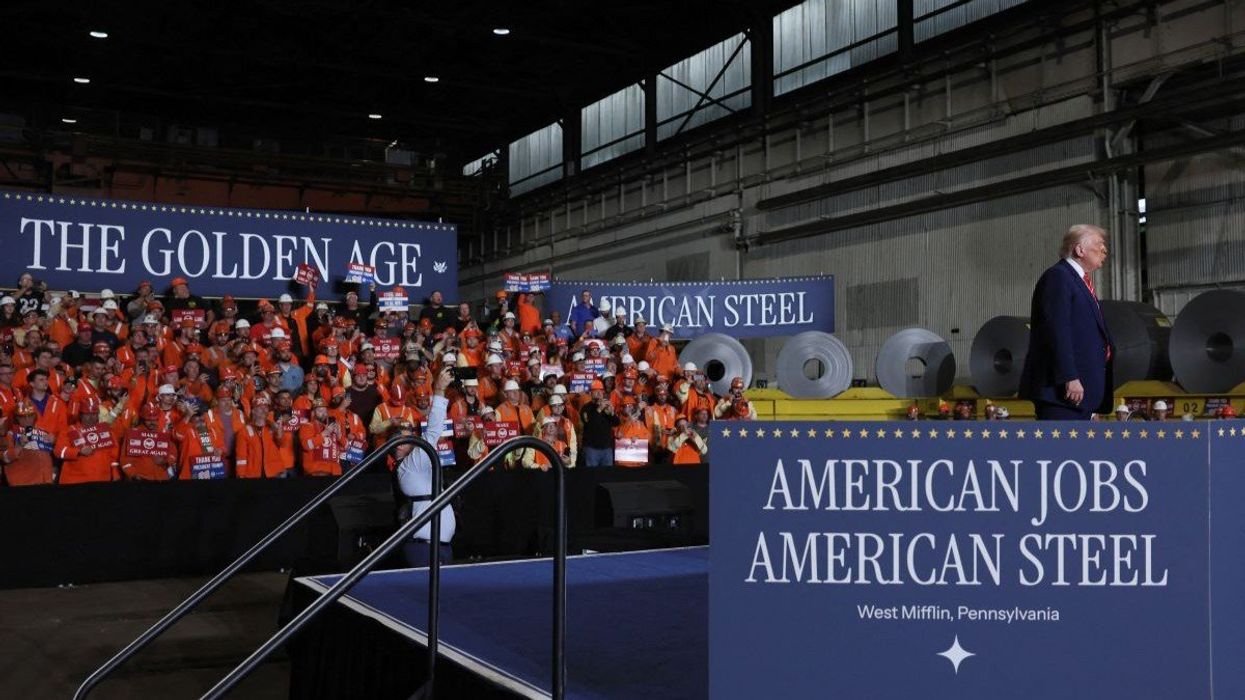
US President Donald Trump appears onstage during a visit at US Steel Corporation–Irvin Works in West Mifflin, Pennsylvania, USA, on May 30, 2025.
What We’re Watching: Trump doubles metal tariffs, Canada Liberals bid to secure the border, Wildfires spread
Trump doubles steel and aluminum duties
Days after a judge nixed Donald Trump’s “Liberation Day” tariffs, the US president signed an executive order doubling steel and aluminum duties to 50%. Trump hopes the tariffs will boost domestic steel and aluminum industries, but the higher duties are terrible news for Canada, which is the top exporter of both metals to the US. Canada’s US-bound exports of steel were already down before Trump doubled the tariffs. Now they’re set to drop further — and take jobs with them. Mark Carney must now decide if he’ll respond, and risk provoking Trump, or back down and betray the anti-Trump, “elbows up” rhetoric he ran on.
Liberals introduce border bill in new Parliament
On Tuesday, Public Safety Minister Gary Anandasangaree introduced the Strong Borders Act, which aims to strengthen border security, combat the trafficking of fentanyl and guns, and tackle money laundering. Anandasangaree said the bill was “not exclusively about the United States,” but admitted it aimed to remedy certain “irritants for the US.” The law would give the government sweeping discretionary powers — to open mail, for instance — so it is expected to meet a measure of resistance in Parliament.
Canadian wildfires send toxic smoke south
Wildfires in Canada have burned 2.1 million hectares (5.2 million acres) of land so far this year, sending hazardous smoke into the Midwest and East Coast of the United States, and even as far as Europe. Experts say the wildfire season in Canada is off to an extraordinary, and dangerous, start, reminiscent of the 2023 season, which was the worst in the country’s history. The flames are putting at risk the health of millions on both sides of the border.Semiconductor chips are seen on a printed circuit board in this picture.
Graphene: Could it reduce chip-making costs?
What if the stuff found in pencils could be used to make computer chips? That’s a real possibility, according to new research published in the journal Nature.
Research scientists from Georgia Institute of Technology and China’s Tianjin University found that graphene, the material commonly found in modern pencils, can act as a semiconductor. For years, it was believed that graphene only behaved as a semimetal, not a semiconductor, but researchers have now discovered graphene’s “band gap.”
This breakthrough is notable amid the race to find cheaper and more available alternatives to silicon for the semiconductor technology that powers chips. Chips are notoriously expensive to make, but they’ve never been more important to modern life. Not only are chips necessary for manufacturing cars, appliances, and video game consoles — all of which were affected in the recent chip shortage spurred by the pandemic — but the availability of chips, particularly high-powered graphics chips, is a determining factor in what firms and global powers will enable an artificial intelligence revolution.
Using graphene without wasting scarce materials, however, will require a new production process, so mass-producing chips with graphene could take another “five years to a decade or more,” according to The Wall Street Journal.