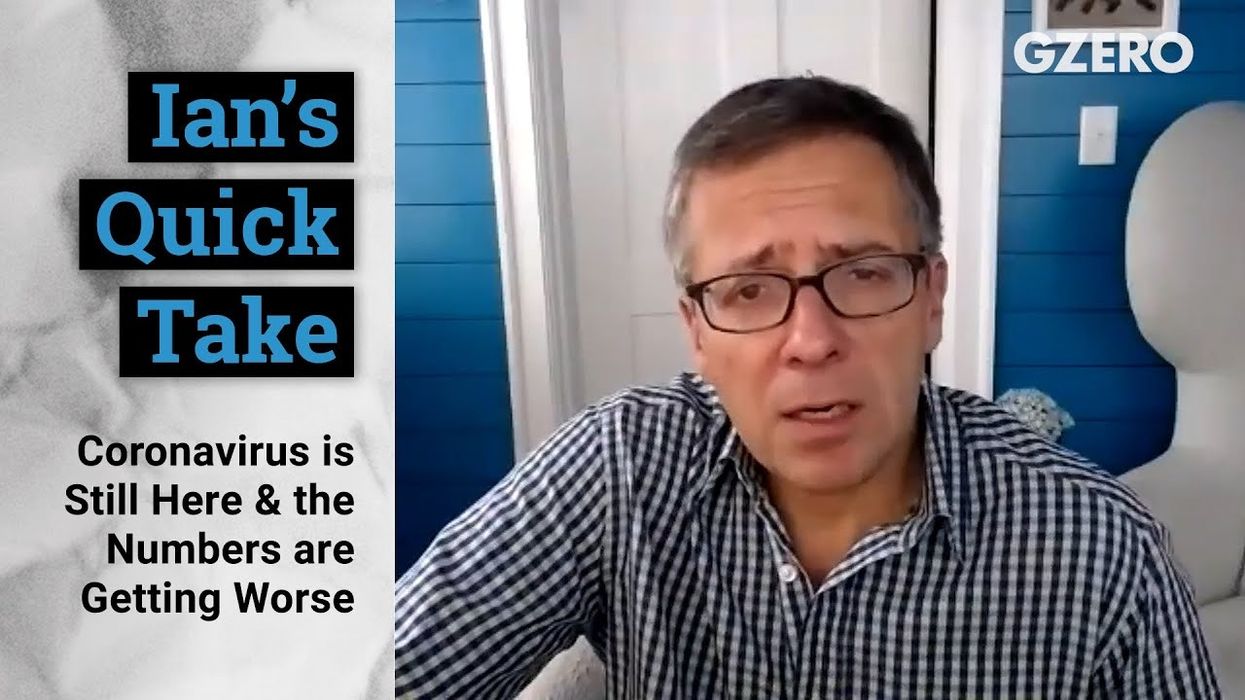
Quick Take: Coronavirus is still here & the numbers are getting worse
October 12, 2020
Global Stage LIVE from United Nations WATCH REPLAY
Ian Bremmer, political scientist and president of Eurasia Group and GZERO Media, shares insights on global political events.
Presented by

Ian Bremmer's Quick Take:
Hi, everybody. Ian Bremmer here and welcome to your week. I hope everyone's having a decent Monday. So much talk about. I want to really focus on coronavirus. Still have to think that is the story in the United States and globally. Everything else is second, third place. A very critical driver of the US election, of course, as it should be. The most important crisis of our lifetimes, irrespective of where you place responsibility, accountability, blame. Your view of that has to be a significant driver of how you think about voting.
The numbers are getting worse. Both in the United States, in Canada, in Europe, and in global developing markets, we are seeing larger numbers of coronavirus cases. In part, that is increased testing though, in many states in the US, we still have positive rates well over 10% of testing, which means we're not testing as much as we need to. That is true in the United Kingdom, that is true in other countries as well. I would argue that the numbers that we're seeing are still so much lower than what the reality is in terms of total cases that we've had. The World Health Organization believes at this point that we probably have about 10% of humanity that has gotten coronavirus. In other words, something like 800 million people, about 20 times the total numbers of cases that we are aware of.
Now that's both good news and bad news. I mean, the good news is that we know what mortality is. We know how many people pretty much have died of the virus. We don't know how many people have the virus. And if the doctors are generally right, that there's vastly more cases, and this is pretty much consensus at this point, that means that mortality from coronavirus is a lot lower than is generally being reported. And indeed, mortality levels continue to go down. And they're going down because we're learning more about the disease. We have better treatment. Now we understand how to fight the disease more effectively. We understand how to quarantine more effectively, how to target super spreader events, as opposed to trying to get every asymptomatic case, especially if you have limited amounts of testing.
All of these things are moving more positively, particularly on the treatment front. The epidemiological community believes that by the end of this year, mortality rates for those that have access to these new treatments, the antibody treatments and others, are going to go down significantly. The one that President Trump received, experimental, you have to get IV in a hospital. New antibody treatments coming online you'll be able to take in the home. And that's going to make it faster, easier. Distribution is obviously going to be easier too. And it means you won't get as many hospitalizations. That's also very helpful in terms of containing spread, very helpful in terms of keeping mortality rates down.
So, I mean, when I see the media increasingly mainly talking about case levels, not exclusively, but mostly talking about case levels going up and not talking about mortality rates going down, one is it gets politicized in terms of it's getting worse, it's getting worse. But two, it's not giving you a good sense that lockdowns are becoming less important. In other words, if mortality rate is going down, the comparative utility right of lockdown is also going down. The cost is becoming greater. The more we learn about this disease and the better we are at being able to fight it, the less you're going to need broad scale lockdowns. The more you can focus on really narrow interventions in those places where you see outbreaks as they occur.
By far, the most important thing everyone should be focused on and shouldn't be politicizing are the broad behavioral issues like wearing a mask, like social distancing and avoiding large crowds, especially indoors. That's something that everyone is capable of actually doing. And the fact that that's been politicized, the fact that we still have to say that because many are opposing it, particularly on social media, amplified by bots and trolls and people that are trying to sow further chaos among populations in the developed world in particular, is a big part of the problem. The fact that people willing to take vaccines, those numbers are going down in the middle of a pandemic because vaccinations and the success of vaccinations are becoming politicized. Those are all significant problems.
As to President Trump himself, clearly good news that not only President Trump, but also everyone that we see that has gotten the coronavirus in the White House from this super spreader event around the Amy Coney Barrett party at the Rose Garden, ceremony at the Rose Garden, seems to be getting better. President Trump seems to be no longer shedding virus, no longer contagious at this point. That's obviously a pretty quick recovery given his age and the severity of what he experienced. Also, former governor Chris Christie, out of the hospital. Nobody else seems to be at the ICU at this point. That's all generally good news.
The question is what are the knock-on implications of all of this? I mean, I think that ... And that's where you get bad news. First point is if you are President Trump, it is too late for you to say, "I've had a come to Jesus moment. I mean, this almost killed me. It's serious. If you've got preexisting conditions, please ensure that you're wearing a mask, you're socially distancing, especially if you're in those groups." No, Trump is not going to do that. It's entirely too late for him. It would be the right thing to do for the American people. But it's the wrong thing for him to do if he's trying to maintain as much support as possible, given where he's been over the last couple of years. And the election is making this worse, not better. So, I get that.
But what that means is Trump out there this week with more in-person, large group rallies with no social distancing and comparatively little mask wearing, and that behavior is being modeled and symbolized for people all over the country. And in some cases, all over the world. Makes it harder to fight this than you would otherwise like.
The other point that I think is worth mentioning is that President Trump is 74. He's morbidly obese. He just has gotten through a potentially lethal disease that we don't have a cure for. And he was given three experimental drugs that might or might not have been successful. So certainly, I mean, this has to be one of the most stressful things that Trump has gone through as a human being, given his age and his health makes it even worse. And he's president and he's underwater in the polls and he's in the middle of all these knockdown drag out fights. I mean, just understanding his emotional and mental state is I think hard to do.
But I think back to myself, the one time that I actually had a near death experience, I think it was in 1995. It was in Azerbaijan and I was going out to the refugee camps about an hour, no, it was about three hours, I guess, by drive outside of Baku. And just about an hour out, my driver fell asleep and we hit a truck going almost 60 miles an hour. And I will tell you, we got medivacked out of the country - I was fine, obviously, or not depending on who you are - but I will tell you for a month, two months, I went right back to work and outwardly, I did my best to show I had my shit together. But I mean, for at least a month, maybe two months, I was at various points in the day, I could see that truck just coming right at my face. And that affected my ability to work. That affected my emotional state. That affected my mental state. I mean, it was a solid two months before I got through that.
You have to think that President Trump right now is experiencing the same thing when you talk about just going through coronavirus, the possibility that he might die. And that's before you think about any side effects or impacts on his physical state from going through this steroid regime that usually, with reasonably healthy people, can have significant impacts on your emotional state.
So again, we're heading into this election, just the level of volatility we already see from a particularly unusual president, I just would keep that in mind as we sort of see the behavior and also recognize that it's going to be much more chaotic period, for many reasons, than any of us have seen or experienced before. And one of those pieces of volatility is going to be driven very much by a president that's just gotten through this kind of unique set of events, and he's a human being too, and we have our frailties.
So anyway, just a few things to think about. Hope everyone's doing well and great talk to you all. Feel free to get in touch and I will see you all soon. Bye.



Keep up with what’s going on around the world - and why it matters.