Since ChatGPT burst onto the scene in late 2022, it’s been nearly impossible to attend a global conference — from Davos to Delhi — without encountering a slew of panels and keynote speeches on artificial intelligence. Will AI make our lives easier, or will it destroy humanity? Can it be a force for good? Can AI be regulated without stifling innovation?
At the ripe old age of eight, the AI for Good Summit is now a veteran voice in this rapidly-evolving dialogue. It kicks off today in Geneva, Switzerland, for what promises to be its most ambitious edition yet.
Launched in 2017 by the International Telecommunication Union (ITU), the gathering typically features conversations on AI safety, access, and governance, but also serves as a “show and tell” moment for innovators spotlighting the latest in robotics, autonomous vehicles, and AI-based tools to combat climate change.
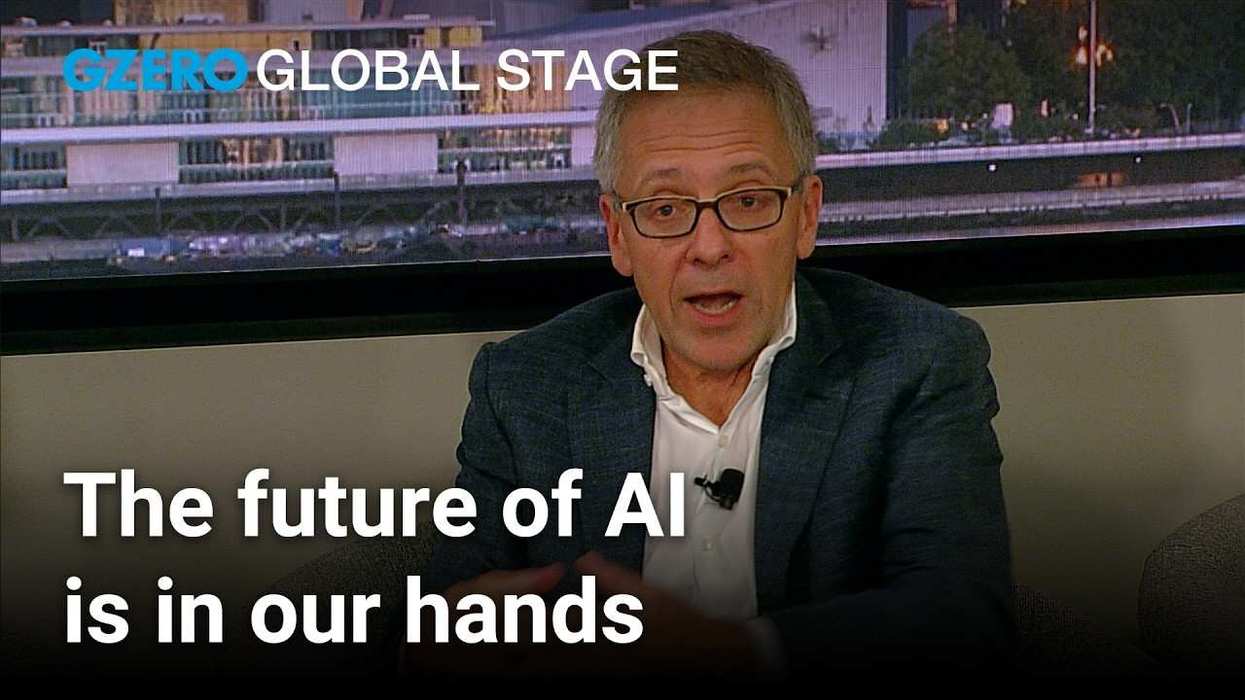
This year, AI for Good is being held at the massive Palexpo, Geneva’s largest convention center, with thousands expected to attend over four days. GZERO is there all week for our Global Stage series, produced in partnership with Microsoft, to help you understand what this summit is and why it’s such a hot ticket (as far as international conferences go).
What is ITU, and why does it host AI for Good? The ITU, founded in 1865, is the UN’s agency for communication technologies. In fact, it was formed 160 years ago as the International Telegraph Union, just as that electronic correspondence method was changing how messages spread across the world. ITU is perhaps best known for establishing global telecom standards, but it’s been playing a growing role in helping more people access the Internet and all the benefits that can bring.
ITU launched “AI for Good” as a platform to connect technology developers and innovators with organizations working on the UN’s Sustainable Development Goals, which seek to bring more people into health and socioeconomic stability by eradicating key challenges like extreme poverty, hunger, and gender inequality.
“We’ve been very consistent and true to our original mission,” the ITU’s Frederic Werner, a summit co-founder, told GZERO. “It was identifying practical applications of AI to solve global challenges and to foster partnerships to make that happen for global impact.”
What happens this week? Expect lots of discussion about the future of jobs and how agentic AI – meaning AI that is autonomously self-improving – could impact companies and the workforce. Salesforce CEO Marc Benioff will address participants on that theme, and Black Eyed Peas frontman will.i.am, now an ITU ambassador, will speak about the importance of training and educating people to work effectively with AI.
Throughout the Palexpo, startup founders and established companies alike will be sharing their creations — like interactive robots and flying cars (more like drones that can carry people, but cool nonetheless). The summit also highlights AI youth initiatives and inventions from around the world.
There will also be a day devoted to policy and regulatory frameworks surrounding AI, a speech from Estonia’s President Alar Karis, and a presentation of suggested standards for AI encompassing everything from healthcare applications to the risks of AI-generated misinformation.
Why does the summit matter right now? For starters, the global “digital divide” remains vast. An estimated 2.6 billion people, a third of the world’s population, still lack Internet connectivity altogether. And nearly 150 years after Thomas Edison introduced the incandescent light bulb, 700 million people still don’t have the electricity to power one. Most are in the Global South.
As more and more industries adopt and deploy AI, the technology could contribute as much as $20 trillion to the global economy through 2030, driving as much as 3.5% of the world’s GDP by then. But the largest and most developed economies, primarily the US and China, stand to gain the most right now, while poorer countries fall further behind.
Conversations in Geneva this week are confronting that concern, calling for “cooperation” and greater global inclusion in the AI economy. In today’s deeply fragmented geopolitical reality, that may be much further in the distance than a self-flying passenger drone.
See GZERO’s complete interview with AI for Good co-founder Frederic Werner here.