Skip to content
Search

Latest Stories

News

What We’re Watching: Bolsonaro's broken silence, Iranian attack plans, Bibi’s return, Colombia & Venezuela’s lunch date

Brazil's President Jair Bolsonaro gives a press statement in Brasilia.

Brazil's President Jair Bolsonaro gives a press statement in Brasilia.

Reuters
Make us preferred on Google

Bolsonaro lets his friend say the hard part

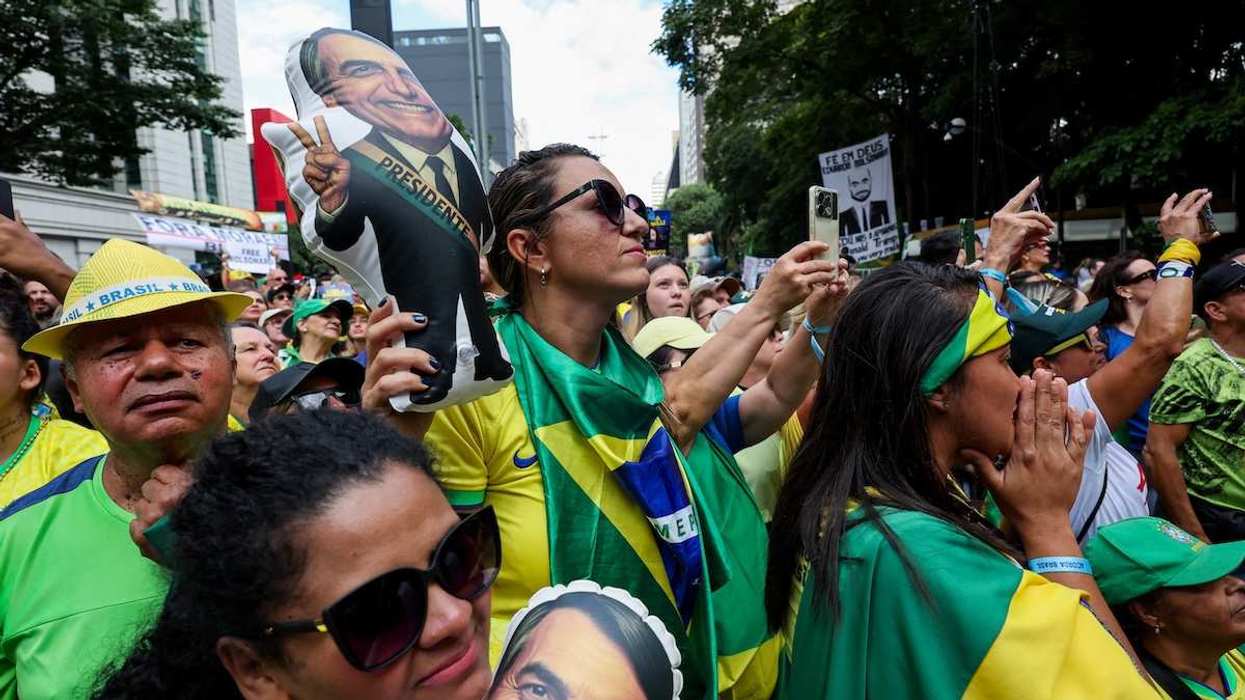
In a prepared and combative statement lasting less than two minutes, Brazilian President Jair Bolsonaro on Tuesday did not concede the election he lost on Sunday. He also failed to congratulate — or even mention — his opponent, Luiz Inácio Lula da Silva. Instead, he welcomed ongoing nationwide protests by pro-Bolsonaro truckers, saying they’re the result of a “feeling of indignation and injustice about how the elections were conducted.” He cast himself as a person who plays by the constitutional rules and said he was proud to have stood for freedom of markets, religion, and expression. “The right has truly risen in Brazil,” he said. After Bolsonaro walked off without taking questions, one of his closest allies stepped up to the podium to say Bolsonaro had in fact authorized him to begin the presidential transition. As that legal and logistical process gets underway, we are watching closely to see how far Bolsonaro pushes the popular protests to try to gain political leverage. Bolsonaro lost to former President Lula by the narrowest electoral margin in Brazil’s modern history. Buckle up.


Will Iran attack Saudi Arabia?

Tehran is reportedly preparing imminent attacks on targets in Saudi Arabia and northern Iraq that could put the US military at risk. Based on shared Saudi intelligence, the news has put the Pentagon on “high alert.” The US has 10 military bases and about 3,000 troops in Saudi Arabia and roughly 2,500 troops in Iraq. Riyadh says the plot is an attempt by the Islamic Republic to distract from the combustible situation at home, where nationwide protests – bordering on revolution – over the in-custody death of Mahsa Amini, 22, have consumed the country for more than six weeks. In recent weeks, Tehran has also bombarded Kurdish towns in northern Iraq that it blames for fomenting unrest in Iran (Amini was Kurdish). While many called for President Joe Biden to sever ties with Saudi leader Mohammed bin Salman after Riyadh recently snubbed the US by cutting OPEC+’s daily oil production, this episode reveals that – for better or worse – Washington and Riyadh’s national security interests remain intertwined.

Bibi is almost back

Israelis went to the polls on Tuesday for the fifth time in under four years, and the results look very good for … former Prime Minister Benjamin “Bibi” Netanyahu. With 85% of the vote counted, Bibi’s Likud Party has won the most seats – 31 – while his right-wing allies also appear to have the numbers to help him pass the 61-seat threshold (out of 120) needed to form a government in the Knesset, Israel’s parliament. Interestingly, voter turnout was at a two-decade high. Far-right parties including the anti-Arab, anti-LGBTQ Religious Zionism bloc, as well as several ultra-Orthodox parties, reaped solid results and will be Bibi’s coalition partners. Still, there are about 500,000 votes from soldiers, prisoners and diplomats that are yet to be counted, but soldiers' votes traditionally skew right. Longtime leader and divisive figure Bibi Netanyahu appears to be on the cusp of victory.

Colombia-Venezuela lunch date

Colombia’s recently elected left-wing President Gustavo Petro traveled to Caracas on Tuesday for a lunch date with Venezuelan strongman Nicolás Maduro. Relations between Venezuela and Colombia fell apart in 2019 during mass protests against Maduro’s regime and clashes along their shared border. But since Petro took office in August, tensions have eased and the borders have reopened. The two leaders planned to discuss the further easing of tensions, joint approaches to protecting the Amazon, and the surprising idea of reintegrating Venezuela — which the UN recently accused of crimes against humanity — into regional human rights bodies. At the same time, Petro wants Venezuela to act as a guarantor for fresh peace talks with the holdout Colombian rebels of the ELN. The meeting between Washington’s closest South American ally, Colombia, and its biggest bete noire, Venezuela, comes as the US is exploring ways to ease oil sanctions on the Venezuelan petro-state in exchange for progress towards fair elections. See our recent interview with Petro here.

More For You

​Turkish President Tayyip Erdogan shakes hands with Saudi Crown Prince Mohammed bin Salman, next to Pakistan's Prime Minister Shehbaz Sharif.

Turkish President Tayyip Erdogan shakes hands with Saudi Crown Prince Mohammed bin Salman, next to Pakistan's Prime Minister Shehbaz Sharif, after signing a joint defence agreement in Mecca, Saudi Arabia, August 7, 2026.

Saudi Press Agency/Handout via REUTERS
Major new Middle East defense pact signed Saudi Arabia, Turkey, and Pakistan on a Friday signed a joint defense agreement that characterizes an attack on one as an attack on all. Although it doesn’t spell out specific obligations, the pact brings together Turkey’s formidable army (NATO’s second largest), Pakistan’s nuclear arsenal, and Saudi [...]
School shooting in Thailand puts gun ownership in focus
Will Fitzpatrick
A 14-year-old boy opened fire at a school outside Bangkok on Friday after killing his grandparents at their home, killing seven people and injuring 30 others before taking his own life. The attack has renewed scrutiny of Thailand’s high levels of gun ownership. Despite having strict gun laws, Thailand has a booming black market for firearms. There [...]
A man holds up a Venezuelan flag in front of the sun.

A man holds up a Venezuelan flag while taking part in a march calling for amnesty for political prisoners and to mark Youth Day, in Caracas, Venezuela, February 12, 2026.

REUTERS/Maxwell Briceno
Since last weekend, Washington’s tutelage over Venezuela’s regime after the capture of autocrat Nicolás Maduro in January produced its clearest step yet toward an actual democratic transition: a US-brokered negotiation between the government and a slice of the opposition, opening what could be the first credible path to competitive elections in [...]
A laborer works at the Congolese state mining company Gecamines' copper concentrator at its Kambove operation in the southern province of Katanga

A laborer works at the Congolese state mining company Gecamines' copper concentrator at its Kambove operation in the southern province of Katanga on January 31, 2013.

REUTERS/Jonny Hogg
The DRC wants to keep more of its mineral wealth at homeThe Democratic Republic of Congo has reportedly banned exports of copper and cobalt concentrates, materials which are refined and later used by countries like China to manufacture widely used technology. The goal is to force more processing at home and capture a larger share of profits [...]