AI, election integrity, and authoritarianism: Insights from Maria Ressa

There’s a big, big problem with using AI to defend democracy, says Rappler CEO Maria Ressa: “You need to feed it.”
“AI as a defense tool will always be behind the eight-ball because it is reactive," she said, requiring terabytes of data at a time to pick out the patterns that betray malicious actors. By the time they are detected, they can flood social media with lies that amplify ordinary citizens’ fear when they don’t know what to believe.
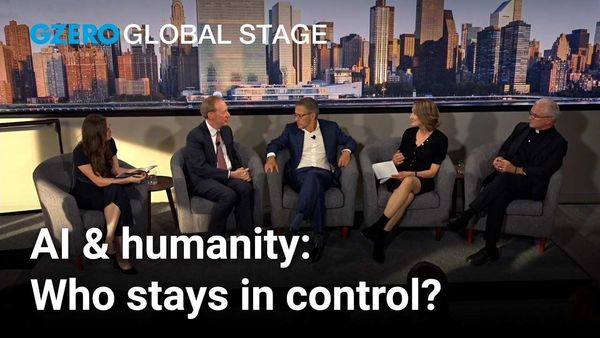
Ressa spoke in a GZERO Global Stage livestream discussion with Ian Bremmer, President and Founder, Eurasia Group & GZERO Media, Eléonore Caroit, Vice-President of the French Parliament’s Foreign Affairs Committee, and Microsoft Vice Chair and President Brad Smith, moderated by Julien Pain, journalist and host of Franceinfo, live from the 2023 Paris Peace Forum.
Her newsroom, Rappler, is one of the last independent media outlets in the Philippines and operates under tremendous political pressure. The government has filed so many lawsuits against Ressa and Rappler that she could face a century of prison time. What’s more, Rappler’s reporting attracted repeated cyberattacks in 2021, trying to bring the website down. “When we were attacked, it took the platforms years to come back and fix it," said Ressa, who was awarded the Nobel Peace Prize in 2021 for her work to safeguard freedom of expression as a journalist.
Watch the full livestream panel discussion: "Live from the Paris Peace Forum: Embracing technology to protect democracy"
The livestream was part of the Global Stage series, produced by GZERO in partnership with Microsoft. These discussions convene heads of state, business leaders, technology experts from around the world for critical debate about the geopolitical and technology trends shaping our world.
- How are emerging technologies helping to shape democracy? ›
- Maria Ressa: Fearless and fair ›
- Facebook allows "lies laced with anger and hate" to spread faster than facts, says journalist Maria Ressa ›
- AI and data regulation in 2023 play a key role in democracy ›
- Paris Peace Forum Director General Justin Vaïsse: Finding common ground - GZERO Media ›
- At the Paris Peace Forum, grassroots activists highlight urgent issues - GZERO Media ›
- AI in 2024: Will democracy be disrupted? - GZERO Media ›
- How to protect elections in the age of AI - GZERO Media ›
- Protect free media in democracies, urges Estonia's former president Kersti Kaljulaid - GZERO Media ›
- UN's Rebeca Grynspan on the world’s debt crisis: Can it be solved? - GZERO Media ›
- Tech accord on AI & elections will help manage the ‘new reality,’ says Microsoft’s Brad Smith - GZERO Media ›