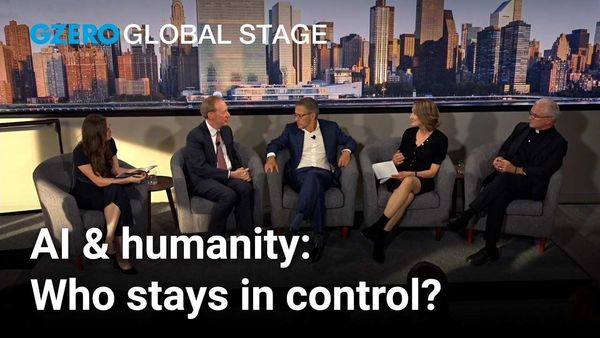
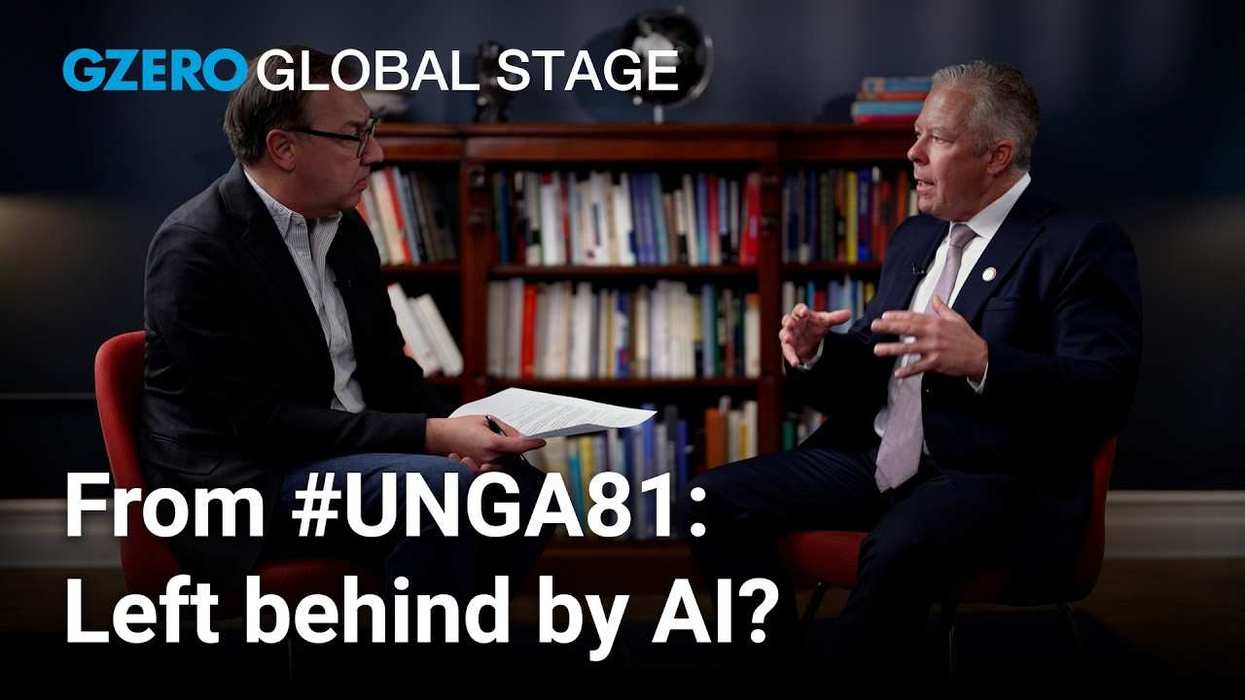
Artificial intelligence could level the playing field for individuals across an array of disciplines...if people have access to it. Microsoft’s Vice Chair and President Brad Smith, points out that access to AI tech remains a privilege that is still unavailable to hundreds of millions around the world.
Speaking in a GZERO Global Stage discussion from the 2024 World Economic Forum in Davos, Switzerland, Microsoft Vice Chair and President Brad Smith points out that while the conversation about AI seems advanced in Davos, a lot of people in the Global South don't yet have access to AI, let alone basic needs like electricity, access to electronic devices, and internet connectivity.
“In a sense, we do the Global South a tremendous disservice if we talk about AI all the time as the next thing,” he said. First, "close the electricity divide, the broadband connectivity divide, the device divide, and then you can close the AI divide on top of it."
The conversation was part of the Global Stage series, produced by GZERO in partnership with Microsoft. These discussions convene heads of state, business leaders, technology experts from around the world for critical debate about the geopolitical and technology trends shaping our world.
Watch the full conversation here: How is the world tackling AI, Davos' hottest topic?
- How AI and deepfakes are being used for malicious reasons ›
- You say you want AI revolution? ›
- AI at the tipping point: danger to information, promise for creativity ›
- The Global South is angry and mistrustful - Ian Bremmer ›
- Can we use AI to secure the world's digital future? - GZERO Media ›
- Microsoft's Teresa Hutson on rebuilding trust in the Age of AI - GZERO Media ›
- France's AI Action Summit maps a European vision for AI - GZERO Media ›
- Customizing AI strategies for every region, culture, and language is critical - GZERO Media ›
- For AI access for all, investment is the key, says Microsoft's Brad Smith - GZERO Media ›