Skip to content
Search

Latest Stories

Analysis

Want to stabilize the world’s worst crises? “Leave your textbook in your drawer.”

​People gather as they watch from afar after an alleged gang member was killed and set on fire, amid an escalation in gang violence, in Port-au-Prince, Haiti March 20, 2024.

People gather as they watch from afar after an alleged gang member was killed and set on fire, amid an escalation in gang violence, in Port-au-Prince, Haiti March 20, 2024.

REUTERS/Ralph Tedy Erol

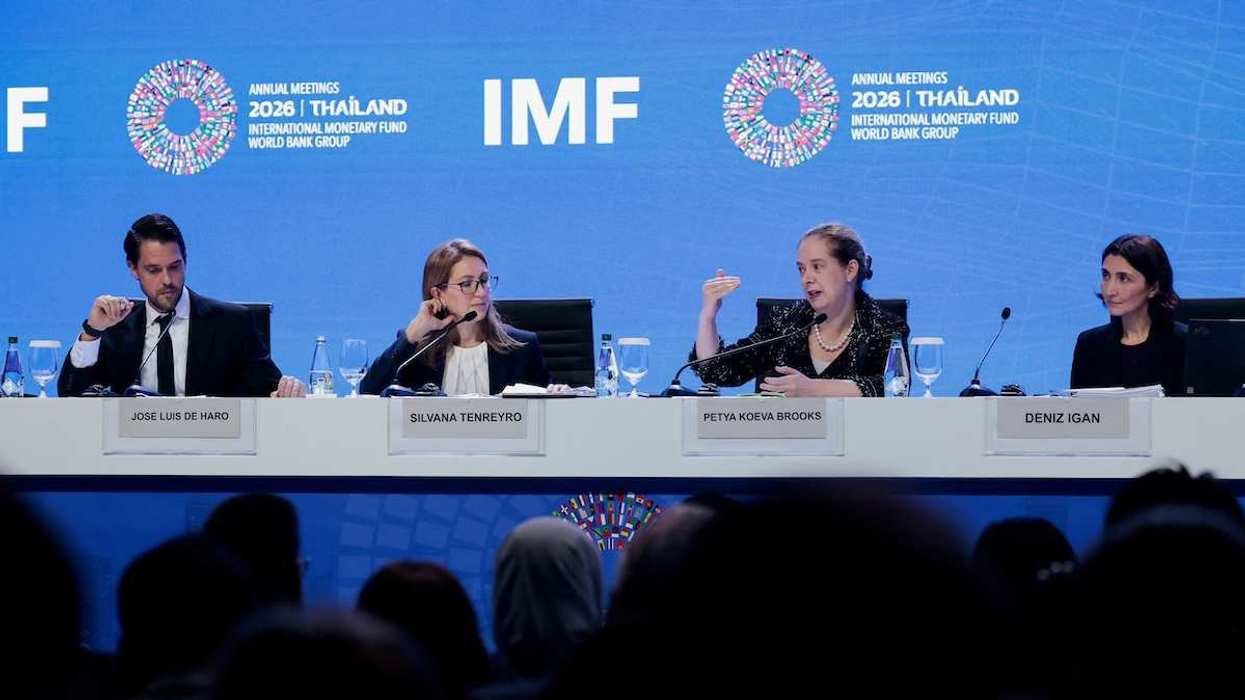
Matthew Kendrick spoke with Ghassan Salamé, the former head of the UN Support Mission in Libya, and former UN Deputy Secretary-General Lord Mark Malloch-Brown, as part of a panel at the IMF/World Bank Spring Meetings on Wednesday.

The international community is struggling to address half a dozen conflicts, spanning from the Middle East to Haiti, that often involve institutions poorly equipped to tackle modern problems. But that doesn’t mean they can afford to stop trying; it just means they need to get creative.

“The most urgent need is to bring back humanitarianism as a domain independent from war,” said Ghassan Salamé, the former head of the UN Support Mission in Libya, noting that the basic concerns of food, education, and healthcare must not be held hostage to military objectives. “And you cannot apply it in a selective way. You have to apply it in Ukraine with the same strength you do in Gaza.”


Bias in attention is especially stark for Sudan, where just 3.2% of humanitarian needs have been funded despite a brutal civil war that has killed over 15,000 and forced a staggering 8.2 million to flee.

“Indifference is much worse than hostility,” said Salamé. “Sudan needs concern.”

Part of the problem, according to former UN Deputy Secretary-General Lord Mark Malloch-Brown, is that “humanitarianism was based on the idea that conflict is temporary, and then you go back to development.” That means when the shooting starts, the IMF and World Bank tend to back away and wait for the dust to settle before starting to help stabilize the affected economy. That just won’t fly in the 21st century, and Malloch-Brown called for the institutions to develop new tools to provide help before, during, and after a country falls into violence to strengthen key unifying institutions, such as ministries of finance, education, and social welfare.

The key, said Salamé, is to “leave your textbook somewhere in your drawer and try to solve the situation as it is.”

Looking at crises in developing countries along longer trajectories can help highlight their hidden potential. When asked how these new approaches could apply to Haiti, where the formal government has all but collapsed, Malloch-Brown said the country “never had the degree of internal development, social reform, or inclusive economic policies that allow a stable polity to emerge.” If Haiti receives “a persistent period of tender love and care,” he added, its economic potential means “I’m optimistic enough to believe it can be fixed.”

More For You

​President Donald Trump delivers an address to the nation from the Diplomatic Reception Room of the White House, in Washington, D.C., U.S. Wednesday, Dec. 17, 2025.

President Donald Trump delivers an address to the nation from the Diplomatic Reception Room of the White House, in Washington, D.C., U.S. Wednesday, Dec. 17, 2025.

Doug Mills/Pool via REUTERS
Less than one day after US President Donald Trump declared a military blockade of sanctioned oil tankers from Venezuela, he addressed the nation during a rare primetime speech – but didn’t talk about Venezuela. Instead, he touted the economy, arguing that it’s doing better than many Americans believe it is.“Boy, are we making progress,” Trump said [...]
French President Emmanuel Macron, German Chancellor Friedrich Merz, Ukrainian President Volodymyr Zelenskiy, U.S. Special Envoy Steve Witkoff and businessman Jared Kushner, along with NATO Secretary-General Mark Rutte and otherEuropean leaders, pose for a group photo at the Chancellery in Berlin, Germany, December 15, 2025.

French President Emmanuel Macron, German Chancellor Friedrich Merz, Ukrainian President Volodymyr Zelenskiy, U.S. Special Envoy Steve Witkoff and businessman Jared Kushner, along with NATO Secretary-General Mark Rutte and otherEuropean leaders, pose for a group photo at the Chancellery in Berlin, Germany, December 15, 2025.

Kay Nietfeld/Pool via REUTERS
The European Union just pulled off something that, a year ago, seemed politically impossible: it froze $247 billion in Russian central bank assets indefinitely, stripping the Kremlin of one of its most reliable pressure points. No more six-month renewal cycles. No more Hungarian vetoes. The money stays locked up, full stop.Turns out that was the [...]
​US President Donald Trump, Ukrainian President Volodymyr Zelensky, German Chancellor Friedrich Merz, French President Emmanuel Macron, UK Prime Minister Keir Starmer, Italian Prime Minister Giorgia Meloni, Finland's President Alexander Stubb, NATO Secretary General Mark Rutte and European Commission President Ursula von der Leyen at the White House in Washington, D.C., USA, on August 18, 2025.

US President Donald Trump, Ukrainian President Volodymyr Zelensky, German Chancellor Friedrich Merz, French President Emmanuel Macron, UK Prime Minister Keir Starmer, Italian Prime Minister Giorgia Meloni, Finland's President Alexander Stubb, NATO Secretary General Mark Rutte and European Commission President Ursula von der Leyen pose for a family photo amid negotiations to end the Russian war in Ukraine, at the White House in Washington, D.C., USA, on August 18, 2025.

REUTERS/Alexander Drago
– By Lindsay NewmanAs his second term came into view, US President Donald Trump put the world on notice that the administration many had been preparing for may not be the one it would be getting. Promising a “golden age of America,” Trump laid out an ambitious agenda. “America First” would no longer be an isolationist story, but an aspirational [...]
A family votes during the second round of Hungary's general election in Budapest, April 23, 2006. Hungarians went to the polls on Sunday with the Socialist-led government of Prime Minister Ferenc Gyurcsany looking set to make history by becoming the first to retain power since the return of democracy in 1990.

A family votes during the second round of Hungary's general election in Budapest, April 23, 2006. Hungarians went to the polls on Sunday with the Socialist-led government of Prime Minister Ferenc Gyurcsany looking set to make history by becoming the first to retain power since the return of democracy in 1990.

REUTERS/Laszlo Balogh
With the year's end fast approaching, it's time to look ahead to the elections that could reshuffle global power dynamics in 2026. Here are a few you should keep an eye on.Hungary’s parliamentary electionsAfter consolidating power and chipping away at democratic freedoms, Hungary’s Prime Minister Viktor Orbán faces his most credible challenger in [...]