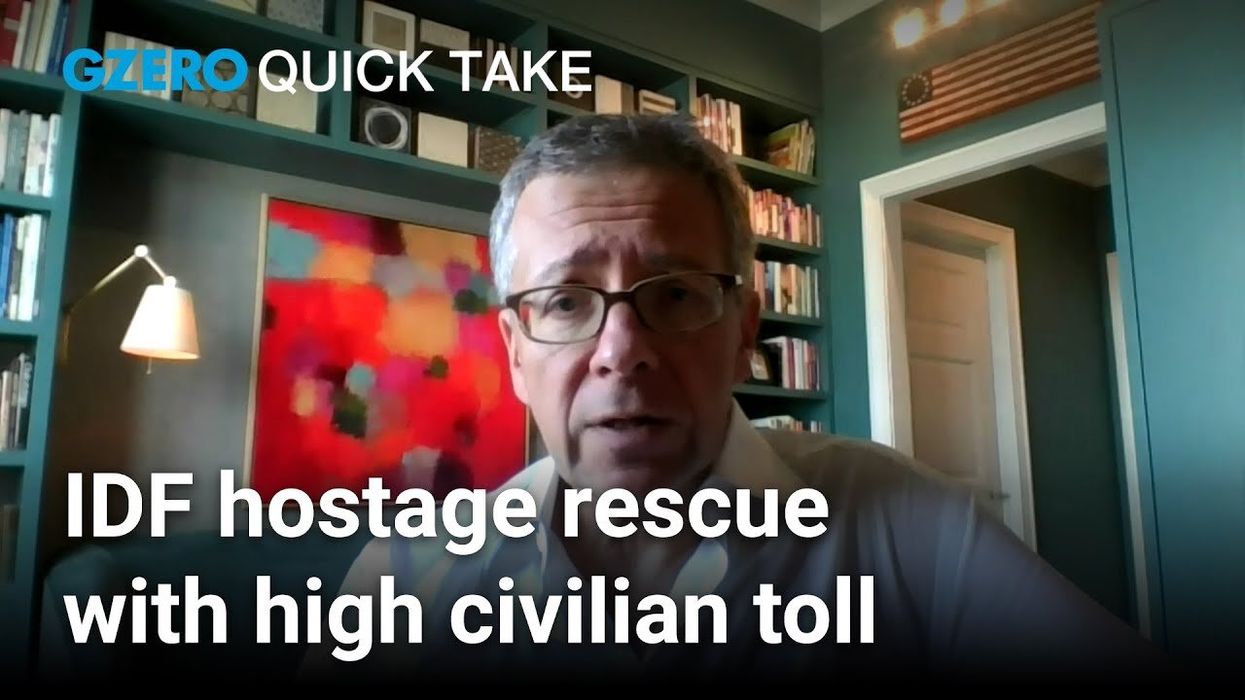
Israel hostage rescue and the worsening human toll
June 10, 2024
Ian Bremmer, political scientist and president of Eurasia Group and GZERO Media, shares insights on global political events.
Presented by

Ian Bremmer's Quick Take: Hi, everybody. Ian Bremmer here and a Quick Take to kick off your week.
Lots of things going on right now, but perhaps, the issue that's gotten most of the news around the Middle East conflict and the issue of the hostages being rescued. Four hostages, some eight months now, being held. Over 100 still that we know of by Hamas in Gaza.
But four of them were rescued by an Israeli Defense Forces operation over the weekend. Not released, as some including, in a chyron, an interview I was in over the weekend, were saying released. No, rescued. Hamas has not released anyone, and there is no agreement going forward, and unlikely in the near term, despite lots of efforts from everyone around the world to get an agreement.
Neither the Israelis or Hamas are coming to one. Now, news beyond that, is that in order to get those hostages out, there were between about 100 and 300 Palestinians killed. Depending on who you talk to, the numbers are completely unclear. How many of those people were civilians? How many of them were Hamas operatives? How many were women and children? That's still unclear. But obviously, the numbers were really, really high. And lots of things to say about this and you should say all of them. First is that Hamas is keeping these people in civilian homes and among a densely populated civilian area specifically to make it harder for Israelis to rescue them without having large numbers of Palestinian civilians killed.
That is indeed the strategy, and both the fact that Hamas continues to hold these hostages, civilian hostages illegally, and the fact that they are using Palestinian civilians as a part of their strategy is that these are war crimes; these are acts of terrorism. And they need to be held accountable for that.
At the same time, Israel has been way too indifferent to civilian casualties. And we've seen that broadly in terms of the war in Gaza, and we've seen it specifically in terms of the events of this weekend. And the fact that the Israeli prime minister celebrated, and understandably so, the rescue of the hostages but didn't mention, didn't even mention the minimum scores of Palestinians that were killed and quite plausibly far more than that, implies that that's not worth mentioning. On the Israeli side, those people don't matter. They don't count. Beyond saying that Hamas is responsible for all of their deaths, which is an extreme statement. The Israelis also bear accountability. But if you don't mention it, it's not even worth a mention is the point. And I think we've gotten to a point in the war of dehumanization where if you are supporting either the Palestinian side or the Israeli side, that the humanity of the people on the other side is no longer a thing for you.
And that is likely to persist for a generation, given the atrocities that we are seeing and have seen on October 7th and in the war since. Let's also focus on the asymmetry. These two actors, Hamas and Israel, do not play by the same rules, right? They also can’t play by the same rules.
I mean, in the sense that if Hamas played by Israel rules, they would have been destroyed by now. I mean, if they weren't trying to intentionally target Israeli civilians and if they weren't intentionally putting Palestinian civilians constantly at risk, there would be no more Hamas because the Israelis are overwhelmingly more powerful militarily, their offensive capabilities, their defensive capabilities, and of course, their intelligence capabilities, which forces a level of greater inhumanity and asymmetry in fighting strategy on Hamas than if they had greater military capabilities. Now, of course, on the other side, if Israel didn't have the incredible military capabilities that they had, they wouldn't have a state, they wouldn't be able to defend it against those that believe that they don't have a right to exist, as a state.
So, I mean, none of these things answer the question of what do we do? And none of these justify, in any way, the behaviors that we've been seeing on the ground from the Israeli Defense Forces in fighting this war from Hamas, in taking these hostages and holding them and putting their own civilians at risk. But it is, I think, incumbent on us as we see this continue to play out that what we're missing and what we need is humanity.
Right now, there are no angels that are fighting. There is only suffering, and there's only dehumanization. We also can't talk about all of this without having an effective deal on the table, and there isn't a deal on the table. And everyone is sort of responsible for that, right? The Israelis have refused a deal with all of the hostages in return for an eventual permanent cease-fire because the Israeli position is, “until we destroy Hamas, their leadership, their military capacity, there can be no end to the fighting.”
And indeed, Benny Gantz, leaving the Unity war cabinet and now leading the War Cabinet to look basically just like the Israeli government, which means Bibi, the PM, and the far right, which puts you farther from any plausible breakthrough agreement than you were even over the past weeks. Hamas has also refused a cease-fire agreement that is on the table.
They've had an agreement on the table for a six-week cease-fire in return for a significant number of hostages being released and also more Palestinians being detained by Israel being released. And then there would be further discussion and negotiations. Hamas has refused that deal. When you're reading about this in the media, you will see people talking about Israel refusing the deal.
You'll see people talk about Hamas refusing the deal. Very rarely will you see people talking about both Israel and Hamas refusing the deal, because they have both set red lines that are mutually incompatible. And that is by design because they don't want a breakthrough that leads the other to be intact and in any way fulfilled. Look in any negotiation, if both sides are dissatisfied, it's probably not effective negotiation. We are not at the point where both sides are prepared to accept that. We're not close.
In fact, I think what we've seen over the weekend, with the hostages rescued, with lots of Palestinians killed, and with Gantz leaving the war cabinet is, we are farther today from a diplomatic agreement, even with Secretary of State Tony Blinken yet again in the region, we're farther from an agreement than we were a week ago, a month ago, two months ago. And we're farther from containing the war, as the potential of this war expanding into the north with Hezbollah and also continuing, of course, on the ground in Rafah and more broadly in Gaza. I think that that is your baseline expectation for the coming weeks and months.
So not great news. And, you know, out of the Middle East these days, it really is. But that is where we are. I hope people find this worthwhile. And I'll talk to you all real soon.






Keep up with what’s going on around the world - and why it matters.