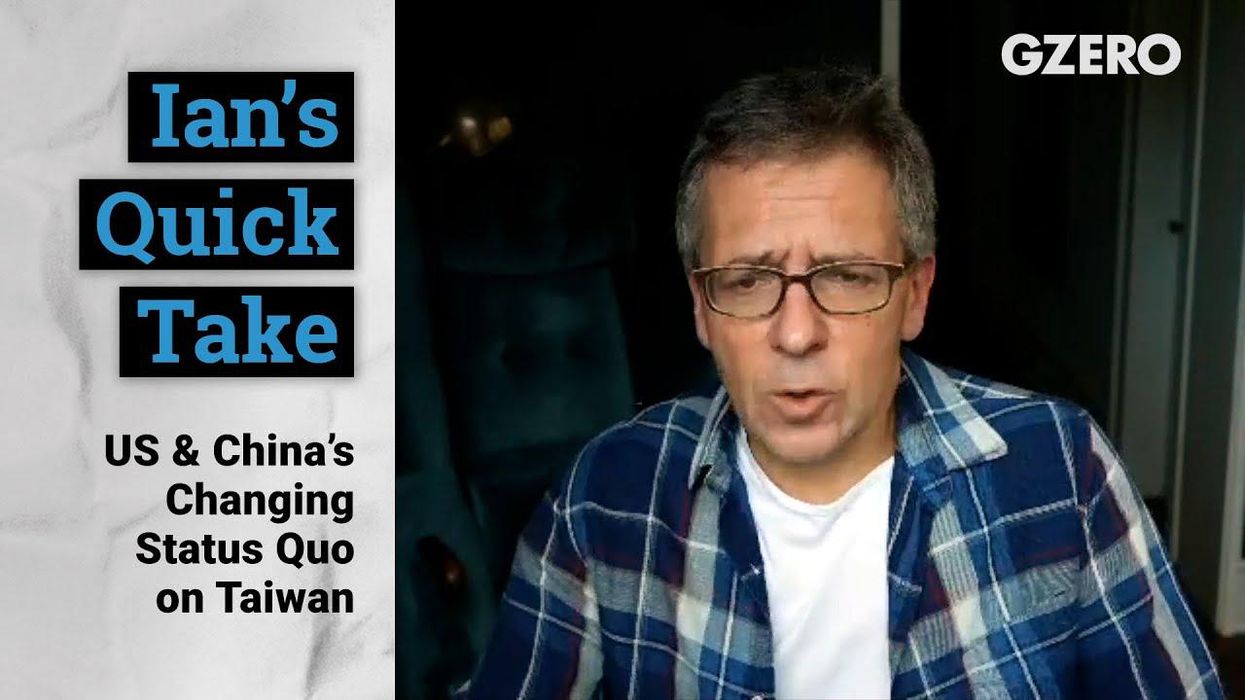
US and China's changing status quo on Taiwan
October 18, 2021
Global Stage LIVE from United Nations WATCH REPLAY
Ian Bremmer, political scientist and president of Eurasia Group and GZERO Media, shares insights on global political events.
Presented by

Ian Bremmer's Quick Take:
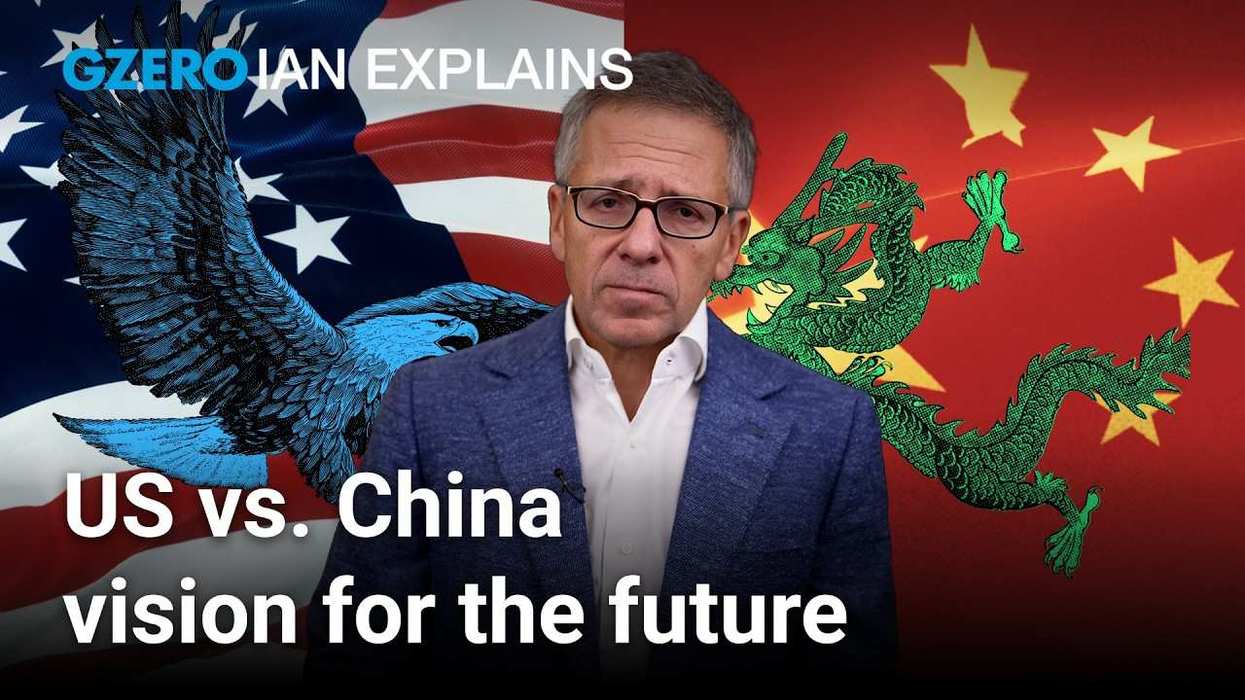
Happy Monday, everybody. And a Quick Take for you. I wanted to talk a bit about Taiwan. I'll tell you, I've talked about it in the media over the last couple of weeks and almost every questioner has been trying to prod me towards, "are we heading to war?" Then I was with some friends at the Trilateral Commission on Friday. I like that group a lot. It's one of these groups that a lot of conspiracy theorists pretend secretly run the world, like the Bilderbergers and the Council on Foreign Relations. Now having attended all three, I can tell you, if they do run the world, they are not inviting me into the rooms where they're making those decisions. If they are doing that, they're also doing a lousy job of it.
Nonetheless, it was fun until I was on stage and the first question I got was about, "Hey, so the Chinese are changing the status quo. Do you think that means we're heading towards war?" I just want to say that, first of all, I am clearly less concerned about the imminence of confrontation and military conflict between the United States and China than almost anybody out there. Accidents are certainly possible, but particularly around Taiwan, where both sides know the stakes and have made them abundantly clear for decades now, and everyone involved gets it I think it's much less likely.
I also think that the American and Western perspective on the Chinese are escalating is obviously only a piece of the story. I understand that, as Americans, if there's going to be a confrontation, we want to win it. But that doesn't mean that you only look at one side of the argument because then you tend to make mistakes. If we want to be honest around who is changing the status quo, there are very strong arguments to be made on both sides of the equation. Certainly, the big headlines over the last couple of weeks with the record number of Chinese military incursions through the Taiwanese Air Defense Identifications Zone, a couple weeks ago, they had several days, record numbers of incursions. Before that, probably the single event that most people pointed to was Hong Kong and the unilateral Chinese decision to aggregate the agreement of the political autonomy and rule of law that Hong Kong enjoys until the expiree of that agreement. They essentially ripped up the deal and decided for their own national security purposes that they would govern it immediately.
Then, finally, after the debacle and the Afghanistan withdrawal and the chaos that ensued on the ground, there were a number of both Chinese high-level state media organs, the editor-in-chief of the People's Daily, for example, some major opinion writers, as well as some Chinese officials, the lower-level, that were basically threatening Taiwan say, "You see, you can't count on the Americans to defend you. Look what just happened to Afghanistan. Don't pretend that you would be able to resist the Chinese incursion."
If you only focus on those things, certainly it looks pretty belligerent. It looks like the Chinese are getting more aggressive. They're changing the rules. But of course, it's not just that. The United States has changed the status quo as well. There's been the secret training of special forces of the United States on the ground of the Taiwanese military for at least a year now. There's been the creation of new status quo architecture in the region, whether it is the QUAD, which they never talk about China, but it's obviously oriented towards China. A new diplomatic agreement that's become quite robust and meeting regularly by Zoom on a whole host of different security-related issues between the United States, Japan, India, and Australia. You've got the new AUKUS defense pact. You've got Build Back Better World, which not much money has gone into it yet, but it's all oriented towards Asia encountering One Belt One Road.
Then, probably most significantly, if the Hong Kong move is the most significant move by China, the most significant move by the United States is on semiconductors and restrictions that make it very difficult for China's most important technology company, Huawei, to continue to operate in a globally competitive way, and also an effort to bring Taiwan's lead semiconductor company, which is responsible for 80% of all semiconductor exports globally, to become a trusted partner of the US. If that happens, they become part of the US military-industrial complex.
That was probably the single biggest potential change to the status quo that either side is talking about right now. Yes, the Chinese officials have said a whole bunch of things, though not Xi Jinping himself whose statements are very similar to what they've been historically. Biden's statements have been very similar to what they've been historically, but there've been crazy people among US policymakers, too.
I saw Madison Cawthorn the other day, who's a member of Congress in good standing, who said that all Chinese assets should be seized as down payments on reparations for the enslavement of Black people. No, that's not what he said. For COVID damages on the United States, which is a literally insane thing to say. If you were in the Chinese government looking at American leaders and American media and cherry-picking the most ridiculous stuff, you would have reason to believe that the Americans are preparing a radical change in the status quo.
The reality on the part of the policymakers that know better who are responsible for foreign policy on both sides is that these are testing moves to ensure the continued strong posture of the other side. When something is that important to you, you don't just want to make sure that you're defending, but you want to make sure that the other side is equally committed. All of that has been happening. It's been happening from Washington. It's been happening from Beijing.
If you ask me who has changed the status quo to a greater degree in the last year, it's probably more the United States than China. It's the United States primarily through a national security lens, broadly defined. It's China primarily through an economic and industrial lens, broadly defined. That should surprise no one because America's power in Asia is principally articulated through the military where China's is principally articulated through the economy. But in reality, all of that is to say there is less to worry about than the inbound questions that I've been getting.
That's it for me. Quick Take to make you a little bit less concerned to kick off this gorgeous week here in New York. It's beautiful. I'm about to get on a plane heading over to the Milken Conference, and I'm sure I'll be sending some stuff from there. Be good. I'll talk to everyone real soon.



Keep up with what’s going on around the world - and why it matters.