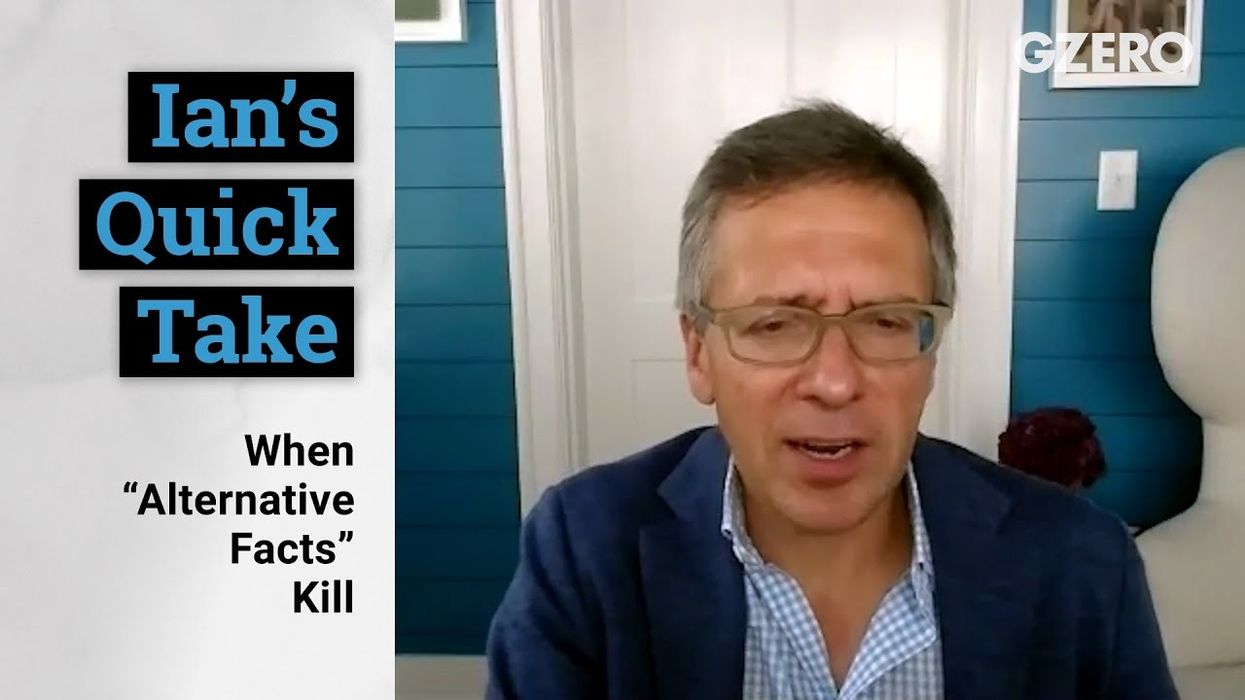
Quick Take: When "alternative facts" kill
September 15, 2020
Ian Bremmer, political scientist and president of Eurasia Group and GZERO Media, shares insights on global political events.
Presented by

Ian Bremmer's Quick Take:
Hey everybody, Ian Bremmer here and I have a quick take, what's going on in the world. I mean, here in the United States, it is nearing 200,000 deaths from coronavirus. Trump doesn't want to talk about the pandemic. And I understand that certainly to the extent that in the next 50 days, if we're talking mostly about the pandemic, that means Trump is losing. But so far that strategy is starting to pan out for him. I mean, not in the polls yet in the sense that he's still down, but if you poll Republicans, they say they're much more concerned about law and order than they are the pandemic, and Democrats are much more concerned about the pandemic than they are law and order. This plays out in a bunch of different ways, first, in terms of how you're going to vote, which is really important. What I've seen is astonishing statistics about overwhelming numbers of Democrats say they're going to vote by mail, overwhelming numbers of Republicans say they're going to vote on the day in person.
First of all, that means it's a lot easier for both sides to say this election has been stolen, it's been mishandled, and they are intending to do that. It's also a lot easier for Trump on the day to say, I won because the votes cast on the day are going to be more in favor of Trump. And as you start counting those ballots, it swings to the Dems. We've seen that historically in other states, but this is going to be far greater given the pandemic. I'm going to be fascinating to see how Facebook responds to Trump's posts that say he won when he hasn't yet. Also fascinated to see what happens on the ground in a number of the states. I'm willing to make the call that this election will be seen as illegitimate by a large piece of the population, certainly something I've never said before in terms of a US presidential election. I say it all the time in terms of elections in other countries, particularly developing countries around the world. The US is not that.
Then there's also the question of how much is fake news starting to affect the overall narrative. I'm sure many of you have seen that QAnon is starting to get serious traffic on Facebook, for example, and among people saying that they believe in some of these conspiracy theories. Look, I understand why they're being promoted. I mean, if you have a question of whether you're going to vote for Trump or vote for cannibal pedophiles, I would vote for Trump over a cannibal pedophile, and I think most people probably would. Some people wouldn't. Don't tell me who you are. I don't really care. But the fact that there's that level conspiracy theory, the sort of thing that you would usually see in places where free media is completely underdeveloped, in the Middle East, for example, many states there. Less Lebanon, less Israel, but more others where the state really controls the whole media, or in Russia, for example, you'd expect to see a lot more conspiracy theory there.
You do, but in the United States, you're starting to see really disturbing levels. I've experienced this in the last two weeks. I would say over the last six months, when I opine publicly about coronavirus and I use numbers from the CDC or from Johns Hopkins or any of the other scientific sites that all are within 1% of each other in terms of numbers of cases and hospitalizations and deaths, overall levels and per capita, people might disagree with my analysis, but they don't disagree with the basic numbers, right? That is now changing. I am now seeing consistently that if you say 200,000 people have died of coronavirus, a significant subset of followers are saying, that's not true. That's fake news. That's a hoax. That actually, it's only 6% of that group has died of coronavirus and the other 94% all had co-morbidities. So they're lying to you.
If you have morbid obesity and you get coronavirus and then you died, you died from coronavirus, not from your morbid obesity. And in fact, one of the easiest way to look at these numbers is to see the excess number of deaths that have occurred in the United States in the last six months compared to what you would normally get, given the size of population. You can do that in different countries around the world and you get a number that's a little bit larger than the total death numbers for coronavirus. I've seen 220,000, 240,000, something around there. Now, to be clear, in a coronavirus environment with lockdowns, people will die from other things like the lockdown. I mean, if you're scared to go into a hospital because everyone there has coronavirus and you've got a serious heart condition, you might have a heart attack and die. No coronavirus, but you were scared to go into the hospital. That kind of thing happens.
People with severe levels of depression who lose their job, sort of become addicted or worsen their addiction on a drug that's dangerous for them, those people will die in larger numbers too. So it's not only about that, but the point is it ain't 6%. When the doctors and scientists are saying 200,000 people have died from coronavirus in advanced industrial economy, you know what? 200,000 people have died of coronavirus. And I understand that Trump wants to change the narrative. I understand that there is a legitimate debate between how fast you reopen the economy and how much you lock down.
Of course, it is a debate that should be had about whether or not you should lock down versus live with the virus, and to what degree. I mean, the lockdowns always in the United States should have been about, we need to buy some time to learn more about the virus, to ensure that hospitals won't get overwhelmed, to improve treatment. And now that you've done those things and you also know a lot more, it makes sense that you should reassess your lockdown. You should reassess what conditions you might put for letting people go back to restaurants and schools and work in the office and all of those things, and I understand that. That is very different from trying to convince people the coronavirus doesn't exist, or is a hoax, or that only 6% of the 200,000 people have actually died from coronavirus.
That is a horrible thing. And when I see more Americans than in many countries saying they're not going to wear a mask for socially distance because it's no big deal, when I see the president of the United States going to Nevada and flouting the rules of the state of Nevada on how many people can congregate in a closed location, indoor location, that blows my mind because it's going to lead to more people getting sick and dying, and that's reprehensible. That's irresponsible. That's what we need not to do. A lot of more people in the United States are going to refuse to take vaccines if they believe the coronavirus is a hoax, because why would you vaccinate yourself or your kids from a hoax. So we need, we need, whether you believe we should stop the lockdowns and stop quarantining and get back to work, I mean, there are lots of real debate you should have about that.
Red state versus blue state, poor versus wealthy, knowledge economy versus service worker versus manufacturing worker, real conversations. But there is no dialogue to be had as to whether or not we need science to inform us on the disease itself. Yes, we do. We need to understand the contours of coronavirus from the doctors, from the epidemiologist, from the scientist, the political decisions we want to take on the back of that, completely different story. But the fact that we have this fake news and that social media, particularly Facebook, but others as well are propagating this and people are believing it is not a place we need to be in the United States, it's not a place we need to be in France right now, they're not a place we need to be as a society. It's going to endanger a lot more people and it's a little sad.
That is your Quick Take for this week. I'll talk to you all again soon.

Keep up with what’s going on around the world - and why it matters.