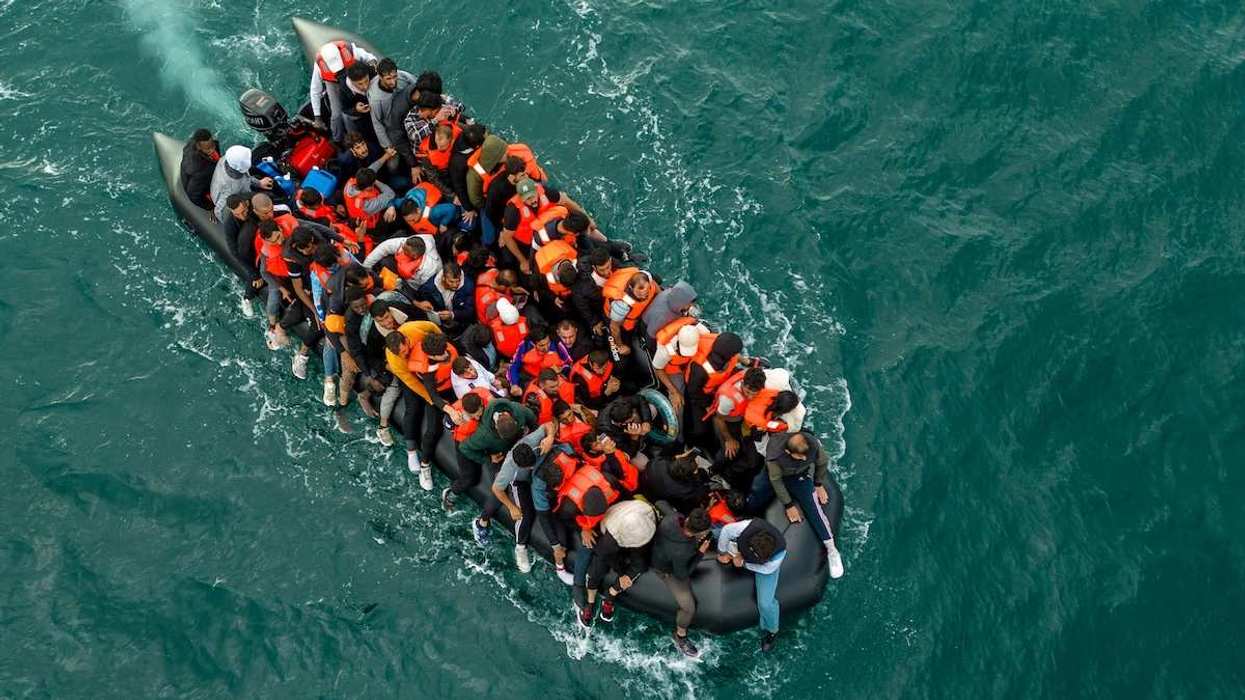
A year into US President Donald Trump’s second term, America’s immigration policy has undergone one of its most sweeping resets in decades. Unauthorized border crossings are at 50 year-lows. While the administration says its focus is the “worst of the worst” criminals, immigration enforcement has expanded to include all undocumented immigrants, with the goal of deporting the most people on record.
At the same time, the administration tightened legal immigration as well, citing national security. It paused all active asylum cases, and signaled it may review some asylum cases granted during Joe Biden’s administration. Temporary protected status, which allows migrants from certain countries in turmoil to live and work in the US, has been revoked for at least 675,000 people. The administration also set a cap of 7,500 refugees in fiscal year 2026, which began in July – the lowest in US history.
Together, the changes mark a shift away from humanitarian protection and legal pathways and toward a system defined largely by enforcement.
To learn more about what this dramatic immigration reset means for the US and for the world, GZERO spoke this week with Leon Rodriguez, the former head of US Citizenship and Immigration Services (USCIS) under former President Barack Obama – an agency that manages legal immigration into the US, including applications for citizenship, green cards, asylum, and refugee resettlement.
He questions Trump’s decision to revoke deportation protections for Venezuelans and says the Obama administration could have done more to create pathways for people to find safe harbor and work in the United States.
Read our full interview below, which has been lightly edited for brevity and clarity.
The US has accepted migrants who would be identified as refugees under modern international laws for close to 80 years now. The number of those admitted has fluctuated from year to year – but they’ve nonetheless continued to be admitted. Why, in your view, has that system endured for so long?
The modern refugee program was started right after World War II, and it was the result of the persecution of many different peoples during the course of the war. This became, for many years, a standard thing, not just by the United States, but by a number of other countries throughout the world that were willing both to accept refugees and to recognize the right of asylum for people who feared going back to their own countries.
I think that's just been a fundamental national value. We're the nation of the Statue of Liberty and Emma Lazarus's poem. That was built into our national identity in terms of how we saw ourselves as Americans. That's something that has been culturally challenged in the last 15 years to 20 years. In a way, that has led to some of the kinds of things that you're now seeing the Trump administration do.
Asylum and refugee admission have long been part of how the United States exercises its foreign policy, and how we respond to various crises. Fully dialing them back is a different formulation - and represents a retreat from how we exercised our foreign policy historically.
One change the Trump administration has made is to strip 675,000 people of Temporary Protected Status (TPS), which allows migrants from certain countries in crisis to live and work in the US. The White House has revoked it for at least 675,000 people on national security grounds.
TPS advocates say it's inhumane to send people back to countries where they might face violence or turmoil. But the Trump administration says recent TPS designations are security risks, and that “temporary” status shouldn’t be a de facto permanent anyway. What’s your thought on that?
Temporary protected status is by its very legal definition, temporary. It only lasts for 18 months at a time. I do see that in most of the cases with which I am familiar, there are good reasons to conclude that people are not able to safely return to those countries.
The example that just baffles me completely is the fact that first on the chopping block was Venezuela, which the administration has declared a narco state and is engaging militarily with ships and boats coming from Venezuela, and demanding that their president resign. But even under those circumstances, it is declaring that Venezuela is safe to return for the people who are currently seeking or have been in temporary protected status in the United States.
One of the interesting aspects about Venezuela’s TPS is that literally one of Trump’s very last acts in his first administration was to extend a benefit called the Deferred Extended Departure to Venezuelan nationals. It’s similar to TPS, but doesn't have the same formalities. It’s also grounded in the foreign policy authority of the United States. That move came on January 19th, right before President Trump left office and Joe Biden took over as president.
Traditionally the USCIS, which you ran, has focused on ways that people can lawfully immigrate and stay in the country. During his Senate confirmation, the current director of USCIS, Joseph Edlow, said that “at its core, the USCIS must be an immigration enforcement agency.” What do you make of that kind of rhetorical shift?
I think it's exactly that. It's a rhetorical shift. The USCIS is an adjudication agency. It's not an enforcement agency. That doesn't mean that it doesn't have enforcement powers. It doesn't mean that it doesn't collaborate with other agencies that have immigration, law enforcement powers, but its adjudication function is really necessary to our way of life as a country.
It is how we get talented people into the United States. It is how to build our economy and help it thrive. It's how we help families to unite. It's how we provide protection to people from places that are experiencing various sorts of crises.
There is always going to be an enforcement dimension to those things, but to not recognize that part of the function is to get the people into the United States who help build our country, who are victims of persecution, who mark us as a country that respects family. The fact that’s not part of the rhetoric, for me, is problematic.
It's not how I would want to see the agency's mission framed. Our country benefits from immigration. We benefit economically, we benefit culturally, we benefit morally in terms of our faith values as a country. The saying that I always used to hear when we trained was “the right benefit to the right person at the right time.”
It's certainly true that USCIS administers the law, but the idea of calling it primarily a law enforcement agency presumes that its only function is to combat violations. That is one purpose of the agency, but it's also to facilitate the admission of people we've decided legally deserve to be here.
During the Obama administration, the country saw the highest number of deportations on record. Trump could break that record soon. Do you think the Obama administration could have done anything differently in hindsight?
That's something that I think about all the time, because clearly part of Donald Trump’s election was a comment on what we had done in the Obama administration.
A big part of me wishes we had done more - rather than the argument that we should have been tougher or more restrictive – I actually feel like we should have had more legal pathways for people to find protection and find work in the United States. That’s always where I personally end up. We definitely don't want irregular immigration. It's dangerous for the people making that trip to the US. It puts a lot of pressure on our country. What we could have done better is to create more legal pathways for people to get here.