Site Navigation
Latest Stories
Sign up for GZERO Daily.
Quick Take
Ian Bremmer, political scientist and president of Eurasia Group and GZERO Media, shares insights on global political events.
Presented by

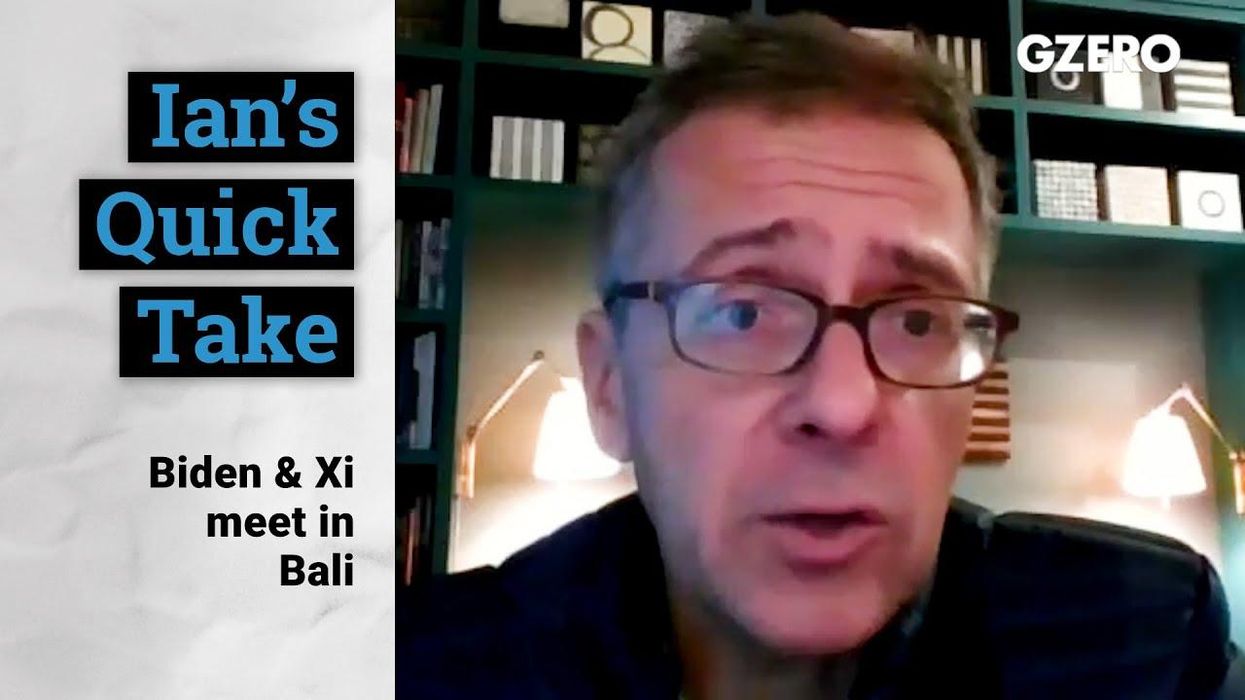
Ian Bremmer's Quick Take: The G-20 of course is in full swing in Bali, Indonesia, and the first face-to-face meeting that Biden has had with Xi Jinping as president. And we shouldn't underestimate this. It's quite unusual. I mean, really unheard of, unprecedented that the two most important leaders on the global stage would have not met in person for two years. And that is indeed the case for Xi Jinping and President Biden. And it's particularly important because these are two leaders that know each other quite well and for a long time. When Biden was vice president, he had a lot of face time in many different venues with then-Vice President Xi, and they got along quite well. They actually like each other, they respect each other. I wouldn't go so far as to say they have a strong relationship of trust, but they enjoy each other's company.
And that's something that you get from Biden when you talk to him. You get the sense that he actually finds that Xi is someone he can deal with. And Biden's perspective on the world is informed by this "great man theory" of international diplomacy, that if you spend enough time with another human being, usually you can improve the relationship. And certainly, I think a big part of this meeting, a three-hour meeting that these two leaders just had on the sidelines of the G-20 is going to make a difference in slowing the escalation and the deterioration of the relationship between these two countries.
There's a lot of significant sharp competition between the United States and China. In many ways, the Biden administration's been more hawkish towards China than the Trump administration was, certainly in terms of trade policy and most specifically technology after the October 7th export controls on semiconductors. This is an overt policy of containment by the United States, and by the way, one that American allies are not really fully signed up for, but the Americans pursued it anyway. US-China policy on Taiwan has been more confrontational than we've seen.
But I think that coming out of today's meeting, you will see first of all, that there will be much more regular high level engagement between the Americans and the Chinese. Very different from the way it was cut off after the Pelosi visit to Taiwan back in August. Secondarily, you'll see that in a number of areas where there isn't direct confrontation like on climate for example, and even on the Russia war, there will be more constructive engagement between the Americans and the Chinese. And the hope from Biden is that you'll be able to do a better job being honest with each other and managing areas of direct conflict as they exist.
And here we're talking primarily Taiwan, South China Sea, East China Sea, national security issues around technology and other dual use trade issues and human rights, the Uyghurs and the rest. But it's a big relationship, it's a complex relationship and it deserves to be a nuanced relationship. And I'd like to believe at least some of the hyperventilating around the likelihood of going to war over Taiwan that we've seen on several occasions over the last nearly 24 months, we will see less of going forward.
I also think that the statement, specifically the restatement between Biden and Xi of no nuclear use in Eurasia, which of course is a pointed criticism at the saber rattling we've seen from President Putin who of course is the one a G-20 member that explicitly said, "Nah, I'm not showing." Up because he doesn't want to be humiliated and isolated by the G-20. But of course, that is the position he's in right now. Xi Jinping is not happy about where the war in Ukraine is going, wants to see an end to it, would certainly support diplomacy. And increasingly the Americans will be in that position too. Not yet because the Americans want the Ukrainians to be able to take as much territory as they can, retake as much of their own territory liberated that's been taken by the Russians. But once that counteroffensive runs out of steam, I think you'll see the Americans and the Chinese in a more similar position on the Russian invasion than they have been in the first nine months. Both sides say that they respect Ukrainian territorial integrity and sovereignty, and that means all the territory that they lost post-February 24th, they should have back. Now, certainly the Chinese will be more sympathetic to the idea that this is partially NATO's fault, but that's not constructive in terms of where the war is going over the next 6, 12, 18 months. And managing potential downside from further escalation and an expansion of the war, including NATO itself, I think is something that the Americans and the Chinese will have a collective interest in. Biden and Xi Jinping both working together on that and having a level of direct regular engagement will be useful in that regard.
So I come out of this saying this meeting went as well as it could have possibly gone given the broader context of where the US and the Chinese are right now, given the difficulties in managing a relationship of two profoundly different systems with different priorities. And that's not going to change anytime soon, but they still need to work together. And I think that that's more credible. And of course, the fact that Xi Jinping now has his third term sewn up and has consolidated an extraordinary amount of power, and that Biden himself is also in a relatively strong position on the back of no wave at all from last Tuesday's US midterm elections will also help, though that only helps in the near-term. Of course, because Biden is going to be facing a Republican House likely who will cause trouble for him. And also, because you've got an American electoral cycle that is still dysfunctional and that the Biden's going to have to fight pretty hard in the next year, two years, and Xi Jinping won't. And of course, that structurally does help. It does benefit the authoritarian over the long-term. Though they've got other challenges economically that are much deeper than the Americans right now that will weaken them.
So anyway, that's where we are. Very interesting. I also do want to give a shout out to the Kremlin and to President Vladimir Putin for the unexpected birthday gift this weekend when they added me to the sanctions list. First time that's ever happened in my life. I'm joined with a lot of very respected and esteemed colleagues like Jim Stavridis, the former head of NATO. And Ivo Daalder, my buddy, the former NATO ambassador. And I saw the Richard Edelman, who runs Edelman Group is on that list. And Tim Snyder, who is not Dan Snyder, thankfully, who is one of the world's greatest living historians. This is a good list. So I guess I'm honored and privileged to be on it. And if what you do to be on it is just try to be honest with everybody. That is the antithesis of where the Russians are right now, and I guess it's where I'm going to be.
More from Quick Take
GZERO Series

GZERO World with Ian Bremmer
Puppet Regime
Quick Take

ask ian
Ian Explains
GZERO Reports
GZERO Europe

The Debrief

GZERO Daily: our free newsletter about global politics
Keep up with what’s going on around the world - and why it matters.