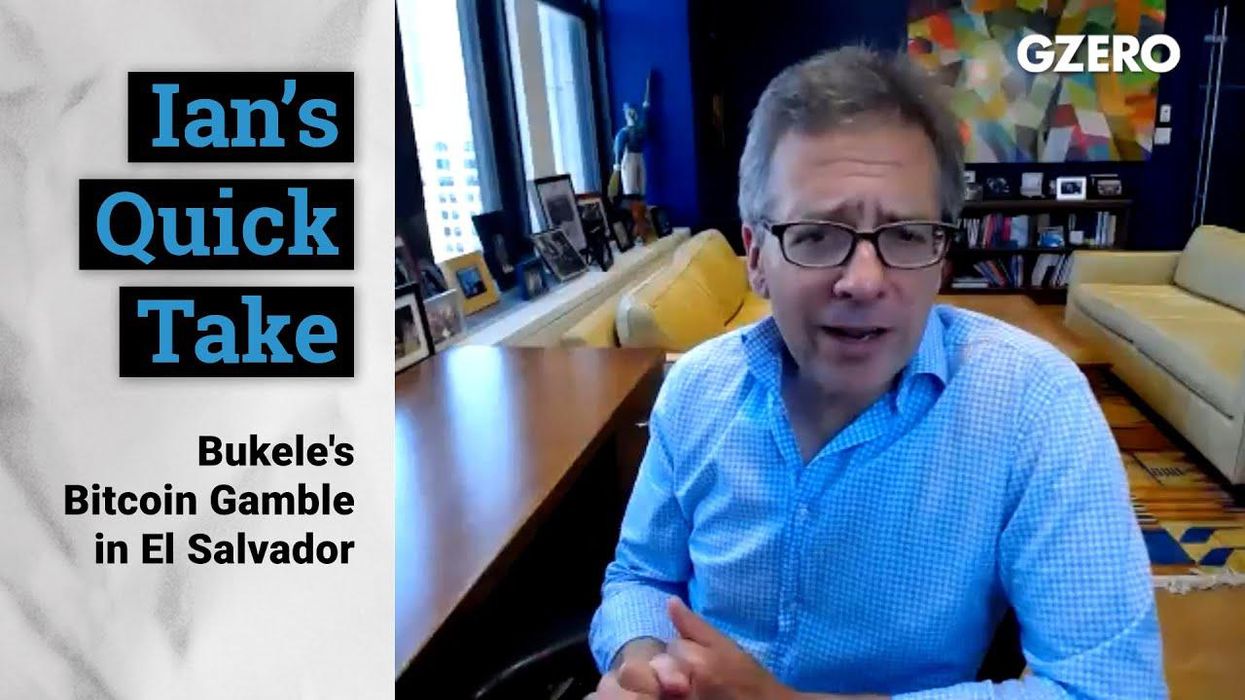
Bukele's Bitcoin gamble in El Salvador
June 07, 2021
Global Stage LIVE from United Nations WATCH REPLAY
Ian Bremmer, political scientist and president of Eurasia Group and GZERO Media, shares insights on global political events.
Presented by

Ian Bremmer's Quick Take:
Hi everybody. Ian Bremmer here, kicking off your week with a Quick Take. Hope everyone's doing well. I thought I would talk about El Salvador, a surprising amount of news coming out of this comparatively small country.
First of all, you've got a president who's been in power now for about a year, Nayib Bukele, he's all of 39 years old and 90% approval ratings, pretty consistent over the last year. And in part, that's because there's been massive violence and huge economic problems and extraordinary corruption in the country. And this is a guy who was a former advertising executive, he was a local mayor, and ran with a lot of charisma, with of course, an enormous amount of social media savvy. In fact, if you follow him on social media, he kind of styles himself the Elon Musk of the Northern Triangle, which is not really a great thing I grant you. The Northern Triangle is like El Salvador, Honduras, and Guatemala. And I mean, I guess if there is one such person that has to be Elon Musk, he's the guy.
But the point is he's really into showing himself as being hip, and technology savvy, and in the moment, and not in anybody's pocket, and I can do whatever I want. And indeed, he has been doing pretty much anything he wants. He said he was going to jail people in El Salvador, in his country, that broke the lockdown. The court said you didn't have the right to do it. He did it anyway. And he occupied parliament with military forces. He's removed his top judges, ignoring the legal process that needs to occur to make that happen. I mean, it feels like there are literally no checks and balances legally on Bukele in El Salvador right now. It's kind of like a Hungary Victor Orban type situation, except when there's no real opposition and the entire population is in favor. And by the way, no European Union either.
Now, there is the equivalent of a check and balance on Bukele and that's not a formal international structure, but rather the fact that his economy is really dependent on the United States. They use the US dollar as currency, and they need support from the IMF because their economy continues to deteriorate. He's handled coronavirus relatively well in terms of spread of cases and whatnot, I mean, almost in a Chinese type way, but that hasn't helped them in terms of getting hit with this massive global recession, the way everybody else has. And if you want support from the IMF, he would need to be much more transparent in the way he governs, which he's not prepared to do. In fact, just this weekend, he arrested yet another high-level opposition member on very dubious corruption claims. And at the same time, disbanded an OAS, Organization American States, unit that was meant to engage in anti-corruption oversight in El Salvador, supported by the United States, said, "I'm not doing that."
So clearly, he is indifferent to the fact that the Americans are not going to allow the IMF, and America's the biggest stakeholder there to engage in further lending. So what do you do? Well, I mean, if you're most leaders, you start putting capital controls on and try to have more direct control of your local economy and your currency, which is really hard to do when you're dollarized. But if you're Bukele, you do something completely unique, which is you say that Bitcoin is going to be the legal tender of El Salvador going forward.
He said, he's going to put legislation in front of the Congress. It will certainly be approved. This will be the first country in the world where Bitcoin is legal tender. Now to be clear, he is not going to be able to make the dollar illegal because a lot of people won't be able to use Bitcoin. Also, if you've watched Bitcoin, it's massively volatile, enormous swings, from dizzying highs to staggering lows sometimes over the course of hours and days. And I mean, if you're a relatively poor person, you don't want your currency to have that level of uncertainty. That's like all of these retail investors invested in GameStop and some of them made millions of dollars and a lot of them were wiped out. And that's why you kind of worry about what happens when the average citizen starts treating the marketplace as a casino.
And here, Bukele is basically saying that's going to be forced upon them. He can get away with it because of his extraordinary popularity, but the challenges for the average El Salvador are really significant, not to mention the fact that Bitcoin is itself hard to transact and expensive to transact in. And so, this is a very interesting new way to think about de-dollarizing. And a bunch of smaller economies around the world that don't have great relationships with the United States and are facing enormous financial pressure, especially if inflation starts picking up in the next year, are going to find this to be very worthwhile watching. It's a serious experiment. A lot of Sub-Saharan African countries, other Central American countries, maybe even some Asian countries. Sri Lanka would be an interesting one to watch because they are in a very similar economic position.
And again, capital controls would be hard for them. But ultimately this is not the thing if you are a crypto advocate that makes you say, "Bitcoin to the moon." It is an interesting thing, geopolitically, because it's one more way that the United States, by trying to weaponize its dollar, to use it as a political and economic club to get countries more aligned with the Washington consensus or else. China is a hedge for some of those countries, Bitcoin is increasingly a hedge for at least one of those countries itself. So pretty interesting stuff. Let's watch El Salvador closely.
Final point. Let's keep in mind that one of the reasons El Salvador is important in the United States is because of so many illegal immigrants coming out of El Salvador because they have no opportunity for themselves and their family, through Mexico, into the United States. It was a problem for Trump, is a problem for Biden, for Kamala Harris. The fact that this president is trying to avoid getting leveraged under America's influence by moving to Bitcoin is something that will make Bitcoin more problematic for US regulators. And so if anything, there's probably more likely to be a backlash when you've got a whole bunch of people saying, "Bitcoin uses too much energy. It's not green. It's used by people that want to engage in illegal activities." And now, it's currency for Nayib Bukele, who's a problem for American national security.
So on balance of, I was going to say, is this a good move for Bitcoin or a bad move for Bitcoin? Geo-politically, I would say it's actually a bad move for Bitcoin, but it's an interesting one for the president of El Salvador. 90% approval, who knew? Okay. Take it easy, avoid fewer people. Talk to you soon.


Keep up with what’s going on around the world - and why it matters.