Site Navigation
Latest Stories
Sign up for GZERO Daily.
Quick Take
Ian Bremmer, political scientist and president of Eurasia Group and GZERO Media, shares insights on global political events.
Presented by

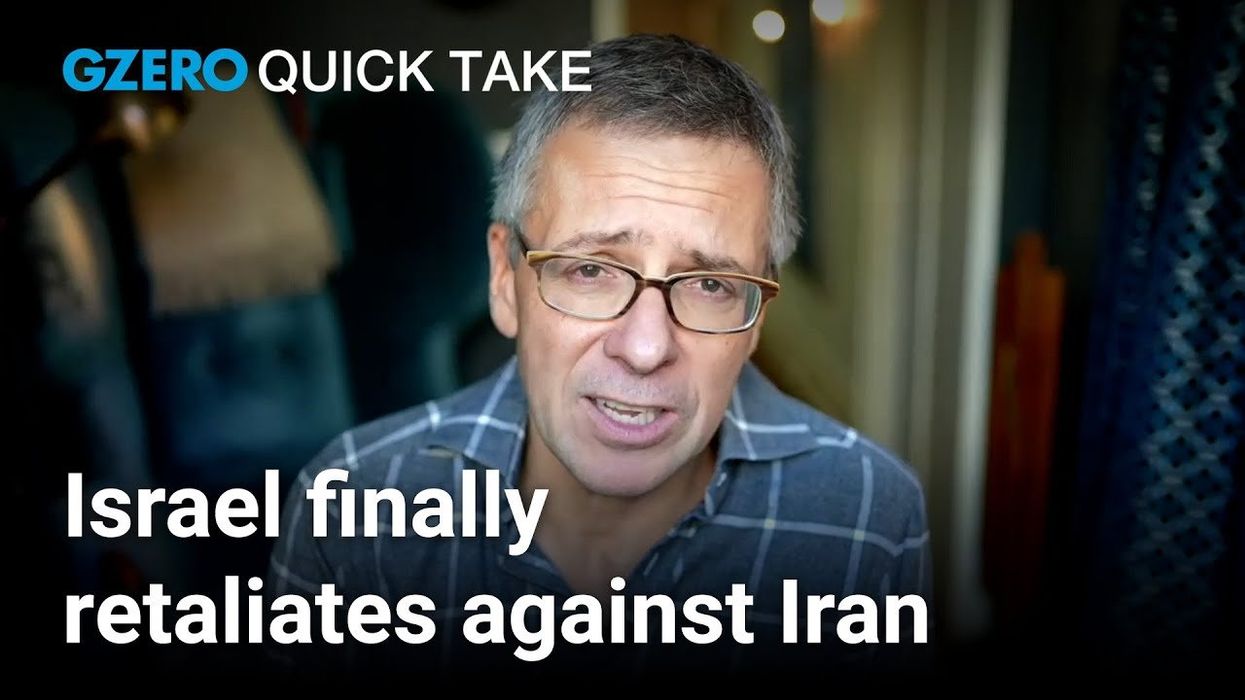
Ian Bremmer's Quick Take: A Quick Take to kick off your week. No, not US elections, that'll be next week. This week. Want to talk about the Middle East and the fact that the Israelis almost a month after Iran launched 180 ballistic missiles at Israel, though most of them didn't get through and no Israeli deaths on the ground, nonetheless, the Israelis expected to respond. And respond they finally have.
Military targets that they focused on. They did some damage, caused more damage to Iran than the Iranians did to Israel during their attack. That's clearly a message that the Israelis intended to send in terms of their ability to have dominance over both escalation and deterrence between the two. Iranian Supreme Leader Khamenei, on the back of that, said not to exaggerate or downplay the strikes, that the Iranians will respond, but also the Iranians said that they fully intercepted the Israeli attack. In other words, nothing big to see here. Crude oil down about 6% today. In other words, this is the end of this escalation cycle between Iran and Israel.
Now, I have been critical of the Biden administration's inability to have much of any impact on Israeli decision-making over the course of this war. This time is a little different, they did have some impact here. And in the early days after the Israelis were hit by Iran, and keep in mind the Iranians got that information that the strike was coming to the United States, the US, of course, immediately shared it with Israel and did everything they could to coordinate with allies in the region to defend Israel effectively, which helped to ensure that the Israelis didn't take casualties, significant casualties.
But also the Biden administration saying they really didn't want Israel to engage in strikes against nuclear targets in Iran, against oil targets in Iran. And they did a couple of things for Israel. First, they sent an additional THAAD missile defense system, which they got to Israel and set up within two weeks on the ground, which is incredible fast-tracking to help further defend Israel.
Secondly, they actually took sanctions, put sanctions on additional tankers that were shutting down their transponders and shipping oil illegally for Iranian export. Not everything. The Iranians have over a million barrels a day that they get out, but probably took about 200,000 barrels a day off the market. In other words, that's money that the Iranians no longer have access to that they were able to use for whatever they wanted, including paying for Iranian proxies that target Israel.
In response for that and American diplomacy, the Israelis ended up, I would argue, with a slightly more restrained strike against Iran. They did engage in hits against Iranian missile production facilities, as well as defense against their ... that helps to defend their nuclear, their research program and weapons program, such as it is, which means that Israel has made it very clear to Iran that if they want to do this again, that Iran is not going to be able to defend itself effectively. So the message has been very, very clearly sent.
Of course, it was also helpful for Israel that they were able to kill Sinwar, the Palestinian Hamas leader, in Rafah, in Gaza, over the past couple of weeks. I mean, the Israeli war cabinet is flying high from a military perspective right now. They didn't need to show great capacity against Iran, nor have they, given their recent successes against Hezbollah.
I think it's interesting how Iran is responding to all of this, that we're seeing Iranian leaders, not just on the president and foreign affairs side, who are more reformist in orientation, but also recently Ali Velayati, who's an advisor to the Supreme Leader, saying that the Iranians are very interested in engaging more with the West, specifically with Europe. In other words, with the Iranians seeing that they are clearly on the back foot vis-a-vis Israel, is there any way that they can more effectively engage with the West, normalized relations, maybe end up with more money for their economy that way?
Certainly, I expect that they are also thinking heavily about what else they can do in their nuclear program, either illicitly or maybe with Russian support. But for now, it looks like Israel's policies vis-a-vis Iran have played out successfully, in part because they are the strongest military game without question in town.
That's where we are right now. Those are the latest headlines, and for the next week we're going to be talking a lot about US elections. I'll talk to you all real soon.
More from Quick Take
GZERO Series
GZERO World with Ian Bremmer

Puppet Regime

Quick Take

ask ian
Ian Explains

GZERO Reports

GZERO Europe

The Debrief

GZERO Daily: our free newsletter about global politics
Keep up with what’s going on around the world - and why it matters.