Trump-Putin chat over Ukraine "deeply" worries Europe
February 13, 2025
Ian Bremmer, political scientist and president of Eurasia Group and GZERO Media, shares insights on global political events.
Presented by

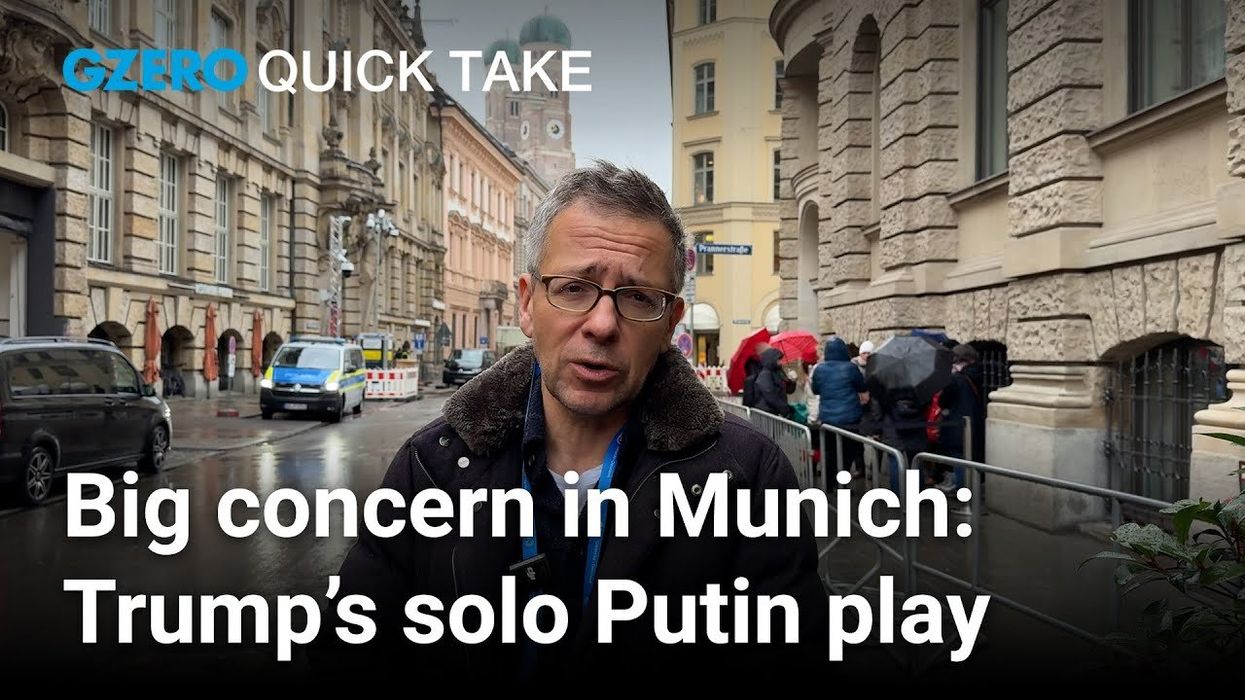
Ian Bremmer's Quick Take: A Quick Take from Munich, Germany, where the Munich Security Conference is just about to kick off. And it is going to be a historic meeting, and not necessarily in a good way.
Everyone I've been speaking to here, deeply concerned about the sudden conversation, 90-minute conversation, with a full readout from, both the Kremlin and from the United States, between Donald Trump and Vladimir Putin. Not so much concerned that a conversation took place, rather that it happened, and Trump is engaging unilaterally without coordinating in advance with the Ukrainians or the Europeans. And in that regard, very, very different than what we've seen over the first three years of the war.
Look, there's no question, everyone does want to see the war wind down. Everyone would love to see a ceasefire. The question is, how and what does the NATO alliance look like after that? What does Europe look like in terms of its engagement, its trust with the United States, the transatlantic relationship? And, of course, what happens with Ukraine? The statements that have been made by Trump and by Secretary of Defense Pete Hegseth are things that we've heard a lot about privately, not just from the Trump administration, from the Europeans, from the Biden administration too, the idea that NATO membership is not in the cards, long-term, if there's going to be some sort of formal peace agreement, that Ukraine is going to have to give up some kind of territory, not that they should, not that that's reasonable, not they don't have territorial integrity, but there's no way for them to get back all the territory that they had back in 2014. Those are things that have now been said publicly by the Americans. But they are being said both unilaterally and also in advance of any negotiation. In other words, concessions are being made to the Russians before both sides sit down. And that is, of course, a very significant concern, for the Europeans and the Ukrainians.
There is also a question what kind of security guarantees would be provided to Ukraine? According to the United States, certainly will not involve Americans on the ground. No troops. Would be European troops. They're the ones that have to do the bulk of the lifting. They're the ones that have to ensure that there was a response if Ukraine were attacked again, after a ceasefire. Now, it's not that the Americans are suddenly washing their hands of all of this. In fact, the first cabinet official to go to Kiev from the Trump administration, just met with Zelensky in the last 24-hours; that’s Secretary of Treasury Scott Bessent. Why Treasury? Because Trump is trying to get something for giving something. It's transactional, as he always is. And in this case, focusing on critical minerals from Ukraine. Nominally, the number is some $500 billion of what would be Ukrainian resources to the United States in return for ongoing, US military support for Ukraine.
Outgoing German Chancellor Olaf Scholz said, “This is selfish, the Americans shouldn't be doing this.” The Ukrainian president, who actually has to work with the Americans going forward, unlike Scholz, saying, “What a great offer. Happy to talk to you. Want to find a way to make this work?” So, on the one hand, it's not as if the United States is leaving Ukraine high and dry. And certainly, a level of engagement between the Americans and the Russians is very important. It’s essential going forward. But of course, what Putin wants is a deal not only to his favor, but not just about Ukraine. He wants to be talking just to the Americans, and he wants to be talking to them about missile defense, about NATO enlargement, about a whole range of issues that he has, that he takes issue with. And that's something that Trump is perfectly interested in.
At the end of the day, Trump is a lot more interested in cutting a deal for himself that allows the Americans to focus a lot more on China and on Asia, from a security perspective, than working with the Europeans to try to do something collectively on Ukraine. And this is the biggest challenge and also the biggest difference between Trump and Biden, in terms of foreign policy. Biden fundamentally believe that a strong Europe, coordinated with the United States, was long-term in American interests. President Trump does not. He believes that a strong Europe is a bad thing. He wants to see more exits, like Brexit, from other countries. He supports Euro-skeptic movements across Europe. He would much rather have individual negotiations with individual European countries where the Americans are stronger.
What does that mean for the Munich Security Conference? What does it mean for NATO? What does it mean for the transatlantic relationship? Long-term, nothing good. Final point here, the Europeans are taking this seriously, but it's late. They've been told, by Americans for several administrations now, they need to be spending more time and more money on their own defense, their own collective security. Macron has talked about it a fair amount in France. The Polish government is certainly taking the lead on that, especially after the Russians invade Ukraine. But most European governments aren't taking it nearly as seriously and aren't prepared to spend the money. And that reality, for decades now, made much more stark and severe with the Russian invasion in 2014 of Ukraine, which the Europeans did virtually nothing about, and now, when 2022, you've got Trump coming in and saying, “I'm not going to do this,” that's forcing the Europeans in a much more stark way, but also much too late for them to get their act together, in my view.
So, we'll see what we see over the next couple of days, but this is going to be a very, again, historic Munich Security Conference. Glad to be here, and we'll talk to you soon.



Keep up with what’s going on around the world - and why it matters.