Ukraine hopes for Europe's help as US negotiates with Russia
February 18, 2025
Global Stage LIVE from United Nations WATCH REPLAY
Ian Bremmer, political scientist and president of Eurasia Group and GZERO Media, shares insights on global political events.
Presented by

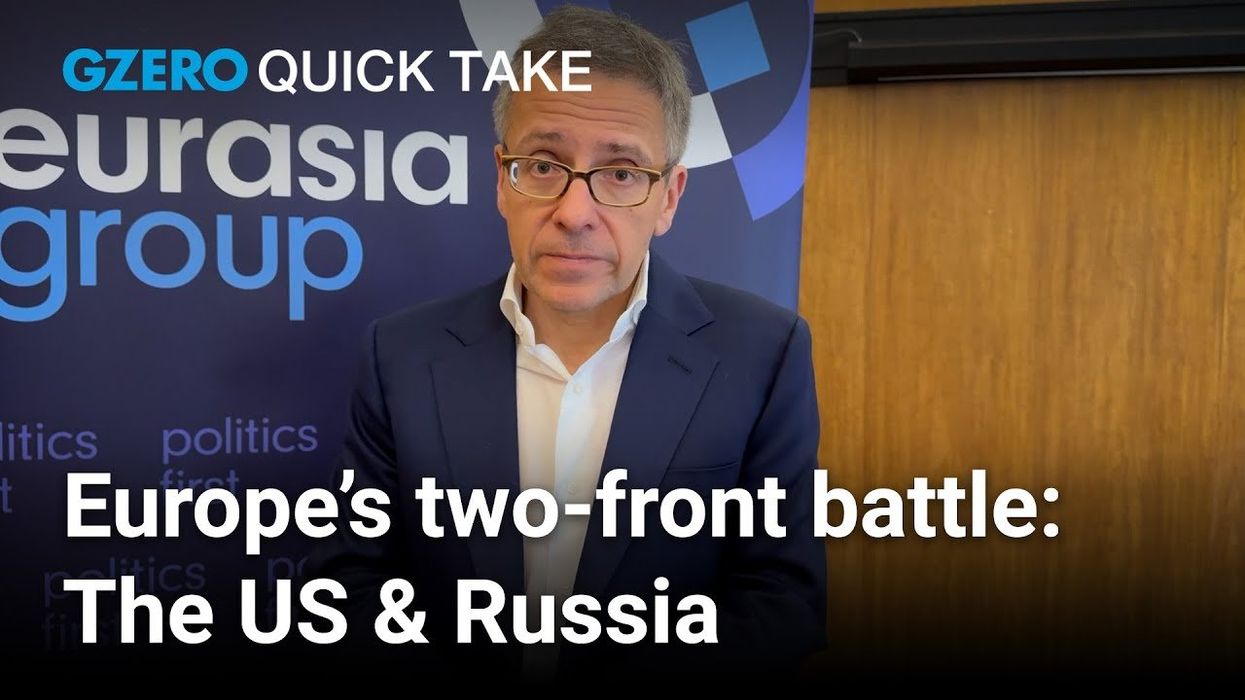
Ian Bremmer's Quick Take: So much going on around the major confrontation between Russia and Ukraine. The Americans now meeting with the Russians in Riyadh while the Europeans have had an immediate emergency summit, many of them. Not all of the EU, but rather if you will, a coalition of the capable and willing in Paris yesterday.
Where is all of this going? Well, the Europeans clearly now understand that they need to come up with a deal that includes Ukraine before the Americans and Russians create some kind of grand bargain, or a deal will be made over their heads, and probably one that they are not going to be very happy with. President Zelensky of Ukraine is looking much more desperate in this environment, understanding that he is in trouble, not only because his forces are having a hard time maintaining the front lines, that's been true for a while now, but also because he is in danger of losing the United States.
The deal that was offered by Secretary of Treasury Bessent to Zelensky in Kyiv in the past days was exploitative. It was referred to by Zelensky as colonial. It would have meant 50% of development rights, exploitation rights of European resources, Ukrainian resources would go to the United States in a privately held company that the Americans would own. And that this was going to pay primarily for aid that had already been given to the Ukrainians. In other words, under the Biden administration, which is kind of unprecedented and staggering, but nonetheless was the offer. He immediately rejected it, but of course, that has led to a big rift all of a sudden between the United States and Ukraine at a time where Zelensky had been doing everything possible to say, "Yes, we know we need peace. Yes, we know we need to work with Trump. Trump is a peacemaker. We're going to engage." That is a very different position right now.
So, he is counting more on the Europeans, but can the Europeans give him anything? Well, coming out of the meeting in Paris, the answer is not so much. First of all, because Olaf Scholz, who is still chancellor for another week before the Germans have elections, said that it was premature to talk about peacekeepers. Premature? When the Americans are about to cut a deal with the Russians, it's not premature. It's way too late. So Olaf looked weak, he looked bitter, and he undermined any possible consensus. So, this meeting was a real problem.
Still, you had Macron, who was talking about the need to commit peacekeepers. You had the Brits, who wavered. They were saying they're definitely going to commit, but only if there's American backstop, which the United States wouldn't support. Poland had said, "No," because they need all of their troops in Poland, which is a sign of great weakness there and deep concern. The Baltics, the Nordics, they would certainly provide something. It is going to take time, though, and time is one thing they do not have.
We will see what comes out of the Marco Rubio meeting that he is leading his delegation in Riyadh together with a super team of major negotiators from Russia. I say super team because that's the way it's been presented on Russian state media. They have been, for the last 24 hours, extolling Trump, extolling the importance of the special presidential plane they are bringing down to Riyadh for these meetings, talking about the potential of recreating an order between the United States and Russia that is not just about Ukraine, but is about NATO containment. Is about engaging in, essentially carving up the world a sphere of influence orientation, where the Russians get a piece of the Arctic, and the Americans get a piece of the Arctic. And the Russians have their territorial ambitions codified, and the Americans have their own territorial ambitions codified. It is absolutely the antithesis of the world that the Europeans want and that frankly, the Americans had been standing for post-World War II.
Increasingly, the Europeans feel like they are fighting a two-front war, from the Russians on one side who are a direct national security threat, and the Americans who are saying that the Europeans' threat is from inside the house and that the EU is a problem, and you want people who are going to make Europe great again, like the AfD in Germany, who 80% of the Germans consider to be a neo-Nazi party. This is a crisis for the transatlantic relationship. It is a crisis for NATO. The secretary general, indeed, attending those meetings in Paris, what he has to say between the Europeans and the Americans, I'd hate to be in his position right now.
Anyway, lots happening every day. That's where we are right now, and I'll talk to you all real soon.


Keep up with what’s going on around the world - and why it matters.