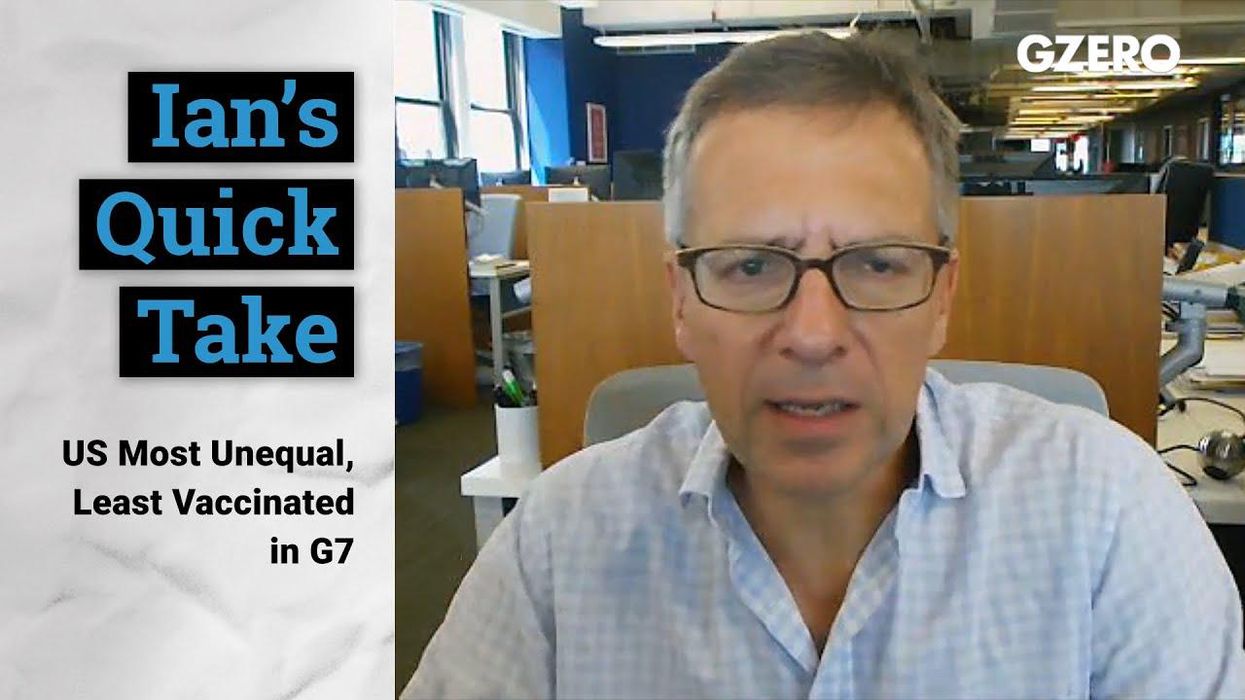
US most unequal, least vaccinated in G7
September 13, 2021
Global Stage LIVE from United Nations WATCH REPLAY
Ian Bremmer, political scientist and president of Eurasia Group and GZERO Media, shares insights on global political events.
Presented by

Ian Bremmer's Quick Take:
Hi everybody, Ian Bremmer here. Welcome to your week, happy to be back in the offices, of course, in New York City. And by the way, and what do I have at my desk here? A fan sent me a Moose the dog cookie, which how does one eat that? You can't eat that because it's Moose, you just keep it! But that's pretty awesome, a Norfolk Terrier in a cookie right there, very talented. Thank you so much.
And let's get started. So what I was thinking about as I saw over this weekend, today. Not only is the United States today the most economically-unequal of the G7 advanced industrial democracies, and the most politically divided, but we're also now in terms of first jabs of the COVID vaccine, we are the least vaccinated of the G7, which is annoying because we were the most vaccinated of the G7 months ago. And of course, all of this speaks to the fact that the United States is enormously wealthy, enormously powerful, there are so many great things about this country, but the politics are deeply, deeply screwed up. And the problems we have are self-inflicted.
And after the 9/11 commemorations this weekend, which I thought were very well done, and I thought the speeches across the spectrum were good, and did reflect both the seriousness of the event and the tragedy of the event, but also how much work is ahead of us today. But if you look at what 20 years of the global War on Terror did and did not accomplish in terms of America's position in the world, in my view, it's not that it distracted us from fighting China. I would say that the problem there was the foreign policy establishment in the US thinking that the Chinese were poor and could never innovate on their own, and to the extent that they became developed, they'd have to align with us or they'd fail.
So it was a level of exceptionalism and arrogance. And it's not like the Americans can't chew gum and walk at the same time. We are capable of having a few thousand troops in Afghanistan and still talking about, and dealing with China. Rather, I think that 20 years of the global War on Terror, both at home and internationally, allowed us to forget about the work that needs to be done all the time to be an effective democracy, to be an example for ourselves, and to be an example internationally. Because the United States is not just a superpower, we are a superpower, but more importantly, the example of our power internationally, and the power of our example for ourselves is a big piece of what makes America the great power that it is. And that is something that has eroded significantly over the last 20 years. And again, and I don't think that this is about the power position of the United States. I think that China is actually creating backlash faster internationally than the United States is, concerning its allies.
And furthermore, I mean, I think if you look around the world, the Asians particularly, very, very worried about Xi Jinping and Chinese consolidation domestically, focusing on their authoritarian and state capitalist consolidated model, and also expanding in their backyard, whether it's about Hong Kong, or recent statements about Taiwan, or the expansion in the South China Sea, the nine-dash line, all of that is making them much more desirous to see American leadership in the region, irrespective of what's happened inside the United States or what happened over the last 20 years in the global War on Terror.
If you're Canada, if you're in Mexico, you have no choice. Whatever you think of the United States, your economies are completely integrated with the US, you're going absolutely nowhere. If you are Europe, you're much more concerned, but you don't actually want to pay for the alternative. Strategic autonomy that the French and the Germans talk about, the willingness to create alternative defense models to build the kind of robust diplomatic engagement internationally that would create an alternative to American leadership, there just isn't even the beginning of that. And of course that's made harder post-Brexit, and it's also made harder post-Merkel. There was just a big debate for the German elections last night, the three main candidates to succeed Angela Merkel, and foreign policy literally was not discussed. And that tells you a lot about what the Germans think is and is not a priority these days.
Now there are other countries that clearly are less aligned with the United States, but that has a lot to do with the fact that the Americans just don't care as much, and now we're talking about the Middle East, and we're talking about Eurasia. And so whether it's the Americans saying, "Well, Ukraine, Georgia, we like your governments, but we're not really prepared to defend you if you get invaded." Or, "Afghanistan, we liked your government, but it's far away, and it's way too expensive. We don't really want to persist on the ground even with a small footprint going forward." In Syria, we say, "Assad has to go," but actually we're not really willing to do anything about it. And so the Russians, the Turks, the Iranians can take over. I mean, that is broadly speaking a part of the world that just does not matter as much to the average American, or to the American national security interest. And as a consequence, there's more of a power vacuum in a lot of those places.
But American legitimacy in terms of, to what extent its power as an example to others, its rulemaking capacity and interest, its moral legitimacy and suasion, those things are really eroding significantly. And 20 years after 9/11, those are the things the Americans need to be focusing on much more. That should be the lesson from 20 after 9/11, the lesson should be that the last act of the United States in the war of Afghanistan was 10 Afghan civilians getting killed mistakenly when we thought we were taking out a suicide bomber that was going to attack the Hamid Karzai International Airport, we were wrong.
And how many times do we need to be wrong, and do so many hundreds and thousands of people, millions of people, that are displaced from these wars need to suffer the ultimate price as a consequence? The torture, the illegal renditions, those were things the Americans did in service of national security and to fight terror, but as a consequence we hurt our own moral authority. We hurt what America stands for, who the Americans need to be, the country we want to be internationally, at least I think we want to be; I certainly want us to be.
And at home, the increasing surveillance, the lack of privacy, the erosion of civil liberties and human rights, this is something that we can't take for granted. And 20 years of the War on Terror have absolutely eroded those rights inside the United States. And now our country is more divided than it's been at any point in any of our lifetimes, it's worse than 1968. You'd have to go back to the gilded age before the Great Depression to see an American economy that was as divided, even though we are, of course, as a whole so much wealthier now, and you'd have to go back really to the election of 1876 before you saw a polity that was so incredibly divided.
And that's why the news of this weekend, that suddenly the United States is less vaccinated with its first jabs than any other G7 country, we've got the vaccines, but suddenly it's become tribal warfare in the United States about whether or not you want to be vaccinated. And that's an insane thing. But in a country that's this divided, where your way of sticking it to the man is saying that you're opposed to the thing that they're telling you to do, because you know that you can hurt them as a consequence, and we see this, it's so pernicious, it's so dangerous to our system, and it is decidedly worse than in any other advanced industrial economy. You do not see this level of dysfunction in the UK, in Canada, in Germany, in France, in Japan. And those are the lessons we need to be taking 20 years after 9/11, after the global War on Terror got started.
So, I hope that's a little interesting to kick off this week. Those are my thoughts, and I'll be with you all real soon. Be good.

Keep up with what’s going on around the world - and why it matters.