Site Navigation
Latest Stories
Sign up for GZERO Daily.
Quick Take
Ian Bremmer, political scientist and president of Eurasia Group and GZERO Media, shares insights on global political events.
Presented by

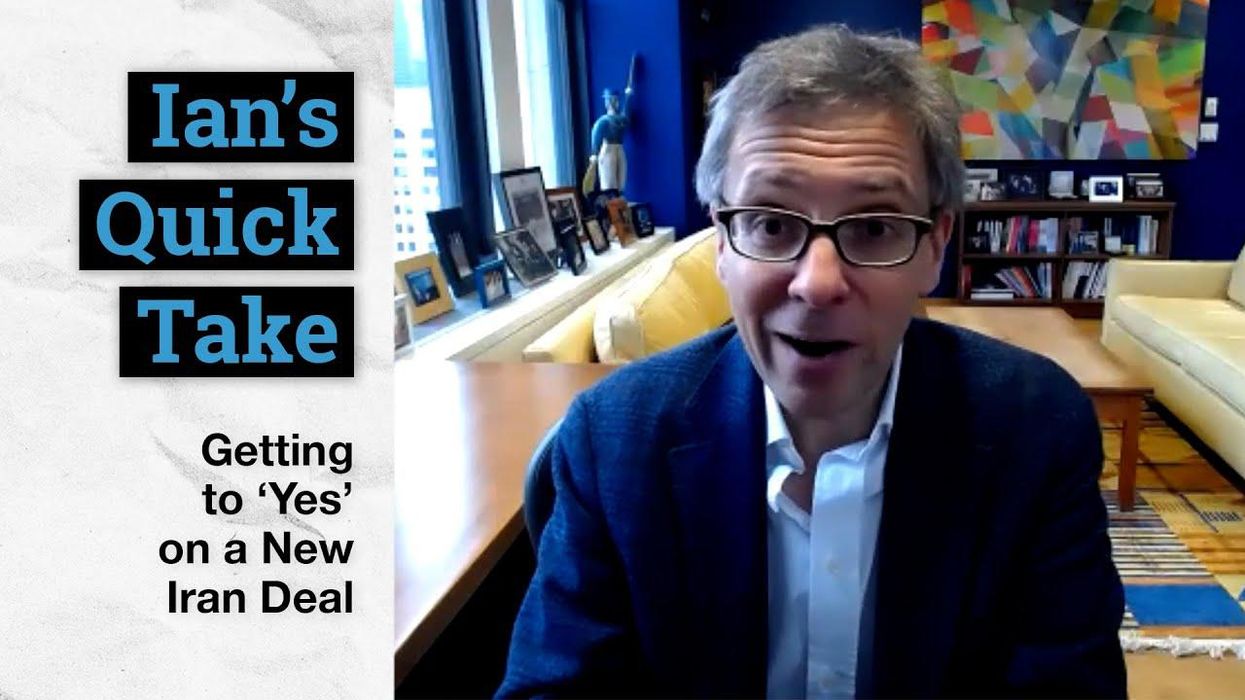
Ian Bremmer's Quick Take:
Hi everybody. Ian Bremmer here. Welcome to your week and I've got your Quick Take and thought I would talk a little bit about where we are with Iran. One of the Biden administration's promises upon election was to get the Americans back into the JCPOA, the Iranian nuclear deal. As of last week, negotiations are formally restarted, and pretty quickly, in Vienna, they're not direct. The Americans and Iranians are both there, but they're being intermediated by the Europeans because they're not yet ready to show that they can talk directly to each other. That's Iran being cautious in the run-up to their presidential election coming this summer. But the movement is there. So far the talk has largely been about sequencing the Iranian government, saying that all of the sanctions need to be removed before they're willing to go back into the deal, because the Americans after all, unilaterally withdrew from a deal that the Iranians were indeed adhering to, and the inspections did confirm that.
The Americans are saying, we don't care. We're much larger than you are. You have now taken steps Iran, to enrich uranium beyond the levels that they had committed to in the deal. They've stockpiled that enriched uranium, they've kicked inspectors out, so they have to show that they are actually back in the confines of the deal. And once they do that, which will take a few months, then you can in lock step bring the American sanctions off. And the Iranians are not prepared to say that they'll accept that, they will get there. And so, if this were just about the United States and Iran finding a way to get back to yes, especially because the people that are actually in the room, the negotiators working level from Iran and the United States include many of the same people that actually put together this deal to begin with, back in 2015, 2016, under the Obama administration. That makes it a lot easier.
Everybody wants to get to yes. But not everybody outside the room wants to get to yes. And we've seen, in quite spectacular fashion over the last several days, a major cyberattack. Looks like it destroyed the independent power source for Iran's nuclear facility in Natanz. One of the most important assessments are that this is taking their nuclear capabilities to develop enrich uranium off some nine months potentially, which makes it a lot harder for the Iranians to push the Americans and say, here's what we're going to do with our program if you don't come back to the deals. So, it undermines their leverage. But it also makes the hardliners in Iran say, why do we want to do this deal at all? Because we've got a big fight with the West. Here we are trying to be somewhat more accountable and they're going to hit us no matter what. The attack from Israeli sources, Iranian sources and American sources, the attack came from Israel.
Why would Israel engage in strikes to undermine the effort by its principal ally, the United States, to get back into the deal? Well, to answer that question we need to go back to 2013, 2015, and ask why then prime minister Bibi Netanyahu, in charge, just as he is right now, sort of, get to that in a second, was willing to do everything he could to individually lobby lawmakers in the United States, and even make a trip to have a speech in front of Congress, to undermine the coming nuclear deal. While Obama, the president of the United States was doing everything possible to get that deal done. So, the fact that the United States and Israel are allies does not mean that they see eye to eye on this. The fact that America is vastly more powerful than Israel and is an enormous supporter of Israel intelligence and defense, does not mean that the Israelis will align with the United States on an issue that is seen to be vastly more important to their own national security, that of a potential Iranian nuclear program, and the enrichment of the Iranian government.
And so, back in 2013, 15, Netanyahu was doing everything possible to see if they could screw up the deal on the American side. They know they can't do that now, because the Biden administration and Congress is completely supportive on the democratic side of getting this deal done. So, what they're trying to do is see if they can undermine the Iranian position. Get the Iranians so angry that they escalate and blow up the prospects of getting this deal done. We've seen some of that with some Israeli strikes against Iranian militias in Syria. We've seen some of that with Israel engaged in what looks to be mining of Iranian ships most recently in The Red Sea. And now, certainly not a coincidence, this massive cyberattack against an Iranian nuclear facility. Clearly the Biden administration is going to be very upset about this. I am sure there is no love lost between Jake Sullivan, Antony Blinken and their counterparts in Israel right now.
But having said that, it's not going to kill the deal. The Iranian government isn't going to take the bait. If they engage in strikes, they will take their time and they will be targeted against Israeli targets, they will not hit the United States. It was very interesting that the foreign minister of Iran, Javad Zarif, was focused on the Little Satan, as they referred to Israel, as opposed to Great Satan, the United States. They're differentiating Satan's which is certainly an important message from Iran. So, I think this is significant. I think it's worth watching. But I also think that by the end of the year, there will be an agreement for the Americans and Iranians to get back into the deal. Keep in mind that the window for the number of years this deal applies is pretty narrow now. I mean, before the Iranians would be able to restart their production, and again the sanctions would snap back, I suspect at the very least, they're going to want to extend the number of years for which the deal applies by five, for example, that seems smart.
They won't be able to get further agreements on things like ballistic missiles and Iran's support for organizations across the region that the US considers to be terrorists. What that also means is that the United States is not going to remove all of the sanctions against Iran. This deal is important in so far as it allows Iran to produce an export, another million barrels of oil a day, that brings the price down. It's important in so far as it prevents verifiably, the Iranians from developing nuclear weapons capabilities, at least for as long as the deal is in place.
But beyond that, it does very little. It doesn't stop them from developing ballistic missiles. Doesn't stop them from engaging in attacks against the United States and its allies in the region. It doesn't end American sanctions against Iran. It doesn't open the Iranian economy for business with American financial organizations or those of other countries that want to do business with those American firms. So, that's where we are right now. It's fascinating geopolitical stuff. We are still very much on track for a deal that does matter, but not everybody is happy about it, and it's going to be pretty controversial. So, that's a little bit from me. Hope everyone is safe and avoid fewer people. We are getting there. Talk to you soon.
More from Quick Take
GZERO Series
GZERO World with Ian Bremmer
Puppet Regime
Quick Take

ask ian
Ian Explains
GZERO Reports
GZERO Europe
The Debrief

GZERO Daily: our free newsletter about global politics
Keep up with what’s going on around the world - and why it matters.