Search
AI-powered search, human-powered content.
scroll to top arrow or icon

Are markets becoming immune to disruptive geopolitics?

There’s no escaping the intricate link between economics and geopolitics. Today, that link has become a crucial factor in investment decision-making, and who better to speak to that than Margaret Franklin, CEO of CFA Institute, a global organization of investment professionals? Franklin sat down with GZERO’s Tony Maciulis at a Global Stage event for the IMF-World Bank spring meetings this week.

Economists once predicted that sovereign debt would overwhelm global markets. But now, having been through the pandemic, the advent of AI, and wars in the Middle East and Ukraine, “there's almost a level of immunity,” she says, “to the dramatic nature of it until something really cataclysmic happens.”


And then? “The response, generally speaking, has been pretty positive,” Franklin says, with central bank intervention saving markets and building resilience.

In much the same way, the World Bank is trying to boost investor confidence by making changes that leverage private sector capital for public sector goals by better evaluating what level of risk the private sector will accept.

Individual investors should do the same, Franklin advises. “Really evaluate your risk profile … making sure you diversify,” she says, noting that fixed-income offerings have become more attractive. Younger investors, meanwhile, need to be cautious with getting their information on social media, she adds.
For more of our 2024 IMF/World Bank Spring Meetings coverage, visit Global Stage.

More from Global Stage

Can we use AI to secure the world's digital future?

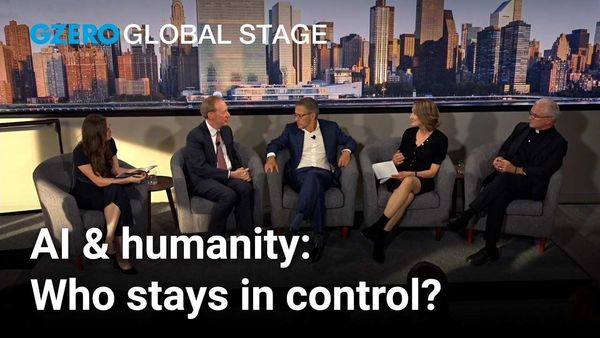
How do we ensure AI is safe, available to everyone, and enhancing productivity? It’s a big topic at this year’s UN General Assembly. That’s why GZERO’s Global Stage livestream brought together leading experts at the heart of the action for “Live from the United Nations: Securing our Digital Future,” an event produced in partnership between the Complex Risk Analytics Fund, or CRAF’d, and GZERO Media’s Global Stage series, sponsored by Microsoft.

Is the Europe-US rift leaving us all vulnerable?

As the tense and politically charged 2025 Munich Security Conference draws to a close, GZERO’s Global Stage series presents a conversation about strained relationships between the US and Europe, Ukraine's path ahead, and rising threats in cyberspace.

Can we rebuild the Internet for democracy?

At the 2026 Munich Security Conference, entrepreneur and Project Liberty founder Frank McCourt makes the case that the internet, and the AI systems rapidly reshaping it, must be redesigned to serve people, not platforms.

Ian Bremmer: The US–China AI space has “Zero Trust”

China was largely absent from the core conversations at the 2026 Munich Security Conference. That, says Ian Bremmer, is telling.

Why countries are picking their own alliances

At the 62nd Munich Security Conference, Parag Khanna, founder and CEO of AlphaGeo, says globalization isn't dead, it's evolving. Speaking with GZERO’s Tony Maciulis, he explains that countries are forming flexible alliances that expand and shrink based on their interests. “You’d rather be in the tent...if it suits your interest than not in it,” Khanna notes, highlighting how the US, Europe, and Asia are adapting to shifting global priorities.

What does “sovereign cloud” really mean?

Sovereignty has become one of the most powerful, and least defined, words in tech policy. At the 2026 Munich Security Conference, SAP global head of government affairs, Wolfgang Dierker, explains why governments and enterprise customers are demanding more control over their data, cloud infrastructure, and AI systems amid rising geopolitical uncertainty.