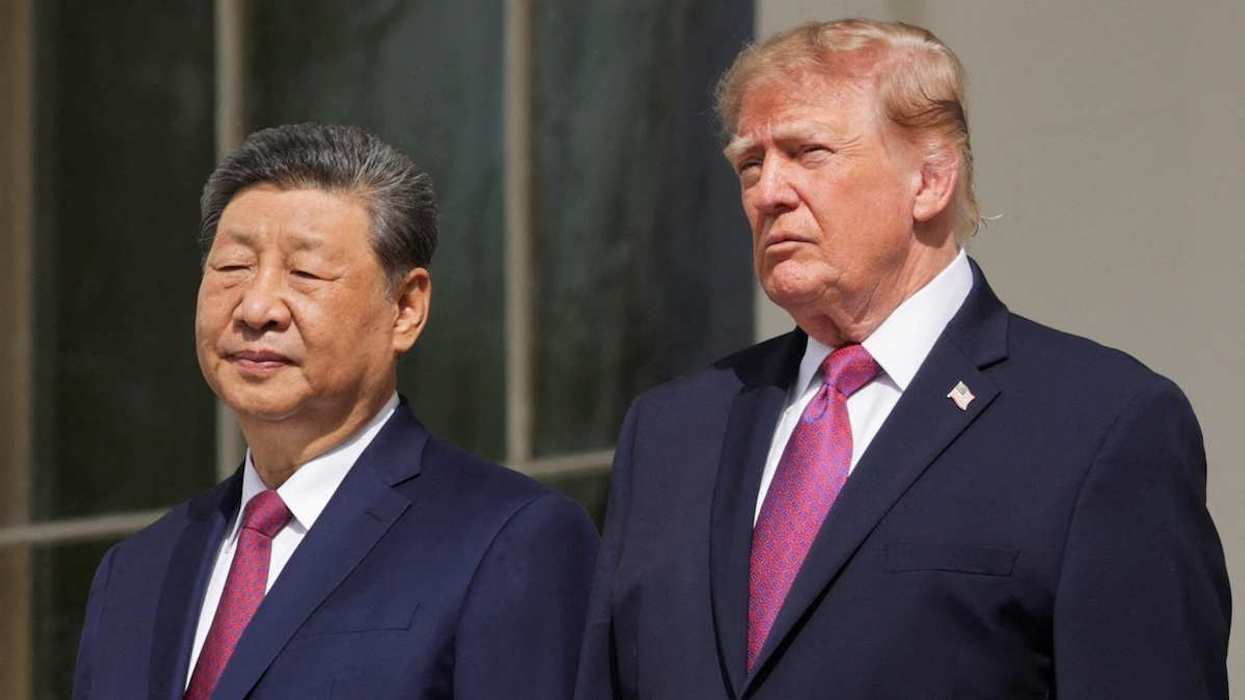
This last week has provided a distillation of US President Donald Trump’s view on how American military might should be deployed at home and abroad.
On the heels of the US’s ousting of Venezuela’s dictator Nicolás Maduro, the US appeared poised to strike Iran on behalf of the government's brutality against protesters, after reports suggested thousands have been killed. By Wednesday evening, Trump’s threats to intervene caused Tehran to change course. According to the president, “very important sources on the other side” informed him that the “killing” of protesters had stopped, suggesting US military action, at least for now, is in a holding pattern.
Meanwhile, about 5,000 miles closer to Washington, a very different set of demonstrations is playing out – and drawing a sharply different response from the same president. In Minnesota, protests have escalated after an ICE agent fatally shot an unarmed woman, Renee Good, during demonstrations against the administration's immigration enforcement efforts. In a Truth Social post on Tuesday, Trump warned Minnesotans a “day of reckoning and retribution” is coming, blaming state Democrats for the unrest. By this morning, he threatened to invoke the Insurrection Act, which would allow the president to deploy military forces to police the protests.
To be clear, these protests are starkly different. Iranian protesters are challenging an illegitimate government, while ICE is operating under a democratically elected president who campaigned on tougher immigration enforcement.
But Trump’s reaction to both reveals a new split-screen in Trump’s agenda: intervention abroad, and a hard-line response to unrest at home. And beyond his base, these policies pose risks of alienating Americans.
In Iran, as protests rock the regime from within, the administration sees an opportunity. Washington views the unrest as a chance to weaken a regime and its regional proxies that have opposed the US and its allies in the Middle East. Trump’s focus on Iran comes amid a strong pivot toward foreign intervention, particularly after a US military operation ousted Venezuelan strongman Nicolás Maduro.“Trump wants to project power abroad to demonstrate his assertive global posture in the wake of Venezuela,” says Eurasia Group analyst Noah Daponte-Smith.
Trump is seeking a compliant Iranian regime that gives concessions in nuclear talks and curtails its regional influence – an outcome he got in Venezuela – but Iran’s Supreme Leader Ali Khamenei has spent decades signaling he’d rather die or rule over ruins than accept terms he views as surrender.
Trump’s outward assertiveness sits uneasily with Trump’s “America First” campaign pledge to limit US involvement abroad and refocus resources at home. In this first year back in office, the US has bombed seven countries and is proposing buying Greenland for $700 billion, an idea just 17% of Americans agree with. Following the strikes on Venezuela, 45% of Americans polled said that the US should be less involved in solving the world’s problems.
Some Republicans have pushed back. Rep. Thomas Massie and former Rep. Marjorie Taylor Greene have criticized Trump for abandoning his non-interventionist stance. Still, Trump has not lost his core base.
“It’s possible this administration can walk and chew gum at the same time,” says Daponte-Smith, who notes that even as Trump has focused on Venezuela, Greenland, and Iran, he has continued to roll out domestic policy initiatives.
“The question for voters will be whether he can actually deliver on those ahead of the midterms – not whether he is spending ‘too much’ time on foreign affairs,” says Daponte-Smith. And if his crackdown on immigration protests begets more protests, the situation could unravel, overshadowing his other domestic initiatives.
How voters will respond to an increasingly visible and militarized immigration crackdown – especially if it expands to other cities – could carry political consequences. “Everyone I know has at least seen an ICE patrol, some people have seen them checking papers or questioning people,” said Daniel Jensen, a 37-year-old Minnesota resident. Jensen noted there are checkpoints at freeway off ramps and bus stops. “It’s all consuming and absolutely way worse than I ever thought it would be.”
Minneapolis Mayor Jacob Frey said that the number of immigration officers agents now outnumber local police. The Trump administration sent 1,000 more officers on Monday, bringing the number in the city to roughly 3,000.
As with much of US politics, Daponte-Smith explains the crackdown has been Minneapolis polarized on partisan lines, with Democrats largely opposed and Republicans broadly supportive.
The pivotal group may be independents. A separate poll showed that only 20% of the group saw the Minneapolis ICE shooting as justified. It is “likely that Trump is alienating independents with this crackdown,” Daponte-Smith says, “which will be a problem in the midterms."