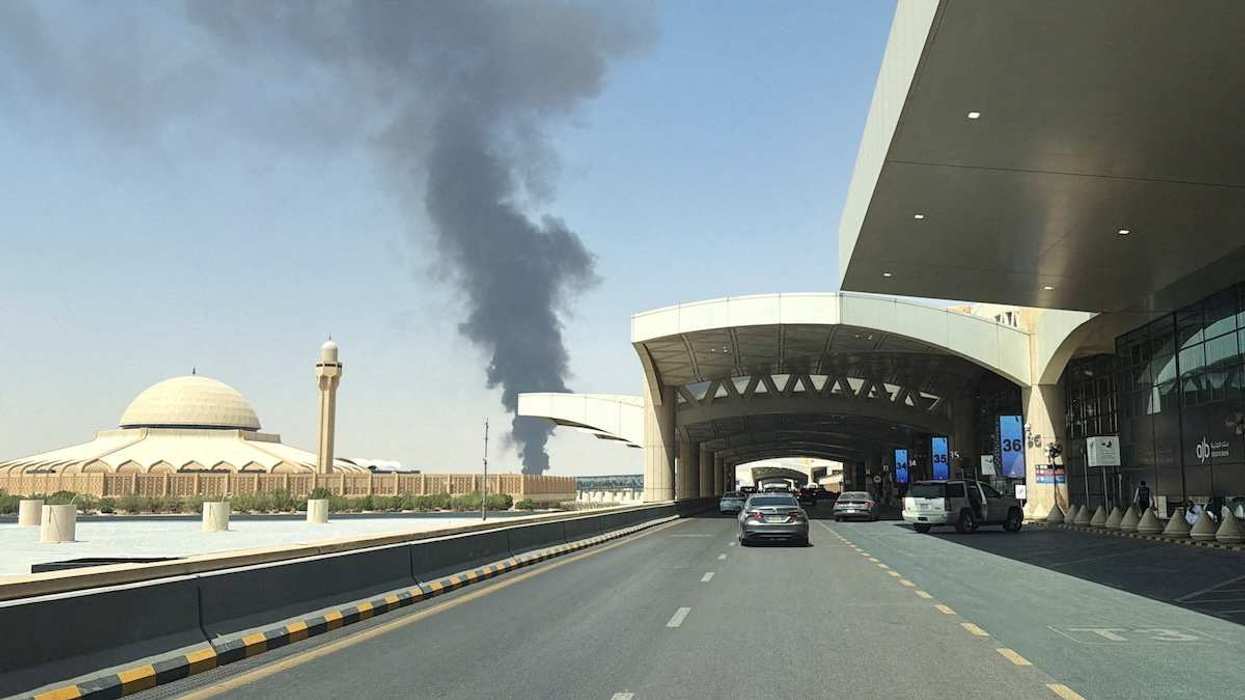
The Trump administration has been rapidly expanding US forces in the Middle East, and is reportedly considering strikes in the region that could escalate into a full-fledged war.
Yet it took 90 minutes for US President Donald Trump to mention Iran during his one-hour-and-48-minute State of the Union address last night. With the midterm campaign effectively kicking off with the first primary elections next week, Trump instead focused on domestic issues like the economy, energy, and immigration. Foreign policy, no longer a top priority for US voters at the polls, was relegated to a kind of postscript, padding what became the longest SOTU address in history.
While Trump did speak for a few minutes about Iran, suggesting he remains open to a deal, he was sparing in his details about what action the United States could take there. His remarks were even more frugal in other areas of his foreign policy agenda. GZERO seeks to fill in the gaps.
The Russia-Ukraine war
Even though it was four years to the day that the former KGB agent ignited the Kremlin’s full-scale invasion of Ukraine, Trump spent a total of 20 seconds discussing the war there. He berated the significant death toll it has wrought, and reiterated a now-familiar refrain that it “would have never happened if I were president.” He made no reference to Russian President Vladimir Putin.
It was a stark difference from the State of the Union four years ago, when then-President Joe Biden opened his address with a lengthy diatribe against Russia’s invasion, just six days after it began.
“Throughout our history we’ve learned this lesson,” Biden said in 2022. “When dictators do not pay a price for their aggression, they cause more chaos.”
While Biden unrelentingly bashed Putin during his time in office, Trump himself has flitted between criticizing and praising the Russian leader since returning to the White House. Trump and Putin have spoken several times by phone and even met in Alaska last summer. Despite Trump’s pledge to end the war within 24 hours, he hasn’t been able to make Putin relent on his territorial demands and make a deal. What’s more, there has been little progress in recent US-brokered negotiations between Russia and Ukraine, as this newsletter noted yesterday.
The future of Gaza
Trump did reference the recent war between Israel and Hamas, touting his role in negotiating the return of all the hostages that the militant group seized during the Oct. 7, 2023, attacks. Clinching a ceasefire deal there has been one of his biggest foreign policy achievements.
Yet he skipped over what the future administration of Gaza looks like.
This came just days after his newly-minted Board of Peace held its inaugural meeting in Washington, D.C., during which nine members pledged to contribute a combined $7 billion for Gaza’s reconstruction. Five countries also said they would deploy peacekeeping troops to the enclave to secure the streets.
Trump, though, didn’t mention these pledges. The reasons for this are unclear, but it may have something to do with the challenge the Board faces in effectuating long-term peace between the Israelis and Palestinians. The main obstacle right now appears to be Hamas’ disarmament, a condition of the second phase of the ceasefire deal that the militant group has refused to comply with. When the Board of Peace met last week, it offered few ideas for achieving this. Trump didn’t offer anything further last night.
Other conflicts only partially resolved
In the House chamber last night, Trump reiterated his claim that he had ended eight wars. Yet a few remain unresolved.
The border crisis between Cambodia and Thailand isn’t as intense as it was last summer, but the two countries have flitted in and out of ceasefire agreements Trump oversaw last July. While Trump took credit for ending the war between India and Pakistan in Kashmir last spring, New Delhi rejects that he played a role, and Pakistan is still ravaged by insecurity. Trump has also claimed that he resolved a dispute between Egypt and Ethiopia over Africa’s largest dam, yet the issue remains unresolved – and Addis Ababa may now have to separately focus on preventing another civil war outbreak.
One area where Trump can take more credit – and he has done so – is the seizure of Venezuelan strongman Nicolás Maduro earlier this year, a move that had much support in certain Latino pockets of South Florida. In a surprise move last night, Trump brought out Enrique Márquez, a Venezuelan opposition leader and former presidential candidate who had been recently freed from prison, to reunite with his niece.
Yet there is still uncertainty about who will run the Latin American country of roughly 27 million people going forward. Trump said the US is working closely with interim President Delcy Rodríguez, but opposition leader María Corina Machado is still pushing for elections to take place within the next year. It’s also unclear whether the US will even be able to access Venezuela’s vast oil reserves, as companies like Exxon declare the country “uninvestable” under current conditions.
The numbers Trump really cares about
The US president’s main aim last night wasn’t to tout his foreign policy agenda, but rather to convince the US public that the economy is working for them. He pointed to energy, healthcare, and housing costs, as well as the stock market.
“When I spoke in this chamber 12 months ago, I had just inherited a nation in crisis, with a stagnant economy,” Trump said last night. “But tonight, after just one year, I can say with dignity and pride that we have achieved a transformation like no one has ever seen before and a turnaround for the ages.”
Yet the American public doesn’t appear to agree. Only 28% of Americans believed Trump’s policies had boosted the country’s economic conditions, per a Pew survey from January, whereas 52% said they had made them worse. This appears to be affecting Trump’s overall approval rating, which dropped 12 points over the last year to just 36%, per CNN/SRSS polling. The drop was especially pronounced among independents.
With the midterms getting underway next week with primaries in Arkansas, North Carolina, and Texas, Republicans are desperately trying to complete the mammoth task of holding onto both the House and Senate. Trump sought last night to deflect frustrations about the economy onto Democrats.
“Now, the same people in this chamber who voted for those [economic] disasters suddenly used the word ‘affordability,’” Trump lamented. “They knew their statements were a lie, they knew it, they knew their statements were a dirty, rotten lie. Their policies created the high prices. Our policies are rapidly ending them.”