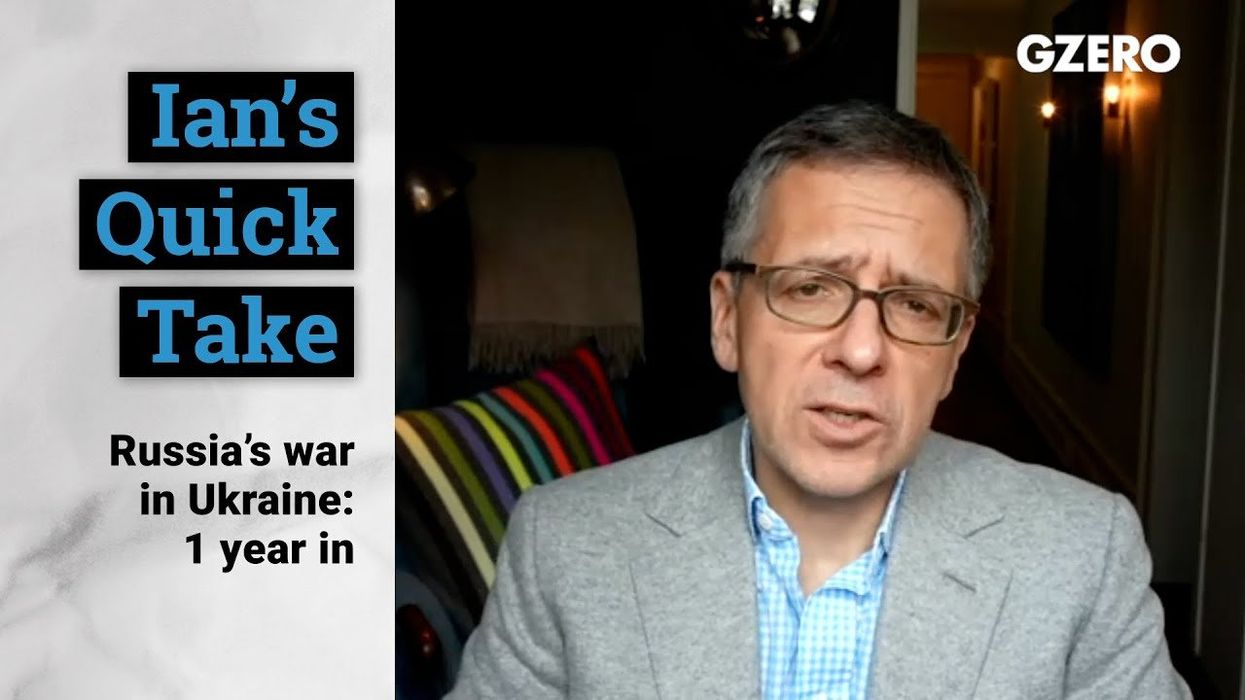
A diminished Russia and uncertain Ukraine
February 24, 2023
Ian Bremmer, political scientist and president of Eurasia Group and GZERO Media, shares insights on global political events.
Presented by

Ian Bremmer's Quick Take: Hi everybody, Ian Bremmer here, and it is one year after Russia's invasion in Ukraine has begun. The war, of course, continues to persist. What do we think about it and where are we going from here?
Well, first point is that in terms of the impact on the global environment so far, what we have is the Ukrainians suffering massively, the Russians expending enormous amounts of military capacity and trying to continue to rebuild it. The Europeans coming together with the United States in unprecedented fashion, NATO, the EU, the G7 much stronger and more cohesive than they were before. But also, the Europeans in particular shouldering a lot of those economic costs because they're the ones that can't do business with the Russians anymore, they have to spend much more on their own defense, and they're going to be fighting an asymmetric war with Russia as a rogue state going forward.
So end of the peace dividend permanently for the Europeans, while the Russians are increasingly decoupled from the West, a rogue state from the West. What does that mean going forward? It means that the Ukrainians can still very much lose this battle on the ground if the West were to no longer support them to the degree that they presently have been, but that the Russians are clearly losing globally in terms of their position on the global stage as a global partner.
NATO expanding, massive increases in capabilities for the Ukrainians economically, militarily as a principal enemy of Russia, and of course the Baltic states: Poland, the Nordics, all the frontline countries dealing with Russia even on the other side of the Russians massive geographical expanse, the Japanese as well.
Now, going forward, we do not know what's going to happen on the ground in Ukraine. We know that the Ukrainians are trying as hard as they can to get more ammunition from the United States and allies that would allow them to engage in a new counter-offensive, probably in April or in May, really depends on how quickly and how much of that ammunition they're able to secure, it can't just come from the US if they don't have enough. It has to come from other countries as well, South Korea certainly providing some, Israel, some others.
It's not about planes, F-16s, it's really not about tanks, it's about ammunition, and it's about continuing to train and stand-up Ukrainian troops on the ground that can fight. So when that happens, there's a lot of uncertainty about what the fight is going to look like on the ground. The Ukrainians might take a fair amount of territory, they might just take a little, or maybe the Russians with more troops are able to hold their defenses.
But either way, we're not looking at Ukraine being able to retake all of the territory they've lost since February 24th, and we're certainly not looking at Russia being able to push back and take Kyiv, remove Zelensky. If anything, Russia would maybe consolidate control over two of four of the territories that have illegally annexed, Donetsk and Luhansk.
At that point, there is a more open question about whether negotiations will go forward. Let's keep in mind back in September, October, the White House position was do everything you can to support the Ukrainians, see how much land they can get back, and then we can maybe talk about negotiations. They did that, the Ukrainians took some territory, no talk of negotiations. The Ukrainians still want to fight. They don't want to give up any land. The West isn't forcing them too.
That is going to play out again over this spring and summer, questions will be to what extent the Ukrainians think they can still afford to continue this fight, and is the West still providing the same level of support, and are they believed to be willing to going forward? Republicans getting softer, some independents, Europeans watching the Americans very carefully on this front, an electoral cycle playing out in the US. Lots of things that potentially go a little bit more wrong for the Ukrainians than over the course of the first year.
So I do think we're starting to see a little more softness in the coalition in the coming six months than we have over the last year. Clearly, the Russians are aware of that, Putin's aware of that, the Ukrainians are as well that's why they don't want to fight forever. They understand that they need to get as much support as humanly possible so that they can move the war more in their direction in the near-term.
Also, a country aware of it, China. The fact that the Chinese have decided to put their thumb on the scale with a peace plan right now does reflect the fact that they see nobody in the West pushing for negotiations, but the West starting to get a little weaker in terms of their coalition. So the Chinese see space, and the very interesting thing about their 12-point plan is that if you didn't know it came from China, the Indians could have written it, the Brazilians could have written it, the South Africans could have written it.
This was carefully put together by the Chinese to describe the overall perspective of a majority of the world's population, pretty much the entire developing world who supports Ukrainian territorial integrity in a way the Russians obviously don't, don't want to see nukes use, weapons of mass destruction used, but also want an end to sanctions, and want a cease-fire. That is the position of the so-called Global South, and China basically got there first.
Now, the United States hasn't had very much to say about it. They're certainly not going to support a Chinese peace plan, especially when the Ukrainians are not going to get behind. But that provides some space for the Russians to say we are more aligned with the Chinese, also facilitates Xi Jinping going to Moscow in the coming weeks or months, which I fully expect he will do, and that makes the Chinese geopolitical position stronger from their perspective.
Now, the one thing that I would be surprised by is if the potential threat to provide direct military support goes through from China. Because if they do that, then the Americans and Europeans come much stronger together, not just on Russia, but also on China, which is the opposite of what Xi Jinping with his charm offensive has wanted over the course of the past couple of months. He's trying to get his economy back in order and he wants to engage more with everyone on the business and economic side, not just with the developing world.
So that's where we are. Ukraine is in a position where they can lose a lot more than they have lost already. The Russians, on the other hand, cannot win on the global stage. Their economy will be more and more constrained over time. Their security position will be worse and worse over time. That is all about Putin's own misjudgment.
I think that in a year's time, we will not be spending this much time talking about Ukraine. Instead, we will broaden the aperture on the war. We will talk much more about. I fear that is where we're going ahead. I wish it were not the case. I hope I'm wrong, but that's where I think we're presently going.
So that's it for me, I hope everyone's well, and that's your one anniversary of the Russian invasion of Ukraine.

Keep up with what’s going on around the world - and why it matters.