Site Navigation
Latest Stories
Sign up for GZERO Daily.
Quick Take
Ian Bremmer, political scientist and president of Eurasia Group and GZERO Media, shares insights on global political events.
Presented by

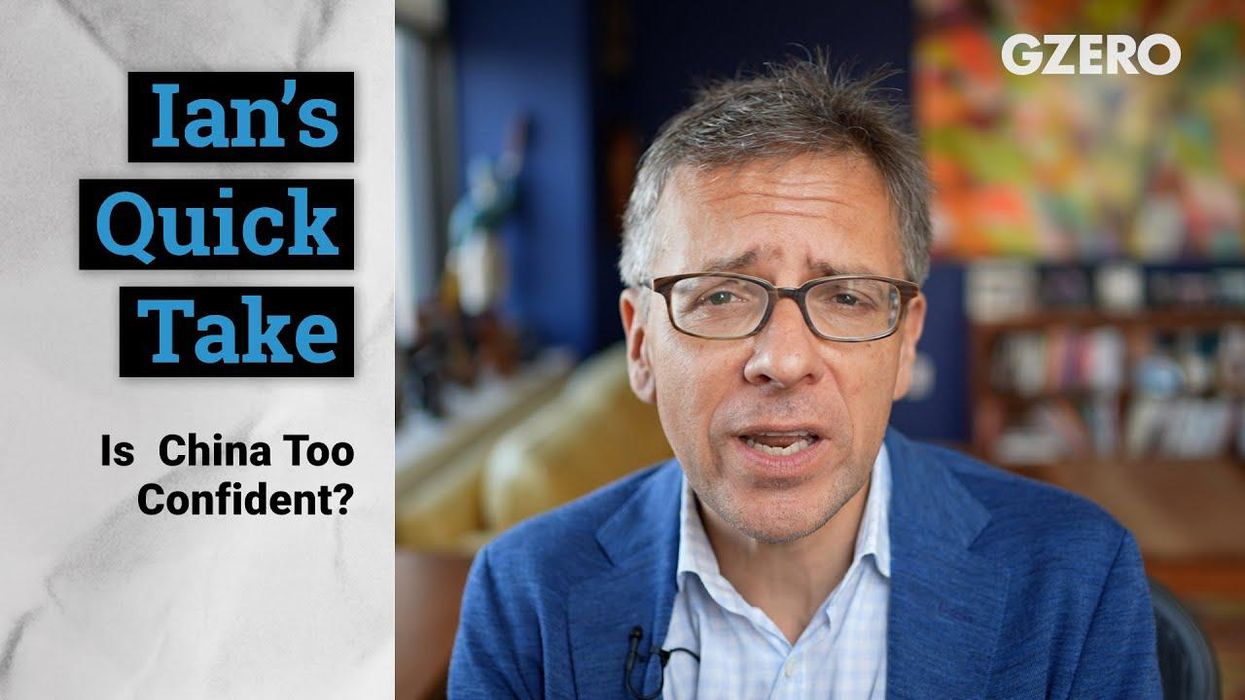
Ian Bremmer's Quick Take:
Hi, everybody, Ian Bremmer here. Happy Monday. Have your Quick Take to start off the week. I want to talk a little bit about China and the backlash to China. We all know that China has been the top international focus of the Biden administration, considered to be the top national security threat, adversary, competitor of the United States. On top of the fact that there's large bipartisan agreement about that, on top of the fact that President Biden doesn't want to be seen in any way as potentially weak on China, to be vulnerable to the Republicans if he were to do so.
The pivot to Asia is indeed happening. This is part of the effort to quickly wrap up after 20 years, the War in Afghanistan, a reduction in US military footprint on the ground. Across the Middle East, an effort to make the Russia relationship more predictable, more stable. All of that is part of the focus on China. And then specifically in Asia, further with the Quad, the United States, Japan, Australia, and India, the first invitation of a foreign leader to the United States to meet with President Biden, that was Japanese Prime Minister Suga.
Very unusual, if you don't pay attention to the fact that Japan is the most effective and important ally of the United States in Asia, vis-a-vis China. Second invitation, South Korean President Moon. Not the Germans, not the Canadians, no, South Korean President Moon. Only makes sense if you consider China to be the top priority.
Now what's interesting is that in the context of that, four years ago, you would have expected the Chinese government to be engaging much more with other Western countries, an effort to split the United States from its allies to ensure that the Chinese don't have a block of Western democracies against them, but mostly the United States. Certainly easy to do when it's Trump's America First, than when it's President Biden, who was more liked by American allies. But still the Chinese as the world's soon-to-be largest economy, have a lot of influence with other countries around the world. You'd think they want to play it.
The interesting thing is, they're not. Indeed, there has been a lot of backlash from other non-American advanced industrial democracies in part because the Chinese have been so angry about criticism from them. Think about the Australian trade war with China. Kicked off by the Chinese in response to the Australian government saying, even before the Trump administration, that they wanted investigations into the origins of COVID. Did it, or did it not come from a nature, from a wet market or escape inadvertently from a Chinese lab? China went all in against Australia in response to that. They got some criticism from the Europeans on the Uyghurs. They knew the Uyghur issue was coming.
There's a greater focus on human rights issues coming out of various parts of the European Union. In response, the Chinese government puts direct sanctions against members of European Parliament. Anyone advising Xi Jinping would have known that was going to blow up in their face. As a consequence, there was a suspension of the much-lauded EU-China investment deal, which was a big deal. It got approved in principle though, not ratified, right before Biden took office. It was a big win for China. Now, not such a big win for China. Italian government, Italian Prime Minister Mario Draghi, saying that he's thinking seriously about pulling his country out of China's Belt and Road. It was the first G7 economy to join Belt and Road. What a loss that would be.
Lithuania pulled out of the "16+1", the Chinese engagement to try to split the Central and Eastern European countries away from the Western European countries. These are the countries that more need Chinese investment. They're largely poorer. They want to ensure they have as much infrastructure support as possible. China has Hungary's Viktor Orban, but most of the Central and Eastern European countries now are counting a lot more on redistribution from the EU, and the support of Germany than they are of the Chinese and the Chinese government made it easier for that shift to occur.
In Canada, the two Michaels, who have been in detention for no legal, legitimate reason and have been mistreated, some say, have even been tortured. This would be a fairly easy thing for the Chinese government to resolve in the run-up to the Beijing Olympics. So far, they've shown no signs of actually doing that. When I look around the world right now, I see all sorts of efforts of the Chinese government, not just to go tit for tat with US escalation, but also to make it easier for the United States to coordinate an escalated competitor, China policy with that of all sorts of American allies.
And so that leads to the question of why is that happening? Why is the Chinese government making it easier for the United States? Why are we seeing this surfeit of advanced industrial democracies around the world all at the same time, showing that they are themselves angrier with China? And I would say that there are a few different things at play here. One is lots of confidence inside the Chinese leadership of China's model. You saw that a little bit after the 2008 financial crisis, global financial crisis. And then when the United States rebounded sharply, it largely went away.
But for a period of months, there was a lot of sense of the US financial system doesn't work, Western capitalism doesn't work. Look at what the banks are doing, look at the Occupy Wall Street movement. We do better for our working to middle class. And so, we should move away from the dollar. We should create our own BRICS Bank currency. Well, it became pretty clear from the economic advisors of the China leadership that that was way, way premature and wrong. And so they backed into more cooperation with the United States and the West.
This time around coming after Coronavirus, where the Chinese economy was the only major economy in the world to grow in 2020, maybe this is just an overhang of the feeling that China got it right. And the United States and Europe couldn't deal with it. And so they're not going to take that level of criticism. They feel much more confident that the model, the political model, the economic model, the technological model that is built to last, that is built for the duration is the Chinese model, not the Western model.
And so to the extent that they're going to recognize that they've played too confident, too hard, it's going to take longer because that level of confidence is a lot greater, a lot more deeply rooted and entrenched than it was in 2008, 2009. That is certainly one piece of it. A second piece of it. It is maybe because Xi Jinping has consolidated so much power today compared to five years ago, 10 years ago, that it's harder to get him good, but critical information that some of his policies are not succeeding.
We have seen this certainly in and around Russia with President Putin over the past years, when he first became president and then prime minister, and then president again. He would display an enormous amount of capacity for understanding details of Russian foreign policy and defense policy, energy policy, privatizations, corporations, policies towards state-owned enterprises. Putin doesn't do that as much anymore, and I suspect part of that is because he no longer has either the interest or the people around him that are going to give him unfiltered, unblemished, "This is what's really going on." If that is now starting to happen in China, then Xi Jinping, who calls the preponderance of the shots is actually thinking he's doing a better job internationally than he really is.
A bit of the "Emperor Has No Clothes" going on in China right now. And I'm sure there's at least some piece of that. And then the final point is that it might be increasingly hard for the Chinese government to admit domestically that they've gotten things wrong, especially with the run-up to the Olympics, with the run-up to Xi Jinping looking for his unprecedented third term, becoming president for life. All of this implies that if you're going to make a shift, you go through your big meetings first, effectively the equivalent what an election campaign would be in the United States, and then you take a softer approach.
I'm sure all three of those factors are playing. It's hard to know how to weight them, but that seems to be a problem for the Chinese government, because right now, the Biden administration and not just the G7, but also the Quad and even some other developing democracies like India, for example, some of the south Americans, are looking at Beijing and having less confidence that this is a model that they want to hedge towards to a greater degree, despite the fact that Chinese economy is doing quite well.
So an interesting issue to think about. Something I'm sure we'll be paying a lot more attention to over the coming weeks and months. I hope everyone's being safe, avoiding fewer people and enjoying this move into the summer or in the Southern Hemisphere, exactly the opposite. Talk to you soon. Be good.
More from Quick Take
GZERO Series

GZERO World with Ian Bremmer
Puppet Regime
Quick Take

ask ian
Ian Explains
GZERO Reports

GZERO Europe

The Debrief

GZERO Daily: our free newsletter about global politics
Keep up with what’s going on around the world - and why it matters.