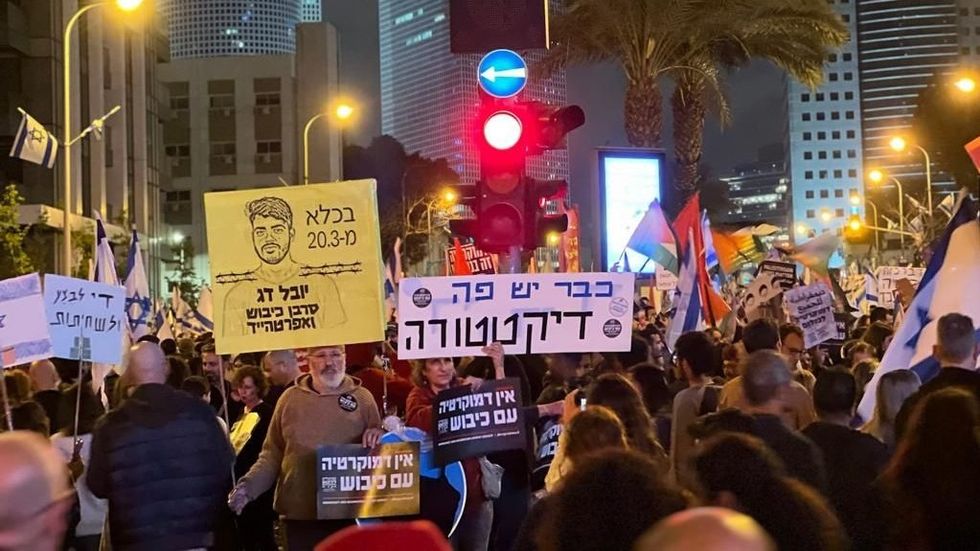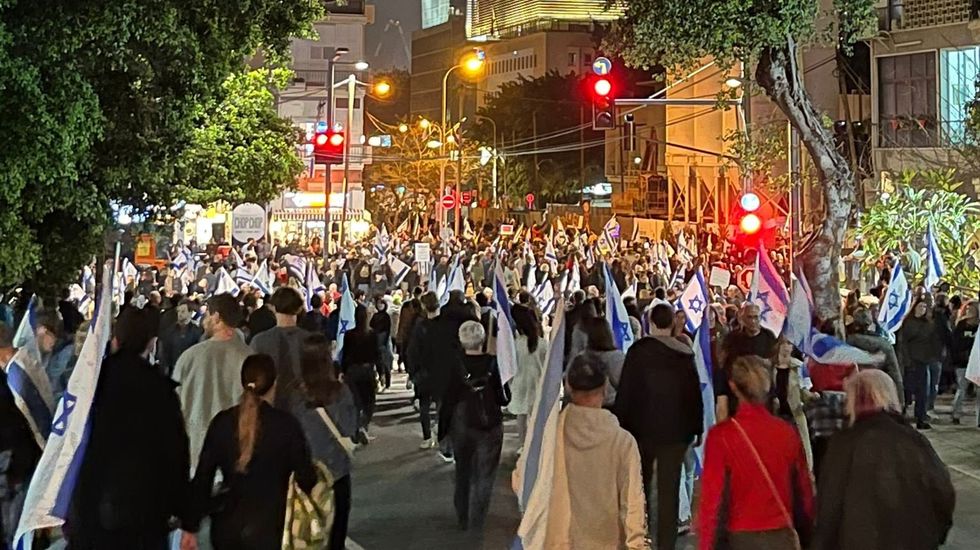
I headed out Saturday night into the arid Tel Aviv night. Not knowing where I wanted to end, I followed the flapping sea of blue and white.
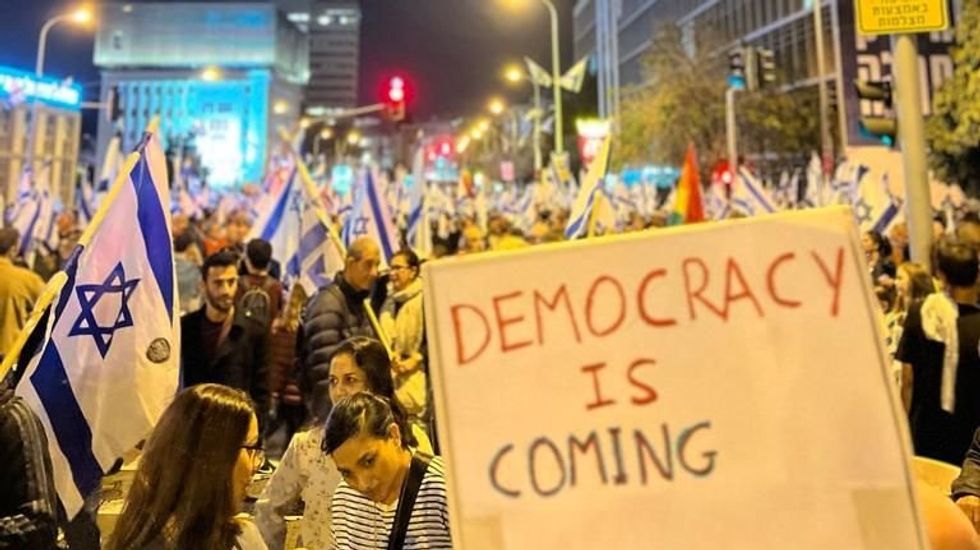
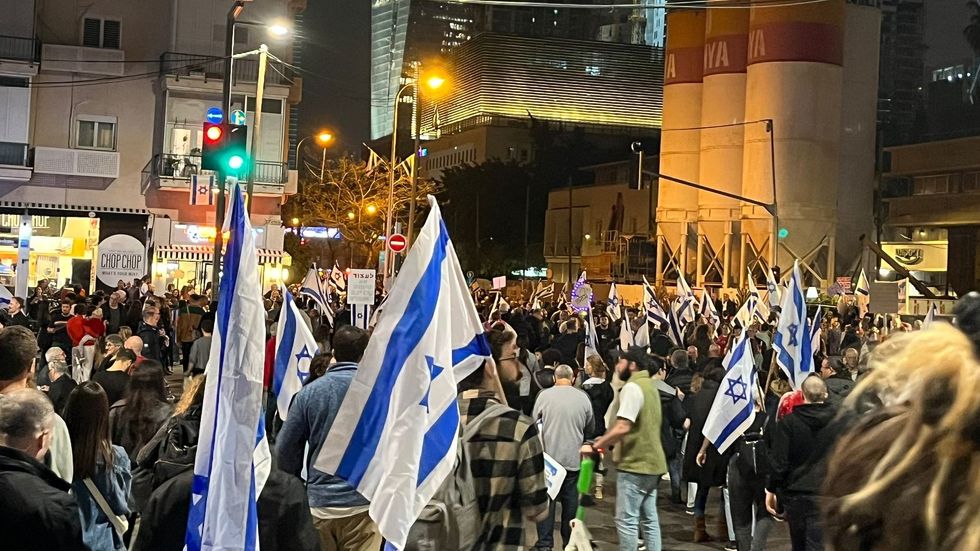
Throngs of people — kids, wheelchair-bound elderly, 20-somethings locked in arms — hauled Israeli flags, which in recent weeks have taken on a whole new meaning for Israelis fearful of where their country is headed. Usually waved as a symbol of national pride, the flag has morphed into an emblem of dissent.
Though spring has just landed, the air was thick in Tel Aviv. And that highlights again the idiosyncrasy of a cosmopolitan, progressive hub in the heart of the Middle East.
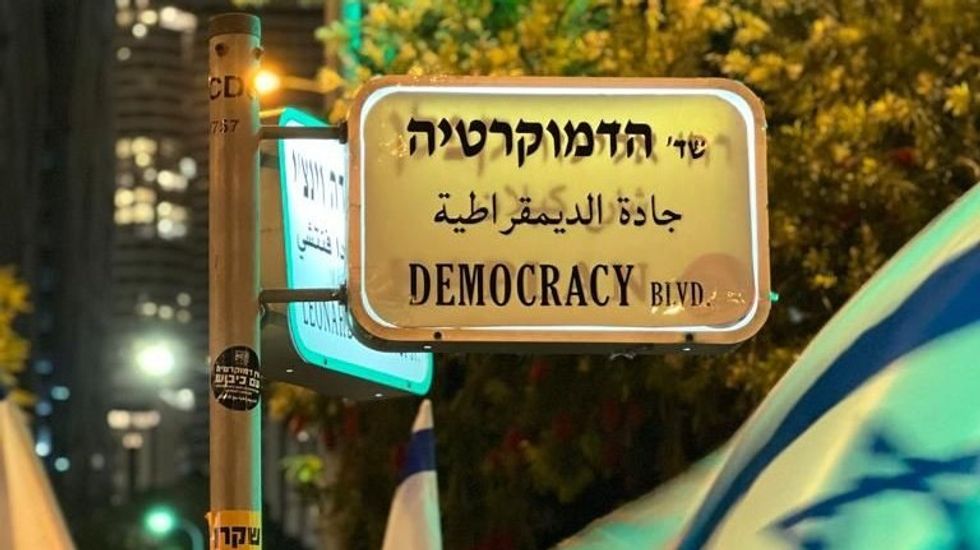
I followed the steady beating of drums and arrived at the recently dubbed Democracy Boulevard.
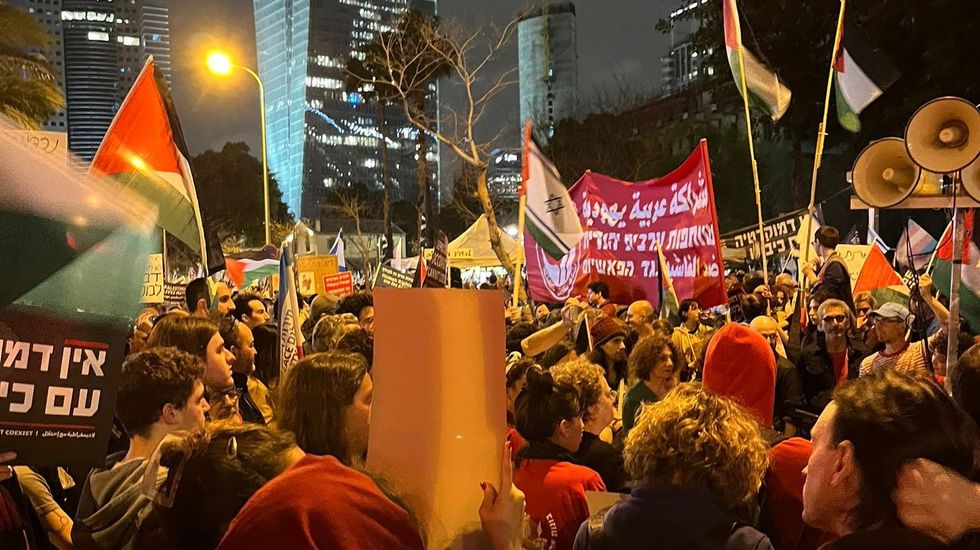
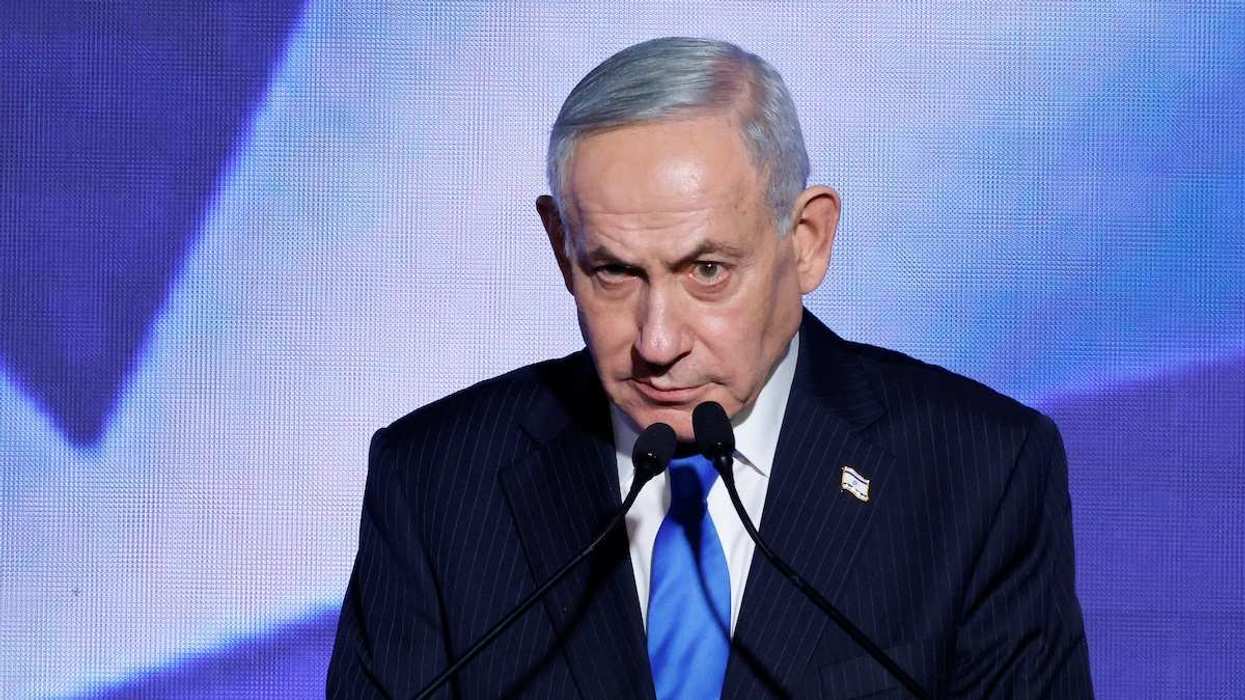
More than 200,000 people hit the streets of a cramped Tel Aviv — in addition to hundreds of thousands in cities around the country — for the twelfth week in a row to protest the Netanyahu government’s attempt to set on fire the symbiotic relationship between the Knesset, Israel’s parliament, and the Supreme Court.
Absent a formal constitution, it’s all they’ve got.
As thousands of protesters marched, sang, and chanted, a crackly version of the Declaration of Independence — recited in 1948 by David Ben Gurion, Israel’s first prime minister, a kibbutznik with Albert Einstein-like hair — blasted over a loudspeaker.
The founding fathers, the background narration reminded the crowd, had vowed to “foster the development of the country for the benefit of all its inhabitants … based on freedom, justice, and peace as envisaged by the prophets of Israel.” The point being made was clear and direct: we’ve digressed.
But as is often the case with large, leaderless movements, the demonstrations here have at times evolved into a broad display of public rage with an unruly focus.
I encountered many women wearing fire-engine red, holding signs lamenting the perceived anti-women agenda of Israel’s most right-wing government in history.
(Just last week, the government rejected a law that would require men charged with domestic abuse from wearing ankle-tracking devices. Itamar Ben Gvir, the far-right minister responsible for law enforcement, says the law would unfairly malign men.)
On Kaplan Street, a handful of women painted the palms of their hands red, meant to represent the government’s indifference to domestic violence after five acts of femicide in 2023 alone. They stood beside makeshift coffins labeled with the names of women recently murdered by their husbands.
It was a disarming scene and I thought about Michal Sela, a young woman with milky skin and smiling eyes I once knew, who was stabbed to death in 2019 in Jerusalem. In a small country like Israel, the pervasive issue of domestic abuse hits home.
There were also other discordant agendas at the scene. A large chorus of anti-settlement protesters held signs against “Israeli apartheid,” some waving Palestinian flags. Many walked by dismissively and asked Ma hakesher? (what’s the connection)? To them, elusory chants about the occupation fail to meet this specific moment. But for others, it’s all one of the same — an asterisk hovering over Israeli democracy.
Perhaps that gets to the heart of it all: Competing visions of what Israel can — and should — be.
I approached a group of pensive-looking seniors donning shirts that read “Diplomats for democracy.” I asked them about their stories and why they were there.
Shlomo Gur, 70, is a former diplomat who represented the Israeli government in the US, South Africa, and elsewhere over a 20-year career in the foreign service. He said he “has never seen anything of this magnitude from a grassroots movement in Israel” in his entire life. Gur explained that he fears his country is “going down the drain.”
This sentiment was cross-generational. Stav Tsur, 27, said she is committed to “fighting for democracy” and against a government that she deems to be “corrupt.” Asked if she thinks protests are having any impact on government decision-making, she said that they already are,” pointing to the fact that the proposed legislation is “already moving much slower” through the Knesset than many expected.
Finally, I spoke to a female doctor wearing a religious head covering who preferred not to be named. She said she showed up as much to send a message of solidarity to her fellow citizens as to protest the government itself. “It’s important that everyone feels that lots of different people feel the same way and that we’re in this together,” she said.
I continued along Kaplan Street but turned around just before the Ayalon highway, where police were targeting protesters with water cannons. Growing more and more frustrated with a movement that won’t yield, they have used increasingly heavy-handed tactics to try to quash the group’s spirit.
The crowd showed little sign of dispersing, but my sister and husband were hungry. Time to dig into some falafel and call it a night.
Check out a few photos from the evening below.