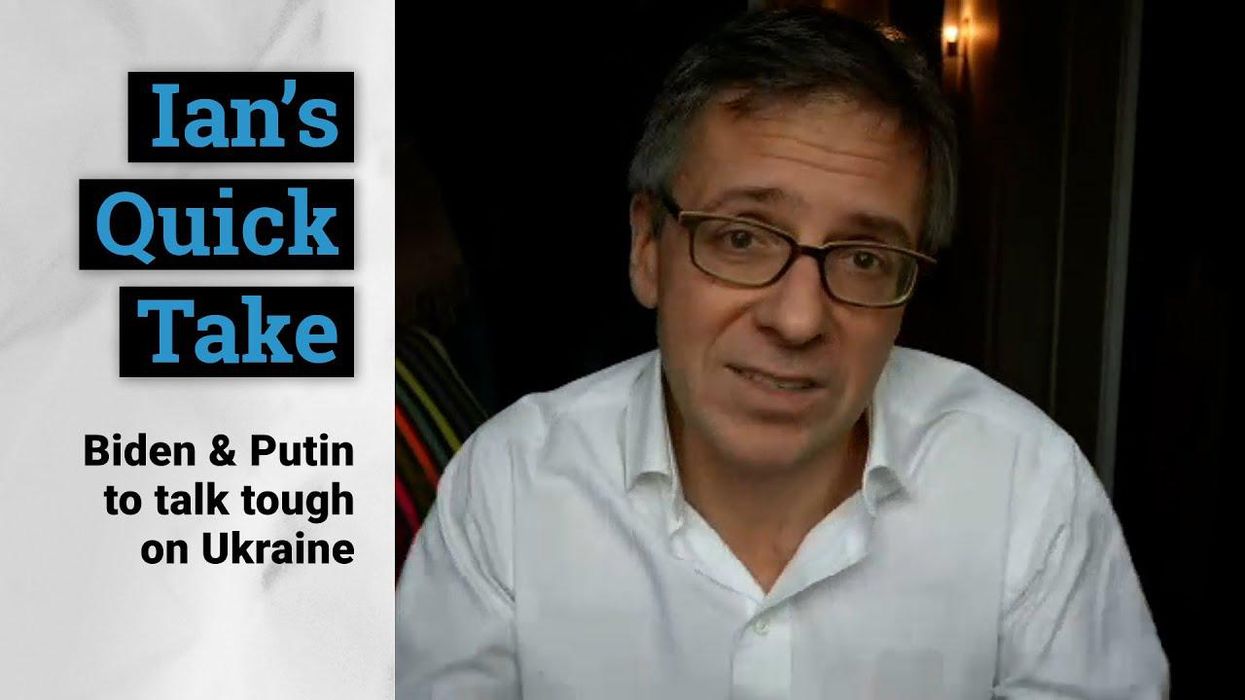
Biden and Putin to talk tough on Ukraine
December 06, 2021
Global Stage LIVE from United Nations WATCH REPLAY
Ian Bremmer, political scientist and president of Eurasia Group and GZERO Media, shares insights on global political events.
Presented by

Ian Bremmer's Quick Take:
I want to talk about Russia. And you will, of course, be hearing all of the stories about Russia gearing up for a war with Ukraine, taking more territory. The Americans saying don't do it, but not setting up any clear red lines. What's actually going on here? Well, it's worth going back to the last that Biden and Putin met with each other. That was in Geneva back in mid-June. And you'll remember that Biden snapped at the end of the meeting and the press conference. He was asked by someone, "How come you trust Russia, you trust Putin?" And he said, "I don't trust Putin. We'll see what happens over the coming months." Now at that point, Ukraine was not the big topic that was being discussed.
This was on the back of the attacks, the cyberattacks against Colonial Pipeline in the United States, clearly coming from criminal gangs in Russia, operating with the full knowledge of the Kremlin. And the big takeaway from the meeting, from the summit, from Biden was telling Putin, "look, you need to put a stop to this because if you don't, they're going to be direct consequences." A stop to what? A stop specifically to cyberattacks emanating from Russia, even if not directly from the Kremlin against critical infrastructure in the United States. Not espionage, which the United States does as well, of course. Not attacks, malware attacks against noncritical infrastructure, which is an annoyance, which the American would like to put an end to. But which Biden was not saying was a red line, but specifically critical infrastructure. And indeed, it's been several months now, almost six months and there has been movement. There has been some progress.
It's pretty clear that the Kremlin gave some form of instruction to these organizations. Let's hold off. Let's cool it on those sorts of attacks. And we indeed haven't seen them at the same degree at the same level that we did back in June. But now we're talking about something very different, which is Ukraine. And indeed the Russians have significantly expanded both their exercises as well as their troops in place across the Ukrainian border. And they've also given some notice to the United States directly and to NATO more broadly that the present status quo is unacceptable. They want some sort of an agreement between NATO and the Russians on what is and is not acceptable behavior. And indeed, tomorrow Biden and Putin are going to be meeting directly to talk about this. What's going to happen? Are we likely to see war between Russia and Ukraine breaking out?
I think no, but I also think there's a lot of danger short of that. There are a lot of other hybrid activities that Russians could indeed take. So why are the Russians doing this? I think there are two reasons.
The first is because indeed, even though Ukraine is not a member of NATO and will not become a member of NATO because the United States is unprepared and other NATO countries in Europe are unprepared to offer defense assurances, that they would protect Ukraine if their territorial integrity was breached indeed, as it already has been in 2014. But also there has been an increase of NATO support for Ukraine in recent months. We've seen more NATO training of Ukrainian troops on the ground. We've seen more extended exercises of NATO, as well as overflight, right up to the Ukrainian border, all sorts of ships going through the Black Sea.
And we've also seen Turkey, a NATO member providing significantly more military equipment to Ukraine, specifically drones. We're also seeing NATO countries talking about increasing ammunition available for the Ukrainians. All of which is sort of unacceptable for Russia. I mean, the same way that Iran is seen as a nuclear threshold state by the United States and Israel, they're deeply uncomfortable with it because it means they're getting closer to having nuke. Increasingly Russia sees Ukraine as a NATO threshold state. And they really want to put a stop to that right now. So that's one thing that's going on. The second thing that's going on is that Putin is in a stronger position right now. Energy prices are higher. Angela Merkel is leaving office. She's the one that was personally responsible for building the Minsk accords and helping to ensure that there was strong economic pushback against the Russians for the territory that they had taken through these little green men in southeast Ukraine. Olaf Scholz will not have the same personal responsibility for that.
Nord Stream 2, the pipeline's been completed. In principle that allows the Russians to bring gas from Russia to Europe and avoid bypassing Ukraine. So for all of those... And of course we've had the pullout in Afghanistan and a Biden administration that is not particularly interested in taking on global policeman roles for second and third order interests of the United States, of which Ukraine is obviously low priority. So that's why we are where we are right now.
What's going to happen tomorrow? Look, I think Putin's going to get the measure of Biden. Biden will probably talk specifically about the hard intelligence the US has about the Russians preparing for some kind of broader invasion, which the Russians will surely deny. And the Russians will demand some kind of guarantees that NATO is not trying to build up their influence in and with Ukraine. They want NATO backing off from the Russian borders.
We'll see if there's any willingness to engage in further diplomacy. I expect the outcome of the call will be in agreement of the two sides, whether it's just the US or whether it's more broadly with some NATO states to engage ongoing in talking about what the NATO-Russia relationship should look like, what is acceptable, what isn't acceptable. And that would certainly reduce tensions if it occurs.
If that doesn't occur, if the US and the Russians bluster at each other and just point fingers and they're deeply unsatisfied, but no additional diplomacy, then I think that there's much greater likelihood of further hybrid activities. Remember, the NotPetya cyberattacks against Ukraine that took 1% off of Ukrainian GDP. I could easily see the Russians doing much more of that, expanding disinformation campaigns. I could certainly see even the possibility of Russia formally recognizing the territories in southeast Ukraine that are presently breakaway and occupied by these little green men, these informal Russian forces that the Russians have denied any influence over, saying they have to provide direct protection for these territories.
What I don't think is going to happen is formal Russian intervention to take more territory in Ukraine for a few reasons. One, extremely difficult to hold. These are territories with Ukrainians that are much more opposed to Moscow rule than the territories that they've already taken. Number two, because there would be very significant economic retaliation from the Americans, from the Germans, from the EU, from the UK. You'd see sovereign debt sanctions. You would see the Nord Stream pipeline not become operative, none of which the Russians want. And then number three, it would be deeply unpopular in Russia itself.
The problem is there's no reason the Russians would engage in a full formal war/intervention into Ukrainian territory. That's not how they operate. They use hybrid warfare. They undermine other countries' sovereignties in ways that they can plausibly or even implausibly deny. Makes it harder for the Americans or NATO to establish red lines and say, well, now we have to respond because it's clear that the Russians did X, Y, and Z, especially in an environment where the Europeans are divided, where many Europeans have a lot of economic dependence on the Russians, others don't. The United States has very little interlinkage. It all makes it hard.
So tomorrow's discussions are actually quite important. They will have implications for the relationship between the two countries going forward. And indeed Ukraine's sovereignty has the potential to be more undermined than it has been even back in 2014, but war, actual war between the two sides, which is what's driving most of the headlines, that I don't see happening anytime soon.

Keep up with what’s going on around the world - and why it matters.