Site Navigation
Latest Stories
Sign up for GZERO Daily.
Global Stage LIVE from United Nations WATCH REPLAY
Quick Take
Ian Bremmer, political scientist and president of Eurasia Group and GZERO Media, shares insights on global political events.
Presented by

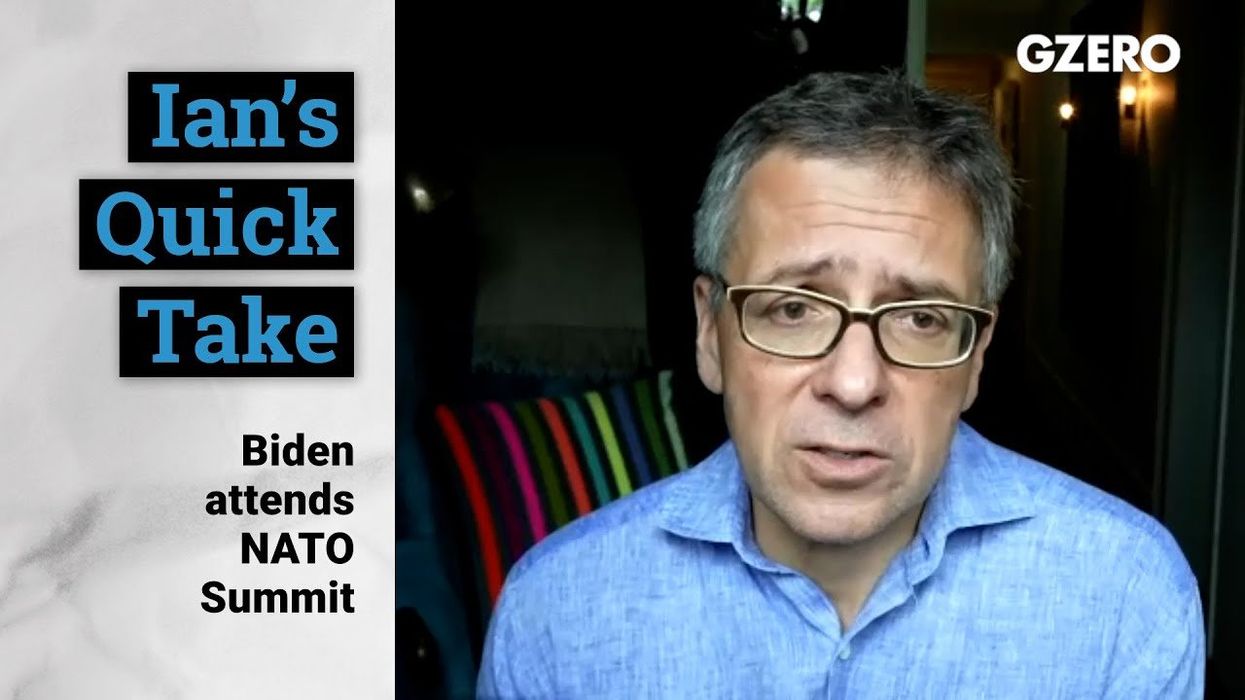
Ian Bremmer's Quick Take: Hey, everybody. Ian Bremmer here, and a happy Monday to you. A Quick Take to kick off your week.
And this week the big news is coming from NATO, the summit that will start within a day in Vilnius. Heads of state from all the key NATO countries, including of course President Biden. And the big topic will be Ukraine. Not the only one big question about Sweden, whether or not they're joining NATO or not. Erdogan can always decide to change his mind and cut a deal at the last minute. But the big news is what's going to happen with Ukraine, with continued military support for Ukraine that we still see expanding pretty much every week. And all, both in terms of the amount and also the types of armaments, and I'll get into that in a moment. And also as to where we stand on NATO membership and a pathway to that for Ukraine itself. Erdogan interestingly very strongly supporting Ukraine to get into NATO, also providing directly some Asov battalion leaders to the Ukrainians that, you know, he had told the Russians he wasn't going to do. This is a couple of indicators and there are many that the grain deal between the Ukrainians, the West and the Russians is not going to get extended in another week's time. Erdogan was critical to that deal. That relationship with Russia is getting more brittle by the day. At the same time, Ukraine is not about to get an immediate pathway into NATO, and Biden made that clear with my friend Fareed Zakaria. Over the weekend, Biden's perspective is, "Hey, we're fighting a war in Ukraine by proxy. We're giving all of the equipment, all the weapons, but we don't want the Americans directly fighting on the ground."
Don't want, a no fly zone with, you know, American fighter pilots defending Ukraine directly. That would both risk a direct war with the Russians, essentially, World War III is what we're talking about. And it's also just unacceptable. The Americans and other NATO allies don't want their own troops directly in harm's way. They're happy to fight a proxy war. They're not happy to fight directly. And that is not a unified position, by the way, the Polish government, the Balts, the Fins now a part of NATO increasingly willing to say, "Yes, we should be giving Ukraine membership now. And that doesn't mean we have to deploy Article 5, everybody knows we're not going to be fighting directly, but they need that security umbrella going forward. It's the only way that we can guarantee that the Russians won't invade again."
And by the way, Macron, who in the early days, the French president, of the war thought that was entirely too provocative, has flipped his view. And now in terms of NATO is aligned with the Poles and the Balts, which is very interesting, while the Americans, I think, are still closer to the German position. Be that as it may, there's an enormous amount of support that the West is providing to Ukraine militarily, the US is leading it. And I think what we are moving towards are multilateral guarantees. In other words that NATO collectively would be prepared to provide commitments to Ukraine, that going forward, they will continue to ensure that Ukrainian troops are trained, are equipped. Intelligence is provided. In other words that there are treaty obligations to Ukraine to help them defend themselves very effectively. That prevents the Russians from believing they get another bite of that apple, that they can wait NATO out, and that eventually Russia will be able to accomplish militarily what they've not been able to accomplish in the first 500 plus days of this war.
The other big thing that's being debated are the cluster munitions that are now going to be provided by the United States. They are not a signatory, of the ban of cluster munitions. And these things are banned because they are so brutally dangerous to civilians. A lot of those bomb pieces that are then on the ground and can sit around for a long time until, you know, civilian inadvertently months, years later walks, trips over it, it acts like a landmine, a kid curious picks it up, maims or kills the kid. I mean, anyone that has seen these cluster munitions in operation, and I know a lot of people that have been involved in NGOs that have tried to help clean them up in places in war zones they've been used, understands just how brutally dehumanizing these weapons are.
So, no, you absolutely don't want them in the fight. Having said that, the Russians aren't signatories. The Ukrainians aren't signatories, and the Russians have been using these weapons all the way through the war. So it's not with the fact that the Kremlin has come out and they said, how dare the Americans provide cluster munitions is just yet another point of massive hypocrisy of the war crimes that the Russians have committed. Now, I understand why Biden is doing this. The Americans are very very low on ammunition all in and want to give the Ukrainians everything they can to help ensure that the counteroffensive is successful. So far, the last couple months, very little land, Ukrainian land has been retaken by the Ukrainians, even as they have initiated this counteroffensive. Part of that reason, not all of it, part of that reason is because they lack ammunition. Part of it is they don't have any air defenses that are effective, any air cover in the region. And so as the Ukrainians take more land, they'll have a hard time defending those soldiers that'll be exposed. But be that as it may, you know, there is a question that the Ukrainians are not in the same position as NATO, you know, the Biden administration is saying, "we're going to defend Ukrainians as long as it takes that the Ukrainians are in charge of these negotiations." It makes one think that the Ukrainians are basically an American core national interest. The reality is that NATO is a core American national interest. The United States is a core national interest and long-term fighting and long-term security, long-term American ability to ensure that its values are promoted globally does mean that you don't want to be dragging yourself down to the same brutal fighting that the Russians are doing.
This has gotten the Americans in trouble in Iraq, in Afghanistan. Gotten Americans in trouble in Guantanamo, in Abu Ghraib. And so if I were Biden, would I approve these weapon systems for the Ukrainians? It would be very hard after many months of, you know, sort of thinking about it, maybe I would, but maybe that's why I'm not Biden. I mean, look, I'm never going to be elected president, but also is, I never would be interested in serving in a position like that, in part because the Americans do not have the same level of moral authority on the global stage that say, Canada does or Germany does, or Japan does. And you know, let's keep in mind, Japan and Germany, we're talking about countries that were involved in fighting World War II and actually being the initiators of World War II with massive brutality, but also systems that recognized that what they did was fundamentally inhumane and brutal and needed to be never repeated. And therefore the institutions had to grow and learn and become more morally accountable to their own people and globally. And I fear that the United States does not have that level of lesson taking from so many of its mistakes over the past several generations, you know, from Vietnam and from some of the others that I've just mentioned. And in that regard, even as it makes it harder for the Ukrainians to take additional territory in the counteroffensive, I would be a "no", on these cluster munitions. But I think it's a good place to debate and I'm more than happy to have that debate publicly over the coming weeks and months.
That's it for me. I hope everyone's doing well, and I'll talk to you all real soon.
More from Quick Take
GZERO Series
GZERO World with Ian Bremmer

Puppet Regime

Quick Take

ask ian
Ian Explains
GZERO Reports
GZERO Europe

The Debrief

GZERO Daily: our free newsletter about global politics
Keep up with what’s going on around the world - and why it matters.